
Company History
Establishment and Early Monopoly (1783–1920s) Founded by Royal Charter in 1783, the bank operated as the official banker to the Irish government and managed the country’s public debt. Throughout the 19th and early 20th centuries, it served as the dominant commercial credit provider and a primary note-issuing bank across Ireland.
Independence, Expansion, and Modernization (1920s–1990s) Following Irish independence in 1922, the bank relinquished central banking duties to the newly formed Central Bank of Ireland in 1943. Over the subsequent decades, the group pursued aggressive domestic consolidation, acquired the Hibernian Bank and the National Bank’s Irish operations, established life assurance operations via New Ireland Assurance, and expanded into the UK retail and financial services markets.
The Celtic Tiger and Global Financial Crisis Bailout (2000–2010s) Rapid balance sheet inflation during Ireland’s property boom led to severe distress during the 2008 global financial crisis. Unlike Anglo Irish Bank, Bank of Ireland avoided full nationalization, but the Irish government injected €4.8 billion in recapitalization aid, holding a peak equity stake of 36%. The lender undertook strict restructuring, balance sheet deleveraging, and cost-reduction plans mandated by the European Commission.
Recovery, Full Privatization, and Consolidation (2020s–Present) By 2022, the Irish State fully disposed of its shareholding, returning the institution to complete private ownership. The bank consolidated its domestic dominance by acquiring substantial performing loan portfolios from KBC Bank Ireland and purchasing capital markets firm J&E Davy, transforming into a diversified financial services player.
Business Model and Strategic Growth
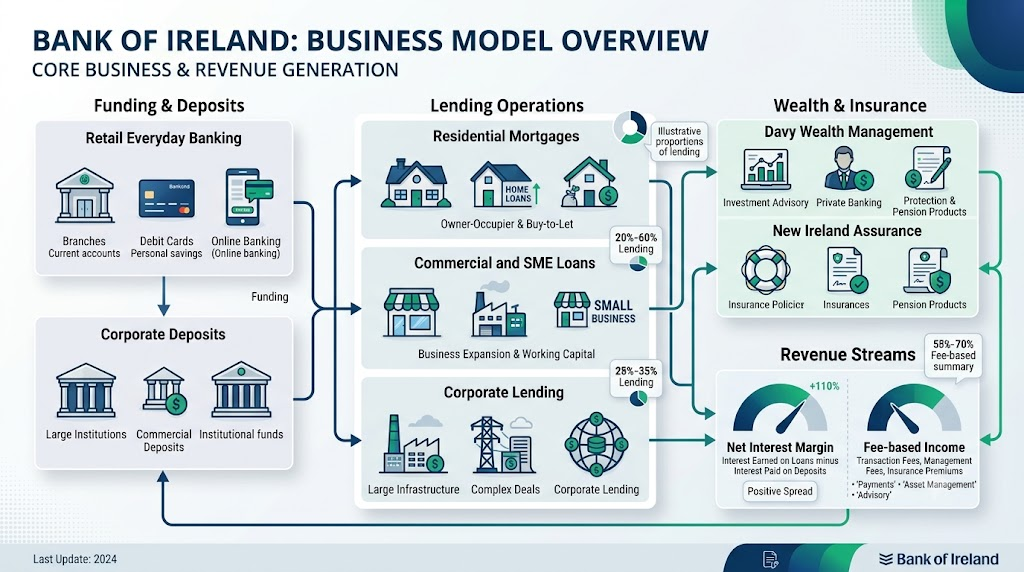
Bank of Ireland operates a diversified commercial banking model that monetizes financial intermediation, transaction fees, and asset administration across three core pillars: Retail Ireland, Wealth & Insurance, and Corporate & Commercial (alongside UK operations).
1. Net Interest Margin Intermediation The primary revenue driver remains lending funded by sticky customer deposits. For FY2024, the group generated net interest income of €3.565 billion, maintaining a net interest margin of 2.91%. Organic Irish customer lending expanded 6% year-on-year, supported by a €34.4 billion Irish residential mortgage book and a customer deposit base of €103.1 billion (achieving an 80% loan-to-deposit ratio). The group leverages low-cost retail current accounts (Everyday Banking balances of €82 billion) to fund corporate borrowing and consumer credit.
2. Fee, Wealth, and Capital-Light Non-Interest Income To mitigate margin contraction in falling rate environments, the bank expands fee-based operations via Davy and New Ireland Assurance. Total business income reached €764 million in FY2024. Wealth and insurance assets under management grew 19% year-on-year to €55 billion, supported by €4.0 billion in net inflows, tapping into an addressable Irish domestic wealth market exceeding €450 billion.
3. Cost Discipline and Capital Distribution Strategy The bank targets an underlying Return on Tangible Equity above 17% by 2027 (achieving 16.8% in FY2024 with a profit before tax of €1.9 billion). Operational efficiency is managed via a 46% cost-to-income ratio, keeping operating expenses below €2.0 billion. Organic CET1 capital generation reached 310 basis points in 2024, enabling shareholder distributions of €1.22 billion (comprising €630 million in dividends and a €590 million share buyback programme), equivalent to an 80% earnings payout ratio.
Information Sources
- https://investorrelations.bankofireland.com/app/uploads/D15136-BOI-FY24-Annual-Results-Announcement-Web-Feb-2025-FINAL-NO-PW.pdf
- https://www.londonstockexchange.com/news-article/BIRG/bank-of-ireland-annual-results-31-december-2024/16910814
- https://investorrelations.bankofireland.com/app/uploads/Annual-Report-HoldCo-2024-Web.pdf
Artificial Intelligence Strategy, Budget, and Partnerships
Bank of Ireland incorporates artificial intelligence as a foundational pillar within its multi-year core modernization and operational resilience framework, targeting front-line efficiency, regulatory compliance, and customized customer engagements.
1. Enterprise IT Investments and Technology Budget Following its foundational multi-year core banking revamp (Project Omega, which scaled from an initial €500 million to over €1.4 billion to transition core systems toward modern Temenos architecture), the group committed dedicated tranches to digital automation. The bank deployed over €150 million toward customer service, telephony, and fraud prevention transformations through 2025. This includes €34 million dedicated to telephony and CRM enhancements, €60 million in digitized branch and self-service capabilities, and €50 million allocated to fraud detection, real-time threat intelligence, and predictive risk scoring.
2. Strategic Partnerships and Implementations
- Stripe Integration: The bank established an infrastructure partnership with Stripe to accelerate programmable payment rails and integrate AI-driven financial technologies directly into core banking workflows. Subsidiary Davy uses Stripe automated reconciliation pipelines, processing over €2 billion in transaction volume while saving 3,000 operational hours annually.
- Google Cloud and Digital Skills: The bank partnered with Google to deploy 10,000 Google AI Professional Certificate sponsorships for business clients while utilizing scalable cloud analytics infrastructure for data pipeline optimization.
- Academic and Regulatory R&D: The bank works closely within national AI research ecosystems, leveraging initiatives backed by Science Foundation Ireland and the Insight Research Ireland Centre to evaluate algorithmic governance, responsible AI architectures, and explainable models.
3. Operational AI Deployments The bank utilizes voice biometrics and natural language processing across contact centers handling 11,000 daily customer calls, delivering a unified single customer view for 2,800 frontline staff and lowering waiting times. Additional applied tools include “Benefits Finder” (an algorithmic tool matching retail consumers to statutory tax benefits) and machine learning models in automated underwriting, real-time transaction screening for anti-money laundering (AML), and customer sentiment indexing.
back to Bank of Ireland