
Company History
- Formation and Expansion(1966–1990s): Allied Irish Banks was formed in 1966 via the amalgamation of three legacy commercial banks: The Provincial Bank of Ireland, The Royal Bank of Ireland, and The Munster & Leinster Bank. Throughout the late 20th century, the institution expanded aggressively domestically and developed overseas operations in the UK and North America.
- The Celtic Tiger and Global Financial Crisis(2000–2010): During the Irish property boom, AIB over-leveraged its balance sheet into commercial real estate and domestic residential mortgages. When the global financial crisis and Irish property collapse struck, AIB sustained catastrophic loan losses, culminating in a €20.8billion Irish state bailout, de facto nationalization(with the state taking an equity stake exceeding 99%), and subsequent delisting from main stock exchanges.
- Restructuring and Re-IPO(2011–2017): AIB underwent severe multi-year operational downsizing, selling off foreign assets(including US and Polish subsidiaries) and working out non-performing exposures. Stabilized under state supervision, the group returned to profitability and executed a landmark re-IPO in June 2017, listing on Euronext Dublin and the London Stock Exchange while the Irish state commenced an phased share selldown.
- Consolidation and Privatization(2018–Present): AIB solidified its domestic duopoly by acquiring wealth manager Goodbody in 2021 and purchasing substantial loan portfolios from Ulster Bank following NatWest’s exit from the Irish market. Concurrently, the Irish government progressively trimmed its stake to low minority levels via pre-arranged market disposals and bank share buybacks.
Business Model and Development Strategy
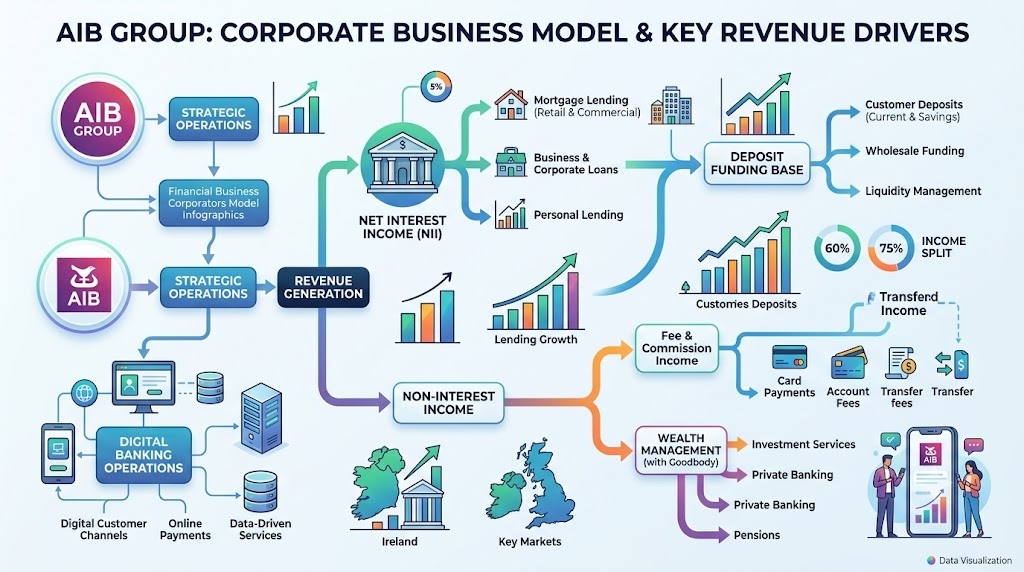
AIB operates primarily as an interest-spread financial intermediary, generating revenues by lending at higher interest rates than the costs incurred on customer deposits and wholesale funding. The group operates through distinct divisions: Retail Banking, SME Banking, Corporate, Institutional & Capital Markets(CICM), and AIB UK.
- Core Revenue Engines:
- Net Interest Income(NII): The dominant earnings driver, delivering €3,748million in FY2025(supported by a €72.3billion gross loan book and a €117.2billion customer deposit base) with a Net Interest Margin(NIM) of 2.73%. Mortgages remain the core asset class, where AIB captures approximately 30% of the Irish market.
- Non-Interest Fee and Commission Income: Contributed €692million in FY2025 within total other income of €756million. Revenue is derived from transactional banking, card interchange, payment processing, wealth management(Goodbody), and its bancassurance joint venture, AIB life.
- Growth and Capital Strategy:
- Domestic Market Consolidation: Deepening primary banking relationships to capture deposit and loan balances vacated by exiting competitors(KBC and Ulster Bank).
- Digital Simplification: Lowering operating overhead by migrating everyday transactions to digital and mobile platforms. In FY2025, operating costs stood at €1,992million, while generating a profit after tax of €2,139million and a return on tangible equity(RoTE) of 25.0%.
- Green Lending Expansion: Scaling transition and green finance, which constituted 43%(€6.3billion) of total new lending of €14.7billion in FY2025.
Sources for Business Model Information
- https://www.investegate.co.uk/announcement/rns/aib-group-cdi—aibg/annual-financial-results-2025/9456968
- https://umbrex.com/resources/company-profiles/aib-group-plc/
- https://www.aib.ie/content/dam/frontdoor/investorrelations/docs/resultscentre/annualreport/2023/our-strategy-2023.pdf
- https://www.aib.ie/content/dam/frontdoor/investorrelations/docs/aib-strategic-update-2024-2026.pdf
Artificial Intelligence Strategy and Partnerships
AIB approaches artificial intelligence under an operational efficiency, risk mitigation, and automated servicing framework anchored by a dedicated AI Centre of Excellence.
- Technology Investment and Budget: AIB commits approximately €400million annually in overall technology and operational investments, allocating capital toward digital platforms, cyber resilience, cloud transitions, and machine learning infrastructure.
- Core Technology Partners:
- Microsoft: In a comprehensive enterprise deployment, AIB rolled out Microsoft 365 Copilot to over 10,000 employees. The integration incorporates Copilot Studio for custom workflow automation and GitHub Copilot to accelerate internal software engineering and code generation.
- nCino: Deployed to modernize commercial and SME underwriting; the bank writes business loans via this platform with up to two-thirds of applications auto-decisioned using automated risk rules.
- Primary AI Use Cases:
- Customer Servicing: Deployment of “Abi”, AIB’s conversational AI assistant, handling high-volume consumer queries and routing contact centre requests to reduce branch and agent friction.
- Fraud and Risk Detection: Real-time transaction surveillance using automated anomaly detection and predictive algorithms to stop unauthorized payments and meet European anti-money laundering compliance.
- Internal Productivity: Automating unstructured document processing, accelerating credit analysis summaries, and streamlining internal operations to keep underlying operating cost growth tightly contained.
Back to AIB