
Corporate History
State Monopoly and Telegraph Roots (1855–1960s)
Founded in 1855 as Telegrafverket, the entity operated as Norway’s state-owned telegraph administration. It expanded into public telephone infrastructure in 1878 and laid the foundation for national telecommunications across challenging Scandinavian topography.
Modernization and Wireless Expansion (1970s–1990s)
Rebranded as Televerket in 1969, the entity pioneered Nordic cellular development. It participated in launching the 1G NMT network in 1981 and the digital 2G GSM standard in 1993. In 1995, the enterprise adopted the name Telenor and transitioned from a public utility into a state-owned corporation as the Norwegian market deregulated.
IPO and International Expansion (2000–2015)
Telenor completed its initial public offering on the Oslo Stock Exchange and NASDAQ in December 2000. During this era, Telenor pursued aggressive internationalization, acquiring controlling stakes and operating licenses across Central and Eastern Europe, as well as high-growth Asian markets including Bangladesh (Grameenphone), Thailand (dtac), Malaysia (Digi), Pakistan, and Myanmar.
Portfolio Restructuring and Regional Consolidation (2016–Present)
Facing intense regulatory risk and capital constraints abroad, Telenor restructured its footprint. It divested its Central and Eastern European assets, exited Myanmar, completed massive market-consolidating joint ventures in Malaysia (CelcomDigi) and Thailand (True Corporation), agreed to divest operations in Pakistan, and refocused capital expenditure on Nordic fiber, 5G modernization, and enterprise cybersecurity.
Business Model and Strategic Direction
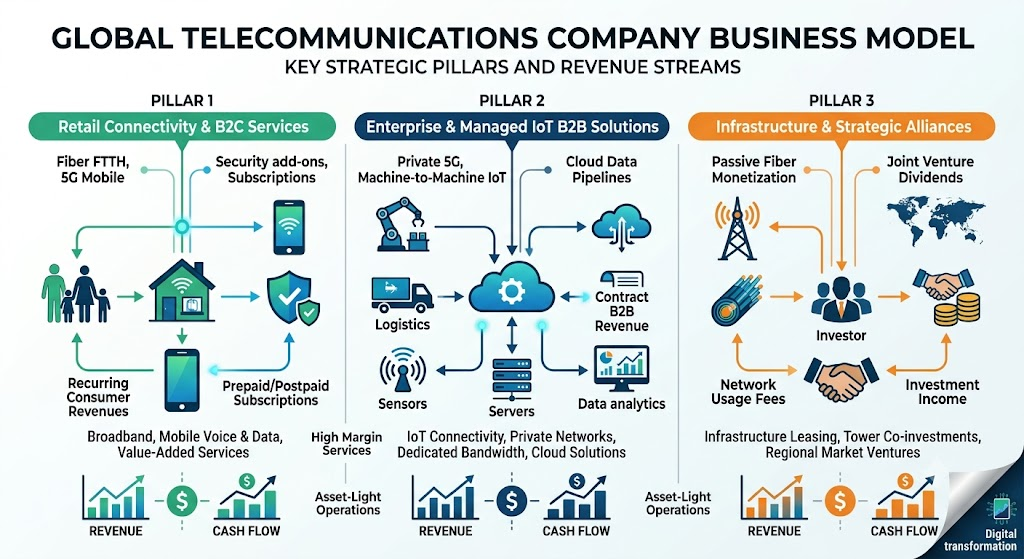
Telenor operates an asset-heavy, recurring subscription business model designed to monetize communication infrastructure across consumer (B2C), enterprise (B2B), and wholesale segments. The company converts network capital investments into predictable, recurring cash flows through three core operational pillars:
- Retail Connectivity & Value-Added Services: Generating the bulk of revenue via postpaid and prepaid mobile airtime, fixed broadband (fiber-to-the-home), and TV packages. Telenor actively drives Average Revenue Per User (ARPU) growth through the “more-for-more” strategy—bundling baseline connectivity with premium cybersecurity protections (e.g., Safe Zones, identity fraud screening) and content packages.
- Enterprise Solutions & Managed IoT: Catering to corporations and public agencies through private 5G networks, cloud-integrated data pipelines, unified communications, and managed IoT. Telenor IoT ranks among the leading global providers of machine-to-machine connectivity, managing tens of millions of active connected assets worldwide.
- Infrastructure Monetization and Synergistic Alliances: Telenor selectively unlocks capital by carving out passive network infrastructure. In 2023, it divested a 30% minority stake in its Norwegian passive fiber business to pension consortia, realizing non-dilutive liquidity while maintaining controlling operational ownership. In Asia, it shifts risk by holding significant equity stakes in merged market leaders (e.g., CelcomDigi in Malaysia and True Corporation in Thailand), extracting steady dividend returns without bearing sole capital burdens.
Key Financial Metrics:
In fiscal year 2023, Telenor Group recorded total revenues of NOK 80.5 billion (an organic increase of 3%) and service revenues of NOK 62.5 billion. Earnings before interest, taxes, depreciation, and amortization (EBITDA) before other items reached NOK 34.6 billion. The company generated NOK 15.0 billion in total free cash flow, supported by structural divestments and capital expenditure discipline, maintaining a stable net debt leverage ratio of 2.2x.
Sources for Business Model Information
- https://www.telenor.com/investors/reports-and-information/annual/annual-report-2023/
- https://www.telenor.com/binaries/investors/reports-and-information/quarterly/2023/Report%20Q4%202023.pdf
- https://iot.telenor.com/zh/company/
- https://docs.publicnow.com/3CCE3A2FB5C7C830CB3813D351E215D7CCDC4077
AI Strategy, Investments, and Partnerships
Telenor pursues an “AI-First” corporate transformation strategy designed to overhaul internal telecom operations, automate network orchestration, and commercialize localized enterprise AI solutions.
- The Sovereign AI Factory Initiative: Telenor entered into an enterprise partnership with NVIDIA to deploy sovereign cloud AI infrastructure across the Nordic region. Backed by an initial capital commitment of NOK 100 million, Telenor built Norway’s first localized “AI Factory” powered by NVIDIA accelerated computing platforms (including HGX hardware and AI Enterprise software stacks). This infrastructure provides regional business, public sector, and research clients with secure, localized high-performance compute that complies with strict European data sovereignty and privacy mandates.
- Network Automation & Predictive Maintenance: Telenor deploys machine learning and generative algorithms across its radio access network (RAN) and core operational centers. AI models analyze real-time cell tower traffic patterns to dynamically adjust power consumption—reducing base station energy consumption by up to 10–15% during off-peak hours—while predictive fault detection systems preemptively identify hardware degradation before customer-facing outages occur.
- Customer Operations and Automated Security: In customer service operations, Telenor integrates conversational AI agents to resolve tier-1 subscriber inquiries, lowering call center operating expenditures while accelerating resolution times. Furthermore, Telenor employs proprietary AI algorithms to screen network traffic for anomalous threats, phishing attempts, and DNS spoofing, blocking hundreds of millions of malicious digital interactions annually for retail and enterprise subscribers.
Back to Telenor