
Corporate History
- State Monopoly Era(1852–1989): Originating from the state-run postal and telegraph services(later known as Staatsbedrijf der Posterijen,Telegrafie en Telefonie or PTT),the organization operated as a government department with an absolute monopoly over Dutch telecommunications and national postal logistics for over a century.
- Privatization and International Expansion(1989–2001): In 1989,PTT was incorporated as a private entity and subsequently listed on the stock exchange in 1994.The postal operations were split into TNT in 1998,leaving KPN to focus exclusively on telecommunications.During the late 1990s,KPN pursued an aggressive,debt-fueled international expansion,acquiring mobile assets across Europe,most notably E-Plus in Germany and BASE in Belgium.
- Retrenchment and Balance Sheet Repair(2002–2014): The dot-com crash and massive 3G spectrum licensing costs left KPN overleveraged.The firm underwent radical restructuring,selling non-core foreign holdings,divesting E-Plus to Telefónica Deutschland for €8.55 billion in 2014,and returning its primary strategic focus almost entirely to its home market in the Netherlands.
- Domestic Consolidation and Fiber Transition(2015–Present): KPN divested its remaining Belgian unit(BASE)in 2016 and committed capital to accelerated fiber-optic infrastructure deployment.Under its current multi-year strategy,KPN shifted from copper to gigabit optical networks and modernized its operating model through large-scale digitalization and automation.
Business Model and Strategy
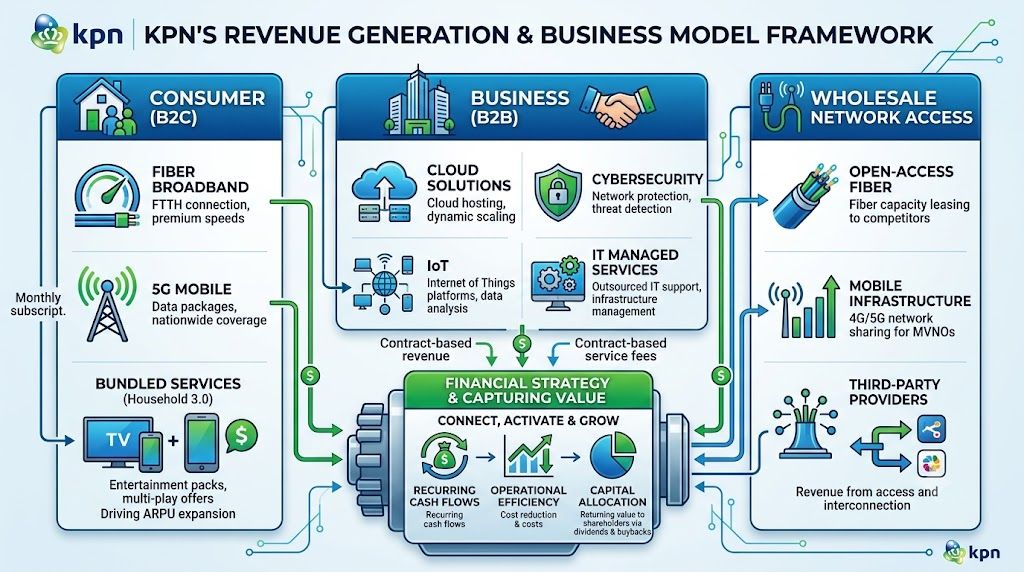
KPN generates revenue primarily by monetizing fixed and mobile network infrastructure through three distinct operating divisions:
- Consumer Segment: Generates revenue via recurring subscription fees(B2C)for high-speed fixed broadband,postpaid/prepaid mobile plans,and bundled multi-play subscriptions(Combivoordeel).Under its Household 3.0 strategy,KPN increases Average Revenue Per User(ARPU)by cross-selling over-the-top(OTT)content packages,cybersecurity software,and home networking services.Group service revenues reached €5,357 million in 2025,underpinned by consumer mobile and broadband growth.
- Business Segment: Provides B2B telecommunications,secure cloud infrastructure,cybersecurity,Internet of Things(IoT),and managed workspace solutions to SMEs and enterprise clients.Revenue streams include monthly per-seat software licenses,managed services contracts,and mission-critical network integration.
- Wholesale Segment: Monetizes network assets by offering open-access regulated and commercial access to third-party virtual network operators and internet service providers(e.g.,budget MVNOs and alternative broadband providers)utilizing KPN’s fixed fiber and mobile cell sites.
Growth and Capital Allocation Strategy:
Under its “Connect,Activate & Grow” framework,KPN operates on a “3-3-7” medium-term plan:targeting ~3% compound annual growth rate(CAGR)in service revenues, ~3% CAGR in adjusted EBITDA AL(After Leases),and ~7% CAGR in Free Cash Flow.In 2025,adjusted EBITDA AL reached €2,636 million with a Free Cash Flow of €952 million.The operational model prioritizes shifting copper users to fiber,aiming to cover up to 85% of Dutch households by 2030 through direct buildouts and joint ventures like Glaspoort.Capital expenditure is managed to taper below €1,000 million annually by 2027 as civil works wind down,allowing ~80% of generated Free Cash Flow to be returned directly to shareholders via dividends and share repurchases.
Business Model Source Links
- https://annualreport2025.kpn/
- https://annualreport2025.kpn/intro
- https://ir.kpn.com/investment-proposition/default.aspx
- https://ir.kpn.com/news-and-events/news/news-details/2025/KPN-delivers-on-Connect-Activate–Grow-strategy/default.aspx
AI Strategy, Budget, and Partnerships
KPN treats artificial intelligence as a core driver of operating margin expansion and digital-first transformation rather than a standalone commercial product.
- Strategic Focus and Financial Targets: AI is positioned at the foundation of KPN’s multi-year operational efficiency program,which aims to generate approximately €100 million in net indirect operational expenditure(Opex)savings annually by 2030.The savings stem from workforce optimization,automated ticketing,and operational self-healing networks.AI also features prominently in KPN’s broader €5 billion capital expenditure commitment spanning infrastructure,5G,and digital systems through 2030.
- Internal Hubs and Agentic AI Architecture: The company established a dedicated AI Excellence Center,housing an internal Data Science Lab and GenAI Lab with over 30 dedicated engineers and data scientists.This unit develops reusable LLM orchestration frameworks,deploying agentic AI pipelines to handle customer triage,automated software code development,and predictive network maintenance.
- Technology Partnerships:
- Microsoft: KPN relies on the Microsoft Azure cloud ecosystem as its primary enterprise AI infrastructure layer,utilizing Azure OpenAI Service for enterprise-grade LLMs,generative chatbots,and automated employee workplace workflows.
- InSpark: A key systems integration and sovereign cloud security partner helping KPN deploy Azure AI solutions while adhering to strict European data privacy regulations.
- AND Digital: Acts as a strategic execution and digital upskilling partner,assisting KPN’s teams in scaling generative AI proof-of-concepts into production environments across customer service channels.
Back to KPN