
Company History
Pioneering the Hypermarket Era(1959–1975) Carrefour was founded in 1959 in Annecy, France, by Marcel Fournier, Denis Defforey, and Jacques Defforey. In 1963, the company invented the modern hypermarket concept by opening a 2,500-square-meter store in Sainte-Geneviève-des-Bois near Paris, combining groceries, general merchandise, and extensive parking under one roof. The format expanded rapidly across France and began international expansion into Spain and Brazil.
Global Expansion and Consolidation(1976–2000) During the late 1970s and 1980s, Carrefour introduced private-label value products(Produits Libres)and accelerated foreign expansion across the Americas and Asia. A defining corporate milestone occurred in 1999 when Carrefour executed a €16.5 billion merger with Promodès, creating the world’s second-largest retailer at the time and adding supermarket formats like Champion to its portfolio.
Operational Overextension and Restructuring(2001–2017) The Promodès integration created significant operational friction and overlapping assets. As hypermarket dominance waned and debt rose, Carrefour began a prolonged retrenchment, exiting underperforming markets such as Mexico, Japan, South Korea, Indonesia, and Colombia. The company shifted focus toward localized store formats, convenience retail, and debt stabilization.
The “Carrefour 2022” Plan and Omnichannel Focus(2018–2022) Under CEO Alexandre Bompard, appointed in 2017, the group launched the “Carrefour 2022” transformation plan. This era focused on cost reduction, aggressive scaling of private-label organic food(“Act For Food”), strategic divestments(including the sale of controlling stakes in Carrefour China in 2019 and Carrefour Taiwan in 2022/2023), and deep operational expansion in Brazil through the acquisition of Grupo BIG.
Digital and European Consolidation(2022–Present) The company initiated its “Carrefour 2026” strategic roadmap, accelerating private-label penetration, retail media monetization, and deep digital ecosystem integration. It reinforced its European core with opportunistic bolt-on acquisitions(such as the Cora and Match assets in France)while deploying automated supply chains and localized franchise conversions to lower operational expenditure.
Business Model and Strategic Direction
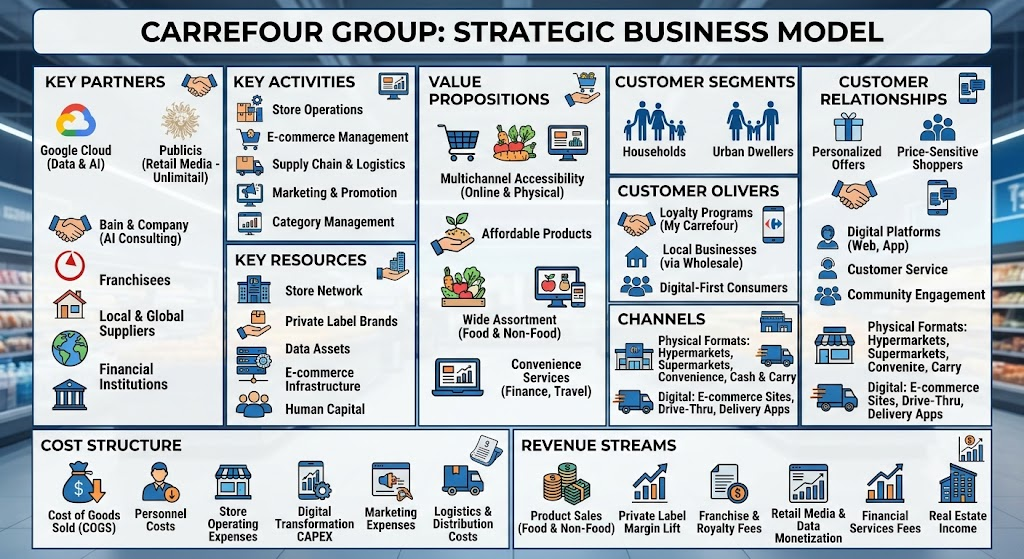
Carrefour generates revenue primarily through grocery and non-food merchandise sales across a multi-format retail footprint, supplemented by retail media advertising, customer financial services, and property management.
Core Revenue Mechanics and Monetization
- Mass Retail and Private-Label Penetration: Carrefour drives gross margin by shifting sales from national brands to its own-brand products(Carrefour Bio, Carrefour Classic, Simpl). Private-label items deliver gross margins roughly 200 to 400 basis points higher than third-party FMCG brands. Under its strategic roadmap, Carrefour targeted private-label sales to account for 40% of total food sales by 2026(up from approximately 33% in 2022).
- Format Diversification and Cash-and-Carry: To combat hypermarket foot-traffic stagnation, Carrefour reallocated capital toward high-margin convenience stores(Carrefour Express, Carrefour City)and low-cost, high-volume cash-and-carry formats like Atacadão in Brazil and parts of Europe. Atacadão operates on stripped-back operational costs, yielding cash flow from bulk sales to B2B and value-seeking retail consumers.
- Franchise and Asset-Light Transition: A critical component of Carrefour’s profit model is transferring capital-intensive company-operated stores to lease-management and franchise contracts(location-gérance). This shifts inventory and local wage risk to franchisees while securing predictable royalty fees, wholesale margins, and management fees, insulating consolidated operating income.
- Retail Media Monetization(Unlimitail): Through its joint venture with Publicis, Unlimitail, Carrefour monetizes its first-party shopper data(capturing tens of millions of loyalty accounts). Brands pay to advertise directly on Carrefour e-commerce interfaces, physical in-store digital screens, and programmatic off-site channels. Retail media delivers high EBITDA margins(typically exceeding 50%), creating a high-margin profit pool independent of physical product volume.
- Financial and Real Estate Operations: Carrefour operates consumer credit services, co-branded credit cards, and personal loans through Banque Carrefour in Europe and Banco Carrefour in Brazil, generating interest income and interchange fees. Its real estate division, Carrefour Property, manages and leases commercial galleries adjacent to hypermarkets, generating recurring rental income.
Financial Scale and Target Metrics For the 2024 financial year, Carrefour generated group gross sales of approximately €91.5 billion, with recurring operating income hovering around €2.3 billion, reflecting a group operating margin of roughly 2.5% to 2.8%. Brazil and France represent the largest geographic contributors, accounting for over 70% of consolidated group sales.
Sources
- https://www.carrefour.com/en/finance/financial-results
- https://www.carrefour.com/en/group/strategy
- https://www.unlimitail.com
- https://www.carrefour.com/en/news/2022/carrefour-2026-strategic-plan
AI Strategy, Partnerships, and Investments
Carrefour has positioned artificial intelligence as an operational driver across supply chain optimization, automated pricing, retail media targeting, and customer service.
Strategic Partnerships and Core Infrastructure
- Google Cloud Partnership: Carrefour established an enterprise partnership with Google Cloud to build its data foundation. Centralized on Google BigQuery and Vertex AI, Carrefour migrated its consumer databases and inventory management systems to the cloud, forming the backbone for predictive inventory and demand forecasting models.
- Publicis Groupe(Unlimitail): The Unlimitail platform utilizes machine learning algorithms to model transaction trends, segment audience behaviors, and automate real-time programmatic ad bidding across European and Latin American retail media inventory.
- OpenAI and Bain & Company Collaboration: In 2023, Carrefour partnered with Bain & Company to deploy enterprise generative AI systems built on OpenAI’s GPT-4 architecture, integrating conversational agents and catalog intelligence directly into customer touchpoints.
Specific Use Cases and Operational Implementations
- Hopla Virtual Assistant: Deployed on the French Carrefour.fr website, Hopla is an AI shopping assistant utilizing OpenAI models. It interprets natural-language user queries(e.g., preparing a weekly dinner menu for four under €50), suggests dynamic product baskets, and accounts for dietary constraints, converting conversational prompts into e-commerce checkout baskets.
- Automated Catalog and Private-Label Enrichment: Generative AI is deployed internally to generate, audit, and optimize product descriptions for over 2,000 Carrefour own-brand items online, accelerating product onboarding and SEO indexing while cutting third-party agency copy costs.
- Predictive Ordering and Waste Mitigation: Carrefour uses computer vision and predictive machine learning models at the store and warehouse level to forecast per-SKU daily demand. This system adjusts real-time markdowns on perishable items nearing expiration, directly preserving gross margin and reducing food waste.
Budget and Investment Allocation Under its 2022–2026 strategic cycle, Carrefour earmarked a dedicated digital expenditure envelope of approximately €3 billion(averaging around €600 million annually in combined digital capex and opex). This capital supports internal IT modernization, logistics automation, cloud migration, and AI model deployment, with the stated objective of generating an additional €600 million in digital-driven recurring operating income through operational efficiencies and retail media revenues.
Back to Carrefour