
Company History
Founding and Chemical Fertilizer Era (1905–1960s)
Founded in 1905 by Sam Eyde and Kristian Birkeland, Norsk Hydro began by utilizing Norway’s abundant waterfalls to produce synthetic nitrogen fertilizers via the Birkeland-Eyde arc process. The company established industrial towns such as Rjukan and Notodden. During World War II, Hydro’s heavy water facility at Vemork became a target of sabotage by resistance fighters. In the post-war decades, Hydro diversified into magnesium, PVC, and petrochemicals.
Expansion into Oil, Gas, and Metals (1960s–2000s)
In the 1960s, Hydro ventured into aluminium manufacturing by opening the Karmøy smelter. Around the same period, it became a pioneer in the North Sea petroleum boom, securing license shares in the Ekofisk and Oseberg oilfields. By the 1980s and 1990s, Hydro had grown into a massive conglomerate straddling oil, natural gas, chemicals, and light metals.
Corporate Demergers and Consolidation into Pure-Play Aluminium (2004–2017)
Hydro undertook extensive restructuring to streamline its focus. In 2004, it spun off its core fertilizer division into Yara International. In 2007, it merged its oil and gas assets with Statoil (now Equinor). Hydro then consolidated its aluminium footprint by acquiring Vale’s bauxite and alumina assets in Brazil in 2011, securing upstream supply integration. In 2017, Hydro acquired full ownership of Sapa, transforming itself into the world’s leading aluminium extrusion manufacturer.
Decarbonization, Recycling, and Digital Transition (2018–Present)
After recovering from a major 2019 cyberattack, Hydro pivoted toward circularity, zero-carbon technology, and renewable generation. The company launched dedicated renewable ventures, scaled up automotive-grade scrap recycling through joint ventures like Alusort, piloted zero-emission smelting cells, and restructured downstream extrusions to adapt to shifting global supply chains.
Business Model and Strategy
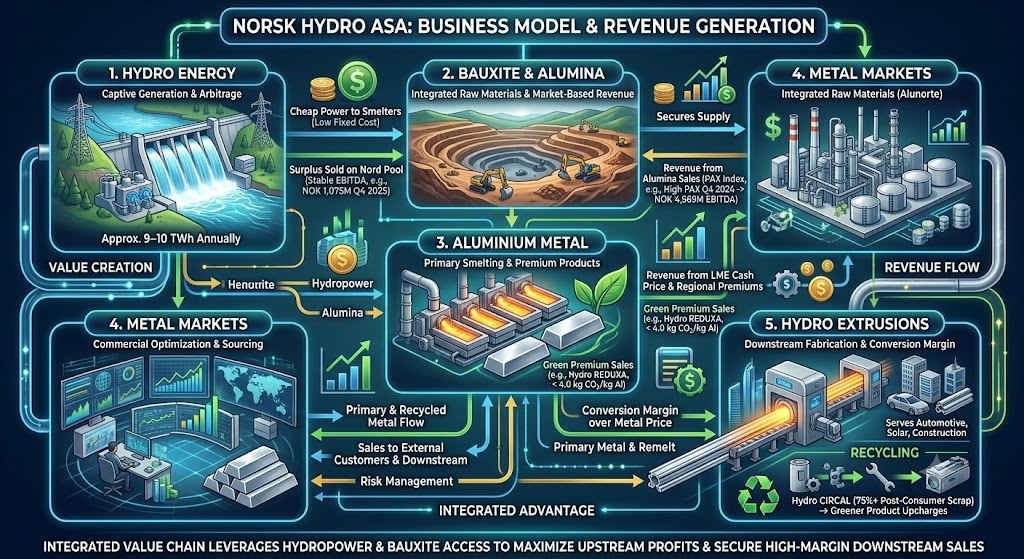
Norsk Hydro operates as an integrated industrial enterprise organized into five primary reporting segments: Bauxite & Alumina, Aluminium Metal, Extrusions, Energy, and Metal Markets.
The company generates revenue across upstream extraction, metal refining, premium downstream fabrication, and merchant power sales:
- Upstream Operations (Bauxite & Alumina, Aluminium Metal): Upstream profitability depends on commodity benchmarks—primarily the Platts Alumina Index (PAX) and the London Metal Exchange (LME) aluminium cash price—plus regional product premiums. For the full year 2024, Hydro reported adjusted EBITDA of NOK 26,318 million, which expanded to NOK 28,900 million in 2025 as higher metal and alumina prices offset downstream softness. In peak quarters, upstream divisions account for the majority of operating cash flow; for example, in Q4 2024, Bauxite & Alumina generated NOK 4,969 million in adjusted EBITDA when PAX reached over USD 800 per tonne.
- Downstream Fabrication (Hydro Extrusions): This segment operates on a conversion margin model rather than direct metal price exposure. Hydro purchases primary metal or remelt ingots, shapes them into precision profiles and tubes for automotive, solar, building, and industrial clients, and bills a fabrication margin over the underlying metal price. While Extrusions faces cyclical pressures during manufacturing downturns (delivering NOK 1,463 million adjusted EBITDA in Q2 2026 after earlier restructuring), it provides customer lock-in and high-margin product opportunities.
- Energy Arbitrage & Self-Generation: Hydro owns and operates hydroelectric assets in Norway generating around 9–10 TWh annually. Hydro uses captive hydropower to supply its domestic smelters at fixed operating costs well below continental market rates. It sells surplus power directly into the Nord Pool merchant market, contributing stable adjusted EBITDA (e.g., NOK 1,075 million in Q4 2025).
- Green Premium and Circularity Strategy: Hydro monetizes customer decarbonization demand by selling low-carbon primary metal (Hydro REDUXA, guaranteed under 4.0 kg CO2/kg Al) and recycled scrap metal (Hydro CIRCAL, containing at least 75% post-consumer scrap). These products carry premium upcharges over base LME pricing. Hydro targeted NOK 6.5 billion in accumulated operational and commercial improvements through 2030, with greener product sales expanding by roughly 50% year-on-year in upcharge revenues.
Sources for Business Model
- https://www.hydro.com/en/global/media/news/2025/hydros-fourth-quarter-2024-resultsbauxite–alumina-record-results-partnering-for-a-green-transition/
- https://www.hydro.com/en/global/media/news/2025/annual-report-2024-accelerating-the-green-aluminium-transition/
- https://www.hydro.com/en/global/media/news/2026/hydros-fourth-quarter-2025-results-solid-upstream-performance-driving-strong-cash-flow-generation/
- https://kommunikasjon.ntb.no/pressemelding/18999797/norsk-hydro-operational-strength-delivering-solid-results?publisherId=4954260&lang=en
Artificial Intelligence and Digital Strategy
Hydro’s AI and digital strategy focuses on process optimization in smelters, automated alloy sorting in recycling, edge-enabled predictive maintenance, and enterprise automation:
- Computer Vision and Scrap Sorting: In its recycling divisions, Hydro deploys automated robotic sorting and machine learning algorithms to process post-consumer metal. Through initiatives such as its HySort technology and Alusort joint venture, optical computer vision paired with Laser-Induced Breakdown Spectroscopy (LIBS) analyzes and categorizes scrap alloys with up to 95% accuracy. This automation quadruples sorting speeds to around 10 tons per hour compared to manual labor, lowers processing overhead by 25%, and minimizes batch contamination during remelting.
- Smelter Process Control & Digital Twins: Primary smelting cells run continuously at nearly 1,000°C. Hydro applies machine learning algorithms to real-time telemetry from electrolysis cells at facilities like Karmøy and Sunndal to anticipate “anode effects,” regulate bath chemistry, and optimize electrical draw. Hydro also utilizes machine learning models to balance power consumption with fluctuating merchant energy prices and renewable feed availability.
- Technology Partnerships and Infrastructure: Hydro partners with Microsoft and Azure for cloud-native infrastructure, data lake architectures, and enterprise AI integrations, while using Siemens and Mendix low-code systems to deploy over 70 custom production and asset tracking applications. For workforce intelligence and human capital deployment across its 32,000 employees, Hydro partnered with SAP and TalenTeam to implement SAP SuccessFactors AI talent intelligence hubs.
- Digital Budget and Automation Scope: While Hydro does not break out AI spending into a standalone public P&L line item, its digital and operational automation investments form an integral part of its annual capital expenditure (cash capex was NOK 12.1 billion in 2025) and its operational improvement program targeting NOK 6.5 billion in total efficiency gains by 2030. In its Extrusions segment alone, automation and algorithmic workflows are scheduled to eliminate over 100 repetitive full-time equivalent (FTE) manual positions to raise line safety, ergonomics, and extrusion speed.
Back to Norsk Hydro