
Market Position and Market Share
Accor SA stands as the largest hospitality group in Europe and ranks 6th globally by total room count, positioned behind Marriott International, Jin Jiang International, Hilton Worldwide, InterContinental Hotels Group(IHG), and Wyndham Hotels & Resorts.
The company operates an international network exceeding 5,700 hotels and resorts across more than 110 countries, encompassing over 854,000 rooms. Accor’s future expansion pipeline comprises approximately 241,000 rooms across more than 1,430 planned properties. In Europe, Accor commands a dominant market share of roughly 30% of branded hotel inventory, with prominent concentration across France, Germany, and the United Kingdom. On a global scale, Accor accounts for approximately 4.5% to 5% of all branded hotel rooms. For fiscal year 2025, the group achieved recurring EBITDA of €1.20 billion and reported a system-wide Revenue Per Available Room(RevPAR) growth of 4.2%.
Supply Chain Upstream and Downstream Analysis
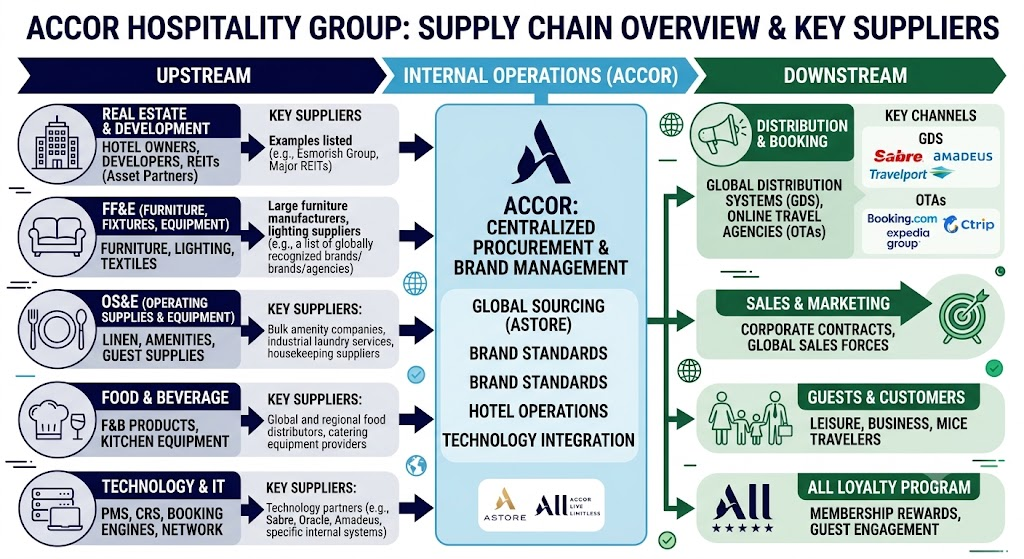
Accor operates predominantly on an asset-light corporate structure, where over 95% of rooms are operated under franchise and hotel management agreements. This model separates operational and procurement dynamics between upstream resource suppliers and downstream distribution channels.
Upstream Analysis and Key Suppliers
- Real Estate Owners and Developers: Institutional investors, sovereign wealth funds, real estate investment trusts(REITs), and family offices provide real estate capital, structural construction, and property upkeep. Major asset partners include groups like Essendi and institutional property syndicates.
- Centralized Procurement and OS&E/FF&E: Accor manages procurement through Astore, its central purchasing organization. Astore negotiates group rates for Furniture, Fixtures, and Equipment(FF&E) and Operating Supplies and Equipment(OS&E). Key upstream suppliers include commercial textile and linen producers, industrial laundry operators, guest amenity manufacturers, and commercial kitchen suppliers.
- Technology Infrastructure and Core Systems: Accor depends on specialized enterprise IT providers. Core infrastructure relies on Oracle Hospitality for Property Management Systems(Opera Cloud PMS), Amadeus IT Group and Sabre for Central Reservation System(CRS) and Global Distribution System(GDS) connectivity, and cloud infrastructure hosted across Amazon Web Services(AWS) and Microsoft Azure. In addition, Accor develops proprietary software through D-EDGE Hospitality Solutions, an internal subsidiary providing channel management and digital booking engines.
Downstream Analysis and Distribution Channels
- Direct Digital and Loyalty Channels: Bookings flow through the proprietary ALL(Accor Live Limitless) loyalty application, brand-specific web portals, and centralized telephone reservation hubs. Direct channels eliminate third-party commission fees and maximize guest retention.
- Online Travel Agencies(OTAs): Intermediaries including Booking Holdings(Booking.com, Agoda) and Expedia Group account for external consumer acquisition. While OTAs impose 15% to 22% commission fees, they provide baseline occupancy for leisure and regional properties.
- Corporate Travel and TMCs: Managed business travel is funneled through Travel Management Companies(TMCs) such as American Express Global Business Travel, BCD Travel, and CWT, routed via GDS networks(Amadeus, Sabre, Travelport) under negotiated corporate rates.
- End Guests: Segmented between corporate business travelers, MICE(Meetings, Incentives, Conferences, Exhibitions), and leisure travelers across two distinct internal divisions: “Premium, Midscale & Economy”(e.g., ibis, Novotel, Mercure, Pullman) and “Luxury & Lifestyle”(e.g., Raffles, Fairmont, Sofitel, Orient Express, and the Ennismore lifestyle collective).
Competitor Analysis: Technology and Financial Comparison
Accor competes primarily against US-based hospitality giants, most notably Marriott International, Hilton Worldwide, and IHG.
Financial Comparison
- Scale and Revenue Base: Marriott dominates the industry with over 1.6 million rooms and annual revenues exceeding $24 billion, followed by Hilton with roughly 1.2 million rooms. Accor operates ~854,000 rooms, generating group revenues in the €5.0 billion to €5.5 billion range.
- Operating Margins and Asset Models: Hilton and Marriott operate nearly pure franchise-fee models in North America, achieving Adjusted EBITDA margins above 60% relative to net fee revenues. Accor operates a bifurcated structure: while its management and franchise fee business delivers high cash conversion, its consolidated EBITDA margin stands lower at approximately 22% to 24% due to hospitality services, shared distribution overhead, and regional joint ventures.
- Geographic Exposure and RevPAR: Marriott and Hilton generate roughly 65% to 70% of their fees from North America, yielding higher nominal RevPAR and lucrative co-branded credit card licensing fees. Accor’s portfolio is heavily weighted toward Europe and Asia-Pacific/Middle East, which subjects its baseline earnings to European macroeconomic cycles and currency shifts, but grants higher organic exposure to lifestyle tourism in emerging markets.
Technology Comparison
- Loyalty Ecosystems: The ALL loyalty program comprises approximately 90 million members, whereas Marriott Bonvoy exceeds 220 million members and Hilton Honors counts over 180 million members. This scale disparity gives US competitors an advantage in direct booking share, lower customer acquisition costs, and co-branded credit card interchange revenue.
- PMS Architecture and IT Modernization: Marriott, Hilton, and IHG have committed to enterprise-wide transitions toward cloud PMS platforms(such as Amadeus ACX and Oracle Opera Cloud). Accor deploys hybrid architectures, pairing Opera Cloud with bespoke local solutions in regional markets.
- In-House Technology Commercialization: Unlike Marriott or Hilton, which outsource software to third-party travel tech vendors, Accor owns D-EDGE Hospitality Solutions. D-EDGE provides reservation engines, channel management, and central reservation software to Accor properties as well as over 17,000 independent hotels worldwide, transforming an internal IT cost center into a merchant technology revenue stream.
Information Sources
- https://group.accor.com/en/news-stories/2025-half-year-results-in-key-figures
- https://press.accor.com/full-year-2025-results-solid-results-above-2025-guidance/
- https://lodgingmagazine.com/accor-reports-full-year-2025-results/
- https://www.voyages-d-affaires.com/en/largest-hotel-groups-2024
- https://marriott.gcs-web.com/static-files/9cf0e9b0-bbfa-48a6-9e21-ffbdbc4b2d78
- https://rategain.com/blog/best-hotel-manager-software/
Back to Accor