
Company History
Foundation and Domestic Expansion(1967–1982)
The group traces its origins to 1967 when Paul Dubrule and Gérard Pélisson opened the first Novotel hotel in Lille, France. The founders pioneered standardized modern hotels along French transport routes, expanding the Novotel brand and later launching the budget chain Ibis in 1974. In 1975, the business acquired the Mercure hotel chain, solidifying its domestic stronghold. The company officially reorganized under the corporate identity Accor in 1983 following a merger with the restaurant voucher group Jacques Borel International.
Global Diversification and Scale(1983–2012)
Accor expanded aggressively across international markets through internal brand creation and debt-fueled acquisitions. It launched the ultra-low-cost Formule 1 chain in 1985 and acquired the US-based Motel 6 chain in 1990. Throughout the 1990s and 2000s, Accor diversified into upscale hospitality by expanding Sofitel and making strategic entries into emerging markets, particularly Asia-Pacific and Latin America. However, managing real estate assets, hotel services, and unrelated business vouchers simultaneously strained balance-sheet efficiency. In 2010, the group executed a demerger, spinning off its prepaid voucher business into Edenred to focus purely on hospitality.
Asset-Light Transformation and Luxury Pivot(2013–Present)
Sébastien Bazin took over as Chairman and CEO in 2013, launching an asset-light corporate overhaul. In 2018, Accor sold a majority stake in its real estate arm, AccorInvest, transforming the company into a pure-play brand manager and franchisor. The capital funded major luxury and lifestyle acquisitions, including FRHI Hotels & Resorts(Fairmont, Raffles, Swissôtel)in 2016 and the Ennismore lifestyle joint venture in 2021. To optimize operational focus, Accor split its operational structure into two dedicated divisions: “Premium, Midscale & Economy”(PM&E)and “Luxury & Lifestyle”(L&L).
Business Model and Strategic Execution
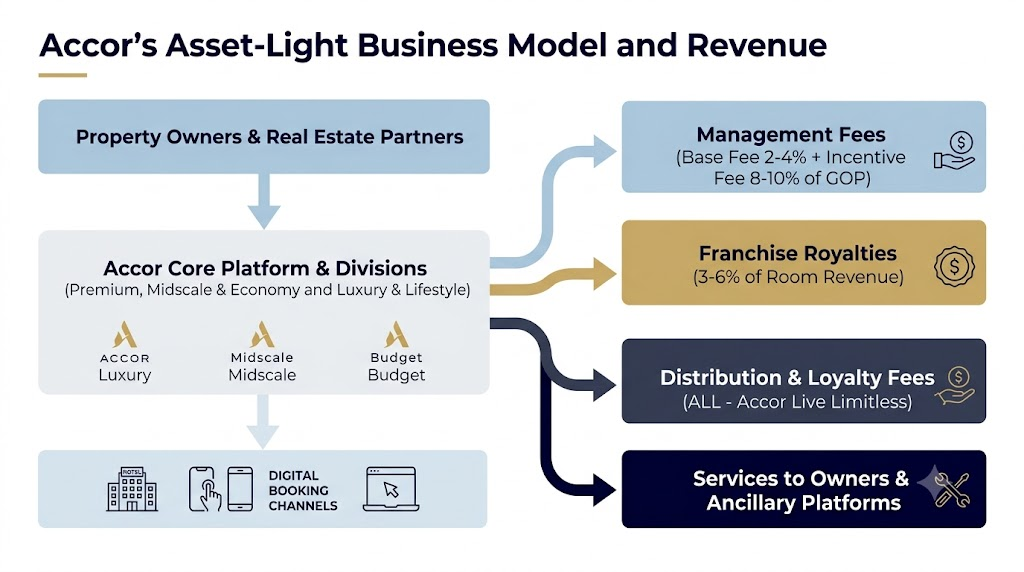
Accor operates primarily as an asset-light hospitality franchisor and management company, generating revenue through recurring management fees, franchise royalties, and loyalty distribution charges rather than direct property ownership.
Revenue Generation Mechanisms
- Management Contracts: Accor operates luxury and premium hotels on behalf of third-party real estate owners. In exchange, the group collects a base management fee(typically 2% to 4% of total hotel revenues)plus an incentive fee tied directly to hotel operating profits(often 8% to 10% of gross operating profit).
- Franchise Agreements: Applied heavily to midscale and economy chains(e.g., Ibis, Mercure), Accor licenses its trademarks and operational manuals to property owners. In return, owners pay royalties(generally 3% to 6% of room revenues), reservation distribution fees, and system-wide technology surcharges.
- Distribution and Loyalty Fees: Through its ALL(Accor Live Limitless)program, Accor monetizes central booking channels, marketing services, and co-branded credit card affiliations, capturing transaction margin from millions of loyalty guests.
- Services to Owners & Ancillary Platforms: Accor generates services-to-owners revenues by providing centralized digital infrastructure, enterprise procurement networks, and shared hotel services, alongside specialized revenue from Ennismore lifestyle dining and entertainment concepts.
Financial Performance and Strategic Drivers
In fiscal year 2024, Accor reported full-year revenue of €5,606 million, representing an 11% year-on-year increase, alongside recurring EBITDA of €1,120 million(up 12% year-on-year). Growth was driven primarily by the high-RevPAR Luxury & Lifestyle division and sustained pipeline expansion across Asia-Pacific and the Middle East. The dual-division corporate structure enables capital discipline: the PM&E division generates stable, volume-based franchise cash flows, while the Luxury & Lifestyle arm delivers higher RevPAR leverage and greater pricing power during peak tourism demand.
Business Model Sources
- https://press.accor.com/full-year-2024-results-another-record-year
- https://group.accor.com/en/hotel-development/solutions-for-every-project
- https://aiinstitute.hbs.edu/platform-digit/submission/accor-hotels-the-transition-of-a-hotel-brand-to-a-hospitality-platform-or-augmented-hospitality/
AI Development Strategy, Budget, and Partnerships
Accor’s artificial intelligence strategy centers on direct booking channel optimization, dynamic revenue management, and property-level hyper-personalization, moving legacy enterprise systems into centralized cloud environments.
Strategic Cloud and Generative AI Alliances
- Amazon Web Services(AWS): Accor partnered with AWS under a multi-year digital transformation initiative to migrate 100% of its core application infrastructure to the cloud. Leveraging Amazon Bedrock and Amazon SageMaker, Accor deployed its proprietary AI Travel Assistant to analyze multimodal guest preferences, deliver conversational booking discovery, and route travelers to direct channels. In customer care, Accor integrated Amazon Connect to drive automated voice and text interactions, lowering contact-center call overhead while elevating customer satisfaction to 97%.
- Microsoft & Cloud Hospitality Stacks: Accor utilizes Microsoft Azure and Microsoft 365 Copilot tools across its corporate and regional back-office workflows, automating procurement coordination, multi-lingual legal reviews, and contract drafting with hotel franchisees.
Core Deployment Domains
- Predictive Pricing & Revenue Management: Accor utilizes machine-learning models that evaluate flight traffic patterns, local event schedules, competitive sets, and macro consumer spending indices to adjust room pricing algorithmically multiple times per day across its 5,500+ properties.
- Personalized Loyalty Marketing: The ALL customer data platform applies predictive AI models to past transaction data, generating tailored dynamic packages, promotional incentives, and personalized dining add-ons for over 80 million loyalty members.
- On-Property Operations: Selective properties utilize edge-AI and Internet of Things(IoT)frameworks to predict utility waste, optimize kitchen inventories, and adjust heating and cooling cycles based on real-time room occupancy.
Capital Allocation and Expenditure
While Accor does not isolate a discrete AI line item in its corporate accounting, its digital, data, and technology platform investments account for an estimated annual capital commitment between €150 million and €200 million. Spending prioritizes data-pipeline refactoring, proprietary API integration with cloud infrastructure, and generative AI agents directly tied to direct-booking conversion improvements.
Back to Accor