
Company History
Founding and Early Consolidation (1964–1999)
The company traces its roots back to 1964 when Thor Mowinckel and pioneers established fish farming operations in Fjell, Norway under the name MOWI. Over the following decades, ownership changed multiple times as the emerging aquaculture sector expanded. Norsk Hydro acquired a majority stake in 1969, later merging its seafood division with Torris Products to form Hydro Seafood in 1990. In 1999, Hydro Seafood was sold to Marine Harvest, then a joint venture owned by Nutreco.
The Mega-Merger Era (2000–2006)
The modern operational structure took shape during the massive industry consolidation of the mid-2000s. In 2006, Norwegian industrialist John Fredriksen’s investment vehicle, Geveran Trading, spearheaded a three-way merger combining Pan Fish, Marine Harvest, and Fjord Seafood. The combined conglomerate adopted the name Marine Harvest and established itself immediately as the unchallenged global market leader in farmed salmon production.
Vertical Integration and Rebranding (2007–2018)
Marine Harvest focused heavily on securing control over its supply chain and downstream positioning. In 2014, the company launched its own fish feed division to reduce dependence on external commercial suppliers, establishing feed mills in Norway and Scotland. In late 2018, the company officially rebranded to Mowi ASA—honoring its original founder—to spearhead a unified global consumer brand strategy across retail shelves worldwide.
Digitalization and Mowi 4.0 (2019–Present)
Entering the current decade, Mowi launched its “Mowi 4.0” automation and digitalization initiative, modernizing pen monitoring, automated feeding, and factory processing. Despite external challenges such as the COVID-19 disruption and Norway’s 2023 implementation of a 25% effective resource rent tax on salmon farming, Mowi expanded harvest output, surpassing 500,000 tonnes annually and driving downstream branded retail penetration across Europe, North America, and Asia.
Business Model and Growth Strategy
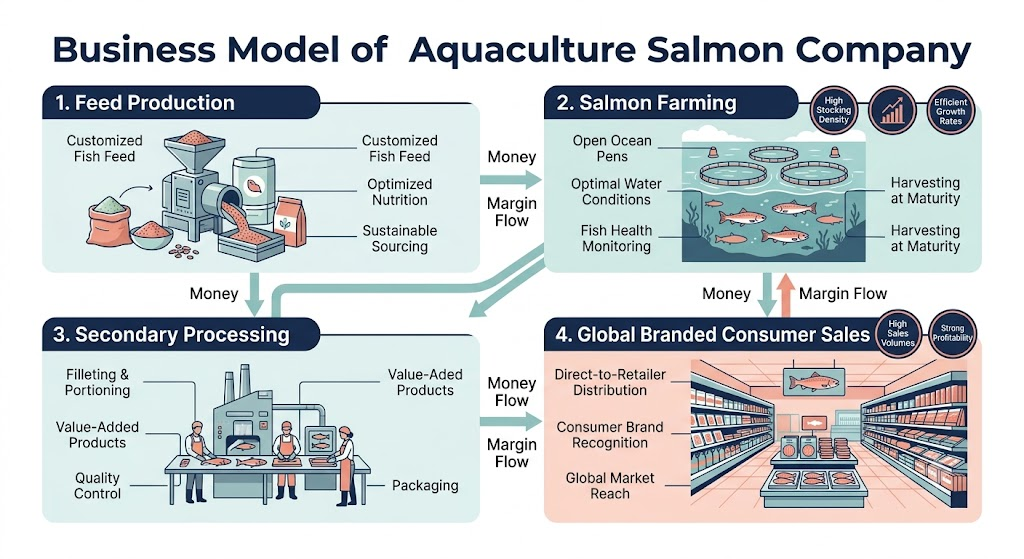
Mowi generates revenue by monetizing farm-raised Atlantic salmon through a vertically integrated, four-pillar operating model: Feed, Farming, Markets, and Consumer Products. Rather than functioning merely as an upstream livestock farmer vulnerable to spot commodity swings, Mowi captures margins at every step of value addition.
- Farming (Upstream Biomass Generation): The Farming division represents the company’s primary operational engine, yielding approximately 559,000 gutted weight tonnes (GWT) of salmon annually across operational hubs in Norway, Scotland, Chile, Canada, Ireland, and the Faroe Islands. Mowi monetizes biomass on the spot market through contracts structured against benchmark salmon indices (such as Fish Pool prices). Upstream profitability is determined by farming cost per kilogram versus market spot prices, with operational earnings driven heavily by survival rates, feed conversion ratios (FCR), and biomass yield.
- Feed Production (Cost Control and Biological Optimization): Mowi produces over 500,000 tonnes of specialized salmon feed per year internally. While intercompany feed transfers are conducted at arms-length market terms, this vertical unit insulates Mowi from third-party feed manufacturer margins (e.g., Skretting, BioMar) and tailors feed formulations to maximize salmon health and color traits.
- Consumer Products and Secondary Processing (Margin Hedging): Mowi processes raw harvest into value-added consumer offerings—such as skinless fillets, pre-marinated portions, and cold-smoked salmon—across secondary processing facilities in Europe, the Americas, and Asia. This downstream arm cushions group earnings: when raw salmon spot prices decline, processing margin spreads expand; when salmon prices spike, downstream operations adjust consumer retail pricing.
- The “MOWI” Consumer Brand (Category Redefinition): Mowi actively shifts volumes from generic private-label supermarket counters to its proprietary “MOWI” branded lines. Branded retail products command a consistent price premium of 15% to 25% over unbranded commodity cuts, dampening commodity cycle shocks and locking in multi-year shelf-space agreements with global retail chains.
- Scale and Capital Efficiency Strategy: Mowi achieves group annual operational revenues surpassing €5.5 billion. Management leverages disciplined capital expenditure, continuous farming cost deflation through automated feeding hubs, and geographic volume diversification to sustain return on capital employed (ROCE) above historical targets, distributing excess cash flow via structured quarterly dividends.
Sources for Business Model Information
- https://mowi.com/investors/reports/
- https://mowi.com/about/our-value-chain/
- https://mowi.com/wp-content/uploads/2025/02/Mowi_Q4_2024_Report.pdf
- https://www.global-agriculture.com/animal-health-welfare/mowi-asa-reports-record-q4-revenue-of-eur-1-59-billion-2025-harvest-reaches-559000-tonnes/
- https://www.seafoodsource.com/news/business-finance/mowi-delivers-record-q4-full-year-harvests-in-2025
AI Strategy, Budget, and Partnerships
Mowi’s artificial intelligence strategy is anchored in its group-wide “Mowi 4.0” modernization program, which systematically transitions fish farming from manual, labor-intensive inspection to algorithmic, sensor-driven aquaculture.
- Core AI Architecture and Capabilities:
- Biomass and Weight Estimation: Using stereoscopic underwater machine vision, AI algorithms measure the length, girth, and trajectory of swimming salmon in real time, calculating biomass volume and size distribution within pens with over 95% accuracy, eliminating the need for destructive manual sample weighing.
- Automated Behavioral Feeding: Acoustic and optical computer vision tracks fish satiety by analyzing feeding vigor and pellet sinking rates. Machine learning models autonomously halt pellet delivery when feeding velocity drops, cutting feed waste (feed represents over 40% of standard production costs) and lowering seabed organic deposition.
- Real-Time Parasite and Welfare Monitoring: High-speed edge vision detects and counts sea lice on moving fish under water. Automated reporting satisfies regulatory compliance thresholds without requiring physical fish handling, significantly mitigating stress-induced mortality.
- Key Technology Partnerships:
- Tidal (Alphabet’s X Moonshot Project): Mowi maintains a flagship partnership with Tidal. Originating inside Alphabet’s moonshot factory and now spun out as an independent aquaculture intelligence platform, Tidal deployed smart underwater perception systems across hundreds of Mowi’s Norwegian sea pens. The partnership extended into Mowi Genetics AS, leveraging machine perception to identify individual fish phenotypes without physical tagging to optimize selective broodstock breeding.
- Remote Operations Centers (ROCs): Mowi established centralized regional ROC control rooms in Norway and Scotland. Operators utilize cloud-based telemetry dashboards to remotely monitor feeding, camera feeds, and water telemetry (temperature, salinity, dissolved oxygen) across geographically dispersed fjord locations, optimizing human resource deployment.
- Investment Budget and Scale: Mowi funnels digital farming initiatives through its broader annual operational and maintenance CapEx budget, which typically ranges from €300 million to €350 million per year. Digitalization, automation, and R&D-specific technology outlays account for an estimated €30 million to €50 million annually, with management targeting operational farming cost reductions of €0.10 to €0.20 per kilogram of harvested salmon through precision AI feeding and reduced biological treatments.
Back to Mowi