
Corporate History
Founding and Early Struggles (1984–1990)
Established in 1984 by Christopher Ryan, Liam Lonergan, and Tony Ryan, the airline launched services in 1985 with a 15-seat Embraer Bandeirante turboprop flying between Waterford and London Gatwick. Operating initially as a conventional full-service carrier, it struggled with intense legacy competition and accumulated substantial financial losses, pushing the business close to liquidation by 1990.
The Low-Cost Pivot (1991–2000)
Michael O’Leary was appointed to restructure the airline and traveled to the United States to study Southwest Airlines’ operational model. Ryanair subsequently pivoted to a strict low-cost carrier format: it phased out mixed fleet types in favor of a single airframe family, eliminated complimentary in-flight catering, prioritized secondary airports with lower landing charges, and initiated rapid European expansion following European Union aviation deregulation.
Aggressive European Expansion and Fleet Growth (2001–2013)
Capitalizing on the post-9/11 downturn and the 2008 financial crisis, Ryanair negotiated large-scale aircraft orders with Boeing for 737-800 airframes at substantial discounts. It set up dozens of operational bases across continental Europe, aggressively challenged flag carriers, and drove down European airfares while steadily increasing ancillary fee categories.
Digital Transformation and Fleet Modernization (2014–Present)
The company launched its “Always Getting Better” customer service overhaul, redesigned its digital booking platform, and established Ryanair Labs to enhance digital sales. It adopted a corporate group structure comprising Ryanair DAC, Buzz, Lauda Europe, and Malta Air, and took delivery of high-capacity Boeing 737-8-200 “Gamechanger” aircraft to lower per-seat fuel burn and expand capacity.
Business Model and Strategy
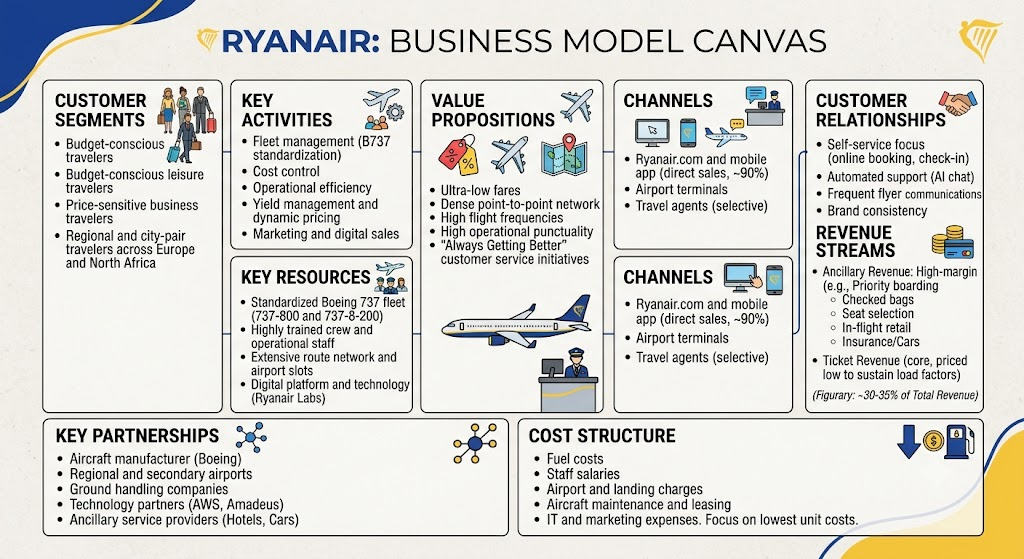
Ryanair’s business model is engineered around ultra-low operating unit costs driving high-volume passenger demand, which the carrier then monetizes through high-margin ancillary sales.
- Bare-Fare Unbundling: Base ticket prices are priced near or below direct cash flight costs to sustain industry-leading load factors (consistently between 93% and 95%). The ticket provides strictly seat transportation from origin to destination.
- High-Margin Ancillary Revenue: Ancillary services generate approximately 30% to 35% of total operating revenue (surpassing €4.3 billion out of €13.95 billion total revenue in fiscal 2025). Monetized add-ons include priority boarding, carry-on bags, checked luggage fees, allocated seating, in-flight retail sales, and commissions earned on third-party travel insurance, car rentals, and hotel bookings.
- Extreme Asset Utilization: Turnaround times are tightly scheduled at 25 minutes. A homogeneous Boeing 737 fleet minimizes maintenance inventories, pilot certification overheads, and turnaround friction. Aircraft achieve utilization rates exceeding 9 hours per day.
- Direct Digital Distribution: Over 90% of bookings are processed directly through Ryanair’s website and mobile application, sidestepping global distribution systems (GDS) and avoiding intermediary commissions.
- Airport Bargaining Power: By directing millions of travelers to secondary or regional airports (e.g., Beauvais, Bergamo, Charleroi), Ryanair negotiates substantial rebates on passenger handling fees and airport charges.
Sources for Business Model Information
- https://airinsight.com/ryanair-reports-fy25-profit-drop-on-lower-fares/
- https://thinkinsights.net/digital/ryanair-business-model
- https://businessmodelanalyst.com/ryanair-business-model/
Artificial Intelligence Strategy
Ryanair focuses its AI investments on operational optimization, maintenance predictability, dynamic ancillary conversion, and automated customer service to keep structural overhead low.
- Core Cloud and AI Partnership: Ryanair works primarily with Amazon Web Services (AWS) as its enterprise cloud and machine learning infrastructure provider. Its engineering and product hub, Ryanair Labs, collaborates with specialized AWS partners such as Cation Consulting.
- Customer Support Automation: The airline deployed an agentic generative AI customer service infrastructure powered by Amazon Bedrock and foundational language models (including Amazon Nova models). The system handles over 120,000 chat interactions daily in seven languages, maintaining an 80% containment rate without requiring human intervention. This follows an Amazon Connect voice implementation that deflected 80% of inbound calls to self-service digital workflows, saving over 500,000 human agent hours annually.
- Predictive Maintenance and Flight Dispatch: Ryanair applies machine learning models to flight telemetry data from its Boeing fleet to predict component failure before mechanical delays occur. Ground dispatch algorithms optimize turnaround timelines and luggage loading distribution to avoid gate delays.
- Pricing Optimization: Advanced statistical and predictive algorithms dynamically adjust ancillary pricing (such as priority boarding and checked luggage) based on route demand, booking window timing, and real-time cabin capacity.
- Budget and Spend Model: Ryanair does not report standalone AI expenditure line items in its annual financial statements. Instead, it funds AI projects internally via Ryanair Labs and routine operational technology budgets, maintaining strict cost caps and avoiding speculative R&D that does not provide direct, near-term cost deflection or ancillary sales upside.
Back to Ryanair