
Corporate History
Post-War Reconstruction & Industrial Scale (1952–1985)
Founded in 1952 by Francis Bouygues as Entreprise Francis Bouygues, the company started as a building contractor focused on France’s post-war rebuilding effort. It expanded into major public infrastructure, civil engineering, and international projects throughout the 1960s and 1970s, culminating in an IPO in Paris in 1970.
Diversification & Media Entry (1986–1993)
Bouygues acquired Colas, a major road construction specialist, in 1986. Seeking exposure outside the cyclical construction sector, Francis Bouygues spearheaded a consortium in 1987 that acquired the privatized French national television network TF1, marking the conglomerate’s formal expansion into media and commercial broadcasting.
Telecommunications & Generational Transition (1994–2020)
Under Martin Bouygues, the company secured France’s third mobile license in 1994 and launched Bouygues Telecom in 1996. The late 1990s and 2000s cemented the group’s three-pillar structure (construction, telecoms, media). During this era, Bouygues also built and subsequently monetized a major stake in Alstom, reallocating capital back into proprietary infrastructure and network assets.
Transformation via Energy Transition & Equans (2021–Present)
In 2022, Bouygues completed its largest corporate acquisition to date by purchasing Equans from Engie for an enterprise value of approximately €7.1 billion. This transaction repositioned the group toward energy efficiency, HVAC, electrical engineering, and industrial automation services, creating an operational giant where technical services generate a leading portion of total revenue.
Business Model & Growth Strategy
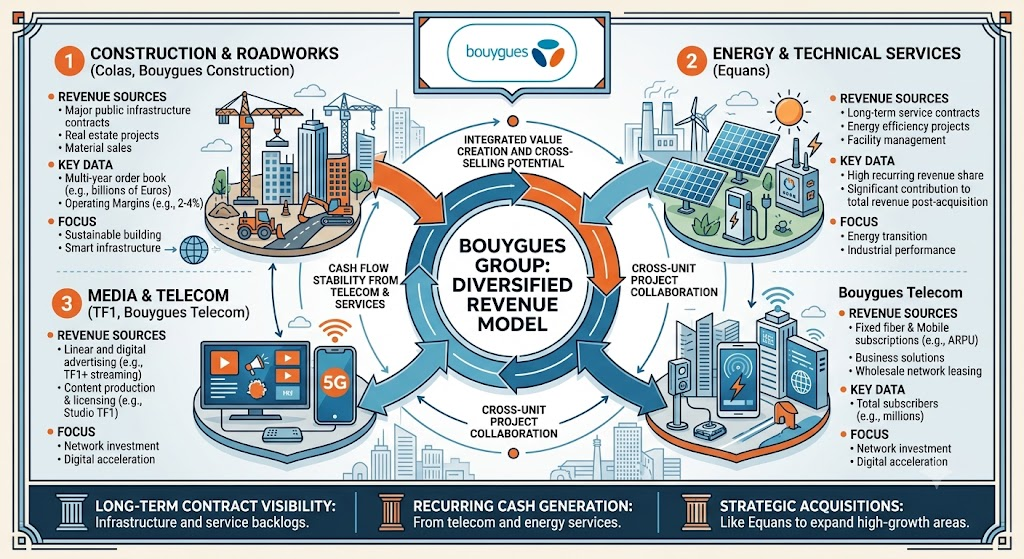
Bouygues generates revenue by bundling project delivery, multi-year recurring service contracts, subscription billings, and digital advertising:
- Energy & Technical Services (Equans): Generates revenue via long-term contracts for facility electrical engineering, HVAC installations, automation, and industrial maintenance. In 2025, Equans recorded €18.7 billion in sales with a current operating profit from activities (COPA) margin reaching 4.4%. It operates as the group’s largest revenue engine, driven by building decarbonization and infrastructure electrification mandates.
- Infrastructure & Construction (Bouygues Construction & Colas): Earns revenue via fixed-price or cost-plus engineering and construction contracts for roads, railways, airports, commercial complexes, and public-private partnerships (PPPs). Colas monetizes bitumen production and road materials alongside paving operations. These divisions turn over high volumes (€56.9 billion group total sales in 2025) while operating at tight margins (Colas and Bouygues Construction operating margins hovering around 2.7% to 3.7%).
- Telecommunications (Bouygues Telecom): Generates high-margin, recurring monthly subscription fees (ARPU) across fixed fiber broadband (FTTH) and mobile data services. Bouygues Telecom serves over 27 million mobile and 5 million fixed customers, deriving additional revenue from business cloud solutions, handset sales, and wholesale network leasing.
- Media (TF1 Group): Monetizes broadcast television through linear advertising spots, programmatic digital video ads on its streaming platform TF1+, and international content production/licensing via Studio TF1 (formerly Newen Studios).
The group’s overarching development strategy relies on portfolio hedging: utilizing steady free cash flow from telecom subscriptions and energy services to service group debt and absorb cyclical macro fluctuations in private real estate and construction bidding.
Sources for Business Model
- https://www.bouygues.com/en/financial-figures/
- https://www.nasdaq.com/press-release/bouygues-very-robust-2025-results-and-free-cash-flow-record-level-2026-02-26
- https://www.globenewswire.com/news-release/2025/11/05/3181085/0/en/bouygues-nine-month-2025-results.html
- https://pestel-analysis.com/blogs/how-it-works/bouygues
AI Strategy, Budget & Partnerships
Bouygues manages AI deployment pragmatically across operational efficiency, risk management in contracting, and customer engagement, partnering primarily with external cloud and enterprise AI vendors rather than developing proprietary frontier foundation models:
- Cloud & Model Orchestration Partnerships: In 2025, Bouygues signed a multi-year strategic partnership with Amazon Web Services (AWS) to scale generative AI across its business units. A key deployment is LegalAize, a genAI platform built on Amazon Bedrock using Anthropic’s Claude to parse complex construction and energy procurement contracts, flagging indemnification liabilities and risk clauses for Equans project teams.
- Agentic Customer Acquisition & Care: Bouygues Telecom partnered with Google Cloud and consultancy Artefact to build agentic conversational sales systems powered by Gemini and Google Agent Builder, guiding prospective customers through complex mobile and broadband tariff selections. Additionally, Bouygues Telecom deployed Perion Network’s Outmax AI bidding agents, reporting a 34% decrease in digital customer acquisition costs.
- Internal Agent Platforms & Sovereignty: Bouygues Telecom introduced “Studio IA” in collaboration with French enterprise AI vendor Prisme.ai, deploying retrieval-augmented generation (RAG) agents to internal staff to comply with European data sovereignty guidelines.
- Budget Allocations: Bouygues embeds AI expenditures within existing enterprise digital transformation and IT budgets rather than reporting a singular speculative AI research line item. For example, Bouygues Telecom operates an annual gross capital expenditure envelope of roughly €1.5 billion (excluding spectrum frequencies), with software automation, data lake consolidation, and AI tool integration factored directly into operational IT and network maintenance outlays. Media subsidiary TF1 focuses its AI expenditure on automated video indexing, dynamic content recommendation algorithms, and targeted digital ad placement on TF1+.
Back to Bouygues