
Company History
The evolution of EDP is characterized by four major historical stages:
- Nationalization and Foundation (1976–1990s): Following the 1974 Carnation Revolution, the Portuguese government consolidated 14 nationalized electricity companies via Decree-Law No. 502/76 on June 30, 1976, officially establishing Electricidade de Portugal (EDP) as a state-owned utility to unify the national power grid and infrastructure.
- Privatization and Restructuring (1991–2000s): In 1991, EDP transitioned into a public limited company (Sociedade Anónima). Throughout the 1990s and early 2000s, the Portuguese government executed phased privatization tranches, listing EDP on Euronext Lisbon in 1997 while unbundling generation, transmission, and distribution activities to comply with European Union market liberalization directives.
- Global Renewable Expansion (2000s–2020): EDP pivoted heavily toward international markets and green energy. A landmark move occurred in March 2007 with the $3 billion acquisition of Horizon Wind Energy in the US, establishing EDP Renewables (EDPR) as a global renewables titan. The company also expanded its footprint across Spain (acquiring Viesgo in 2020) and Brazil, while state-owned China Three Gorges acquired a major strategic stake.
- Net-Zero Transition and Portfolio Simplification (2021–Present): EDP accelerated its decarbonization by fully exiting coal power generation in 2021. In 2023, the company took EDP Brasil private to streamline operations and tighten group control. In April 2024, shareholders formally dropped “Energias de Portugal” to rebrand simply as “EDP, S.A.”, reflecting a streamlined, globally integrated clean energy profile.
Business Model and Development Strategy
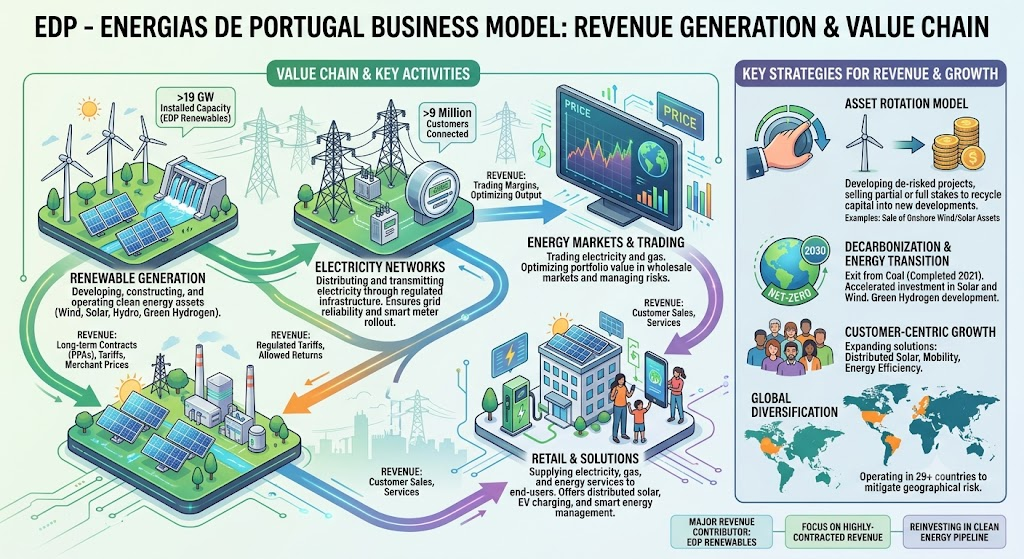
EDP operates as a vertically integrated energy utility that generates revenue through a diversified multi-market framework rather than relying on a single revenue stream. Its primary monetization pillars include:
- Regulated Electricity Networks: EDP earns stable, predictable returns through regulated tariffs for electricity distribution and transmission operated by units like E-REDES in Portugal and network assets in Brazil. These regulated asset bases provide inflation-linked cash flows, contributing substantial portions of group EBITDA with targeted project internal rates of return (IRRs) of 8% to 9%.
- Contracted Renewable Generation: Through EDP Renewables (EDPR), the company develops, builds, and operates onshore wind, solar, and hydro assets. Revenue is secured via long-term Power Purchase Agreements (PPAs) or government-backed feed-in tariffs, accounting for over 60% of contracted net present value (NPV) with target IRRs of 9% to 10%.
- Customer Solutions and Retail Supply: EDP commercializes electricity and gas to over 9 million residential, commercial, and industrial clients across Europe, Brazil, and North America, generating steady retail margins alongside value-added distributed solar solutions and energy management services.
- Asset Rotation Strategy: To fund its aggressive capital expenditures without overloading debt, EDP employs an asset rotation business model. It develops renewable projects, sells down minority or majority equity stakes to institutional partners once de-risked, and recycles capital into new pipeline developments.
To put financial scale into perspective, EDP reported a fiscal year revenue of €18.54 billion, and upgraded its EBITDA guidance to approximately €2.2 billion, supported by robust asset rotation gains and disciplined cost management.
Business Model Information Sources
- https://umbrex.com/resources/company-profiles/edp-energias-de-portugal-sa/
- https://quartr.com/events/edp-edp-investor-presentation_FGO4OTHT
Artificial Intelligence Development Strategy, Budget, and Partners
EDP treats artificial intelligence and advanced data analytics as core operational enablers rather than supplementary tools, having deployed over 300 data- and AI-driven solutions across its global business units with more than 50 additional use cases actively in development.
The strategy focuses heavily on smart grid automation, predictive maintenance, energy forecasting, and trading optimization. For instance, EDP utilizes machine learning models combining historical production, real-time sensor data, and weather forecasts, which has successfully reduced solar generation forecasting errors by up to 30%. In technical grid operations, solutions like the automated technical information system (Telco 2.0) centralize fiber optic and grid data, achieving a 10:1 time-saving in accessing asset registries and accelerating breakdown geolocation. Furthermore, EDP emphasizes internal change management and upskilling, recording over 2,000 employee participants across 200 Generative AI skilling sessions.
To execute this digital and AI roadmap, EDP collaborates with prominent technology leaders. It partners extensively with Microsoft, utilizing the Microsoft Intelligent Data Platform and Azure cloud infrastructure to migrate away from siloed legacy on-premise systems. Additionally, EDP partners with Vodafone in the 5G Living Lab at the Castelo do Bode dam to test automated smart tools and augmented reality, and collaborates with specialized tech providers like NET2GRID for advanced smart meter data analytics. While a specific standalone AI budget figure is embedded within its broader multi-billion-euro digital transformation and clean energy capital allocation plans, the company’s continuous investments target maximal operational efficiency, lower maintenance costs, and minimized grid downtime.
Back to EDP