
Company History
Strategic Formation and Anchor Acquisitions (2001–2016)
The company traces its origin back to Pertra (founded in 2001) and Det Norske Oljeselskap. A turning point occurred in 2016 when Det Norske merged with BP’s Norwegian E&P assets to establish Aker BP ASA. This transaction created a strong partnership between the Norwegian industrial group Aker ASA and global major BP, establishing scale on the Norwegian Continental Shelf.
Organic Scaling and Digital Transformation (2017–2021)
Following its formation, Aker BP expanded its production through key field developments, including taking a major non-operated stake in the giant Johan Sverdrup field. Simultaneously, the company co-founded industrial software maker Cognite to pioneer the digitalization of offshore operational data and digital twin infrastructure.
Scale Expansion and Next-Generation Fields (2022–Present)
In mid-2022, Aker BP completed the $14 billion acquisition of Lundin Energy’s E&P portfolio, elevating its total production capacity above 400,000 barrels of oil equivalent per day (boepd). The company then launched massive greenfield development initiatives, led by the NOK 115+ billion Yggdrasil complex, aiming to set new benchmarks for remote operations, low emissions, and operational automation.
Business Model and Strategy
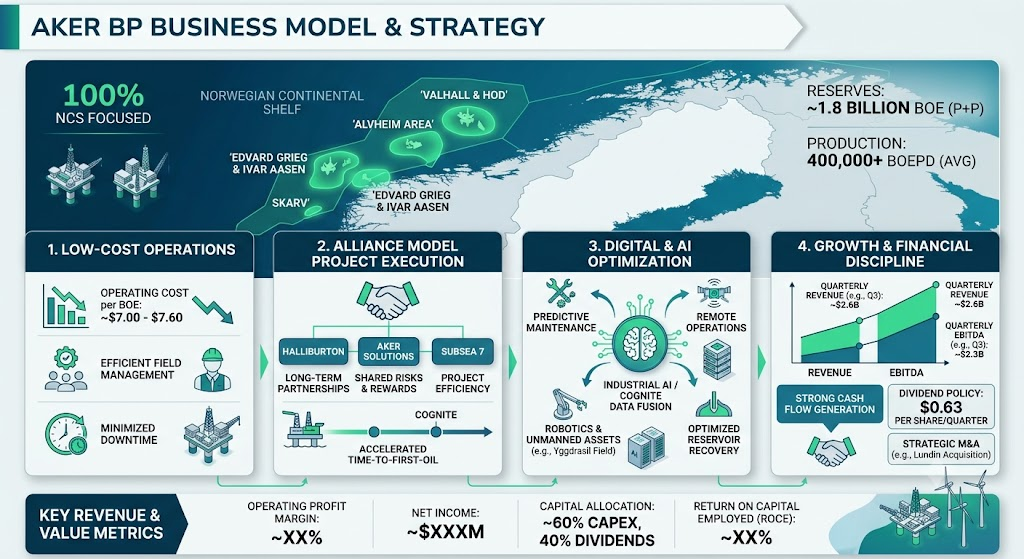
Aker BP operates a pure-play upstream E&P business model focused on extracting and monetizing crude oil and natural gas exclusively on the Norwegian Continental Shelf.
Revenue Generation Mechanics
- Hydrocarbon Sales: The core revenue engine relies on the sale of crude oil and natural gas liquids (NGLs) exported to European energy markets via subsea pipelines and shuttle tankers, along with natural gas delivered directly to Northern Europe.
- Asset Portfolio & Scale: Net daily production averages around 390,000 to 420,000 boepd. Prime revenue contributors include world-class assets such as Johan Sverdrup, Valhall, Alvheim, Skarv, and Edvard Grieg/Ivar Aasen.
- Financial Performance: Total quarterly revenue consistently averages between $2.5 billion and $2.8 billion (e.g., Q3 2025 revenue reached $2.599 billion), generating quarterly EBITDA of $2.2 billion to $2.6 billion due to operational leverage.
Cost Leadership and Value Creation Strategy
- Low Cash Operating Costs: Aker BP achieves competitive advantages by maintaining production costs at approximately $7.00 to $7.60 per boe, significantly below the global offshore average.
- High Efficiency Alliance Model: Rather than traditional transactional contractor bidding, Aker BP utilizes long-term alliance contracts with engineering firms (such as Aker Solutions, Subsea 7, and Halliburton). This framework aligns financial incentives, reduces project execution delays, and controls capital expenditures.
- Capital Allocation: Free cash flow is split between funding extensive organic capital expenditures (~$1.7–$1.8 billion per quarter during peak field buildouts) and maintaining cash distributions to shareholders through quarterly cash dividends (e.g., $0.63 per share per quarter).
Information Sources
- https://akerbp.com/en/
- https://www.otcmarkets.com/file/company/financial-report/501021/content
- https://www.akersolutions.com/news/news-archive/2025/aker-solutions-asafourth-quarter-and-full-year-2024-results/
- https://www.cognite.com/en/customers/aker-bp
AI Strategy, Budget, and Key Partnerships
Aker BP actively pursues a strategy to become an “AI-first” E&P operator, using digital twins, machine learning algorithms, and autonomous robotics to cut operational costs, improve safety, and minimize emissions per barrel.
Core Strategic Focus Areas
- AI-First Autonomous Assets: Through projects like the Yggdrasil field development, Aker BP is implementing AI-driven control setups aimed at running offshore platforms periodically or entirely unmanned. Centralized operations in Stavanger act as a remote control tower utilizing automated predictive maintenance and real-time process control.
- Subsurface and Production Optimization: AI algorithms analyze real-time flowmeter readings, geological models, and sensor data to optimize well trajectories, dynamic reservoir management, and automated cementing operations (e.g., executing over 400 automated cementing tasks with Halliburton).
- Robotics and Computer Vision: Deployment of autonomous drones and ground robotics conducting visual inspections and sensor readings across facilities, cutting visual inspection task times by up to 50%.
Budget Allocation and Economic Impact
While Aker BP folds software development into its broader multi-billion dollar digital infrastructure and field development budgets (such as the multi-billion Yggdrasil capital project), its enterprise AI architectures generate verified economic returns:
- Unplanned downtime reductions yield an estimated $14.5 million in savings annually across key assets.
- Direct production optimization adds over $10.7 million in profit annually.
- Onsite offshore labor efficiency increases save an estimated $10.5 million annually by cutting unnecessary helicopter transfers and manual equipment site visits.
Strategic Technology Partnerships
- Cognite: Provides the primary data backbone (Cognite Data Fusion). It ingests multi-source industrial sensor data into contextualized digital twins that feed Aker BP’s operational AI models.
- SLB (Schlumberger): Provides production optimization algorithms and multiphase flow network insights for subsea environments.
- Halliburton: Collaborates on subterranean digital tools and automated offshore drilling processes.
- Aucotec & Aize: Integrates life-cycle engineering software directly into the real-time operational digital twin for unified operational data flow.
Back to Aker