Market Position and Market Share
ArcelorMittal is the second-largest steelmaker in the world by crude steel production, second only to China’s China Baowu Steel Group.
- Global Ranking:#2 largest steelmaker globally.
- Global Market Share:Holds approximately 2.5% to 3% of total global crude steel production (producing 55.6 million metric tons against global output of ~1.88 billion tons).
- Key Segment Market Share:Holds a dominant ~16% global market share in automotive steel production.
- Regional Ranking:Largest steel producer in Europe, North America, South America, and Africa.
Upstream and Downstream Supply Chain Analysis
Upstream Supply Chain (Raw Materials & Inputs)
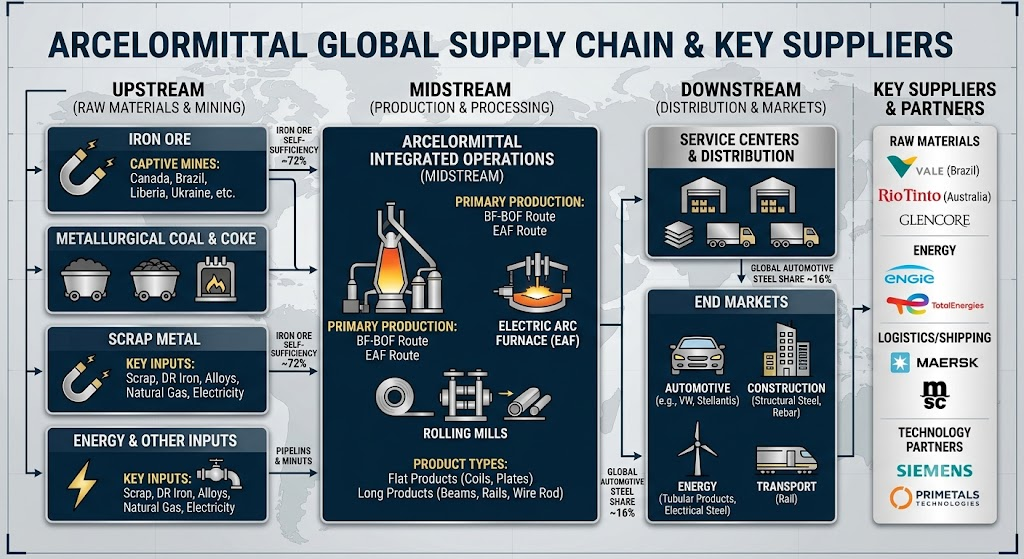
- Iron Ore & Metallurgical Coal:Highly vertically integrated.ArcelorMittal owns captive iron ore mines in Canada, Brazil, Liberia, Mexico, Ukraine, and South Africa, fulfilling around 72% of its internal iron ore needs.
- Coke & Energy:Fulfills approximately 91% of its coke requirements through internal production. Uses natural gas and green hydrogen for direct reduced iron(DRI) operations as part of its decarbonization strategy.
- Scrap Metal:Meets ~55% of its scrap and direct reduced iron(DRI) needs internally to power Electric Arc Furnaces(EAF).
- Key Suppliers: Major third-party raw material suppliers include Vale(Brazil) and Rio Tinto for supplementary high-grade iron ore and pellets.
Downstream Supply Chain (Processing & End Markets)
- Internal Processing & Service Centers:Operates ArcelorMittal Downstream Solutions(AMDS) and Distribution Europe, comprising over 300 commercial and production sites in 60+ countries to supply custom cut, treated, and finished steel solutions.
- Automotive Sector:Directly supplies Original Equipment Manufacturers(OEMs) such as Volkswagen Group, Stellantis, Ford, and BMW with Advanced High-Strength Steels(AHSS), electrical steel for EVs, and proprietary low-carbon steel under the XCarb brand.
- Construction & Infrastructure: Supplies structural beams, rebars, and heavy plates to global engineering contractors.
- Energy & Transport:Manufactures specialized rail tracks, heavy tubular products, and electrical steels for power grids and transport networks.
Competitor Analysis: Technical and Financial Comparison
Key Competitors: China Baowu Steel Group(China), Nippon Steel Corporation(Japan), HBIS Group(China), POSCO(South Korea), and Nucor Corporation(USA).
Technical Comparison
- Decarbonization & Product Innovation: ArcelorMittal leads in low-carbon steel innovation through its XCarb brand, EAF conversions, and DRI-hydrogen projects in Europe. It holds technical advantages in automotive AHSS and electrical steels over regional competitors.
- Operational Efficiency: Nucor and POSCO maintain higher average asset utilization efficiency due to heavy reliance on mini-mills(EAF). ArcelorMittal maintains a hybrid model of integrated blast furnaces(BF-BOF) and mini-mills across mature and emerging markets.
- Geographic Diversification:Unlike Baowu and HBIS, which are heavily concentrated in China, ArcelorMittal maintains global production footprints across Europe, the Americas, Africa, and Asia(AM/NS India JV).
Financial Comparison
- Revenue Scale:Generates over $60 billion annually, comparable to POSCO and Nippon Steel, but behind China Baowu.
- Margin & Profitability: Margins are subject to European energy price fluctuations and raw material price volatility. Pure EAF players like Nucor typically achieve higher operating margins during industrial slowdowns due to lower fixed operational costs.
- Vertical Integration Advantage:Self-sufficiency in iron ore(72%) and coke(91%) acts as a strong financial hedge against raw material price spikes compared to Nippon Steel or POSCO.
Sources
- https://corporate.arcelormittal.com
- https://europe.arcelormittal.com/aboutarcelormittaleurope/who/europewhoweare
- https://en.wikipedia.org/wiki/ArcelorMittal
Back to ArcelorMittal