
Company History
Early Predecessors and Global Expansion (1989–2005)
The company’s origins stem from Ispat International, founded by Lakshmi Mittal in 1989. Through an aggressive series of acquisitions during the 1990s and early 2000s, Ispat purchased distressed state-owned steel assets across Europe, the Americas, and Asia. Key acquisitions included Inland Steel in the United States, International Steel Group (ISG)—which housed historical brands like Bethlehem Steel—and Kryvyi Rih in Ukraine, rapidly consolidating the fragmented steel sector under Mittal Steel.
The Mega-Merger (2006–2007)
In 2006, Mittal Steel launched a $33 billion hostile takeover bid for European steel giant Arcelor (itself created via a 2001 merger of Aceralia, Usinor, and ARBED). After intense shareholder negotiations, the deal concluded in 2007 to form ArcelorMittal. The transaction created an unprecedented industry leader controlling approximately 10% of global steel production at the time.
Restructuring and Strategic Realignment (2008–2019)
Following the 2008 global financial crisis, ArcelorMittal faced severe demand contraction, prompting a decade-long focus on debt reduction, footprint optimization, and asset rationalization. During this era, the company selectively divested non-core assets while shifting focus toward higher-margin products and emerging markets, culminating in the major joint venture acquisition of Essar Steel in India (AM/NS India) alongside Nippon Steel.
Decarbonization and Digital Era (2020–Present)
Recent years have seen the company focus on capital efficiency, selling its US legacy assets to Cleveland-Cliffs while expanding in low-carbon steel initiatives. The company launched its XCarb® green steel brand and invested heavily in direct reduced iron (DRI) and electric arc furnace (EAF) infrastructure to meet stringent carbon reduction targets in Europe and globally.
Business Model and Growth Strategy
Revenue Streams and Profit Mechanics
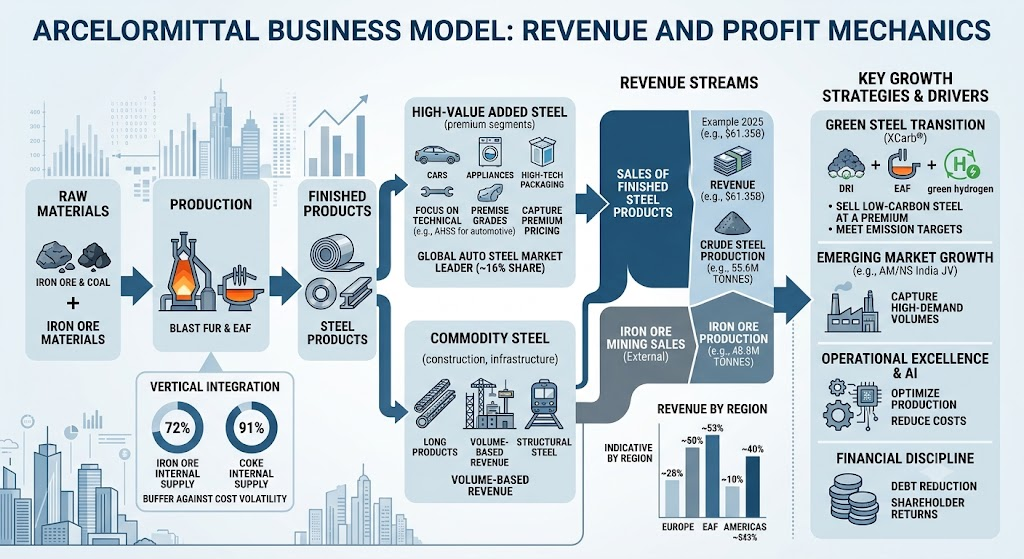
ArcelorMittal generates revenue primarily by converting raw materials into flat steel (used in automotive, appliances, and packaging) and long steel (used in construction, rails, and structural engineering), supplemented by direct iron ore mining sales. In 2025, the company generated $61.35 billion in revenue and produced 55.6 million metric tonnes of crude steel alongside 48.8 million tonnes of iron ore.
- Vertical Integration Margin Capture: Rather than relying entirely on third-party raw material markets, ArcelorMittal operates a vertically integrated model, producing roughly 72% of its iron ore requirements and 91% of its coke requirements internally. This buffers unit margins against wild swings in merchant raw material pricing.
- Value-Added Product Premium: The company captures higher average selling prices (ASP) by focusing on technical steel grades. For example, it commands a ~16% global market share in automotive steel, where advanced high-strength steels (AHSS) yield significantly higher margins than standard commodity rebars.
- Regional Arbitrage and Asset Allocation: Operations are split primarily across Europe (53% of crude steel production) and the Americas (40%), enabling the company to allocate capital to regions with higher spread margins while leveraging local scrap and direct reduced iron (DRI) resources.
Development Strategies
- Decarbonization Leadership (XCarb®): Transitioning legacy blast furnaces (BF-BOF) to Electric Arc Furnaces (EAF) paired with DRI facilities fueled by green hydrogen and natural gas. This allows the firm to preserve market share in regulated regions (like Europe under CBAM) and sell low-carbon steel at a premium.
- Expansion in High-Growth Emerging Markets: Growing throughput via joint ventures in high-demand regions, particularly India (AM/NS India), where infrastructure expansion supports long-term volume growth.
- Cost Discipline and Capital Return: Operating an agile capacity model (closing high-cost mills during downturns) to protect free cash flow, allowing ongoing share buybacks and dividend payouts to shareholders.
Sources for Business Model Information
- https://en.wikipedia.org/wiki/ArcelorMittal
- https://europe.arcelormittal.com/aboutarcelormittaleurope/who/europewhoweare
- https://www.ad-hoc-news.de/boerse/news/corporate-news/arcelormittal-stock-climbs-on-south-africa-deal-talks/70016951
AI Strategy, Budget, and Key Partnerships
Strategic Focus
ArcelorMittal’s AI transformation centers on shifting from isolated, enterprise-level digital applications directly into plant-floor operational technology (OT). The strategy prioritizes deploying real-time process optimization, computer-vision quality control, predictive maintenance, and digital twins across its production facilities in 14 countries.
- Plant-Floor Intelligence: Integrating industrial IoT and sensor data on the factory floor to optimize blast furnace temperatures and oxygen levels, yielding up to a 5% reduction in energy consumption in target facilities.
- Predictive Maintenance & Yield Optimization: AI-driven scheduling tools and predictive analytics deployed at major steel mills have driven net production output gains of ~1% (adding over 1,000 tons of output) while reducing unexpected equipment downtime.
Budget and Resource Allocation Model
While ArcelorMittal does not publish a standalone dollar line-item for “AI budget” in its financial filings, its digital implementation model operates under a strict budget-neutral / self-funding framework. Legacy IT costs are systematically reduced through cloud migration and legacy system rationalization, and the savings are directly reinvested into operational AI and plant digitalization projects.
Key Partners and Concrete Implementations
- Microsoft: Expanded a major partnership establishing Microsoft Azure as the primary cloud backbone under a “Cloud First, Data Centric” model. ArcelorMittal uses Microsoft Fabric, Purview, and Foundry to consolidate plant data, modernize legacy IT systems, and deploy enterprise AI solutions at scale.
- Amazon Web Services (AWS): Formed a multi-faceted industrial automation partnership to deploy cloud and AI directly to the edge of manufacturing operations. The partnership covers predictive maintenance, AI computer-vision inspection, and workforce digital upskilling programs. Additionally, Amazon signed a commercial agreement to buy low-carbon XCarb® steel from ArcelorMittal for its data center construction.
- Infosys: Long-term strategic IT transformation partner tasked with streamlining supply chain, sales, and order management functions through intelligent automation, extracting contract data, and optimizing production scheduling.
Back to ArcelorMittal