
Market Position and Market Share
Ferrari operates at the pinnacle of the global luxury automotive sector, commanding a unique structural position as both an ultra-luxury performance car manufacturer and a high-tier lifestyle investment brand. Within its self-defined addressable segment—high-performance sports cars priced above €200,000 generating over 500 hp—Ferrari holds a dominant global market share of approximately 24%.
In the broader global supercar market, Ferrari accounts for roughly 17% of total global production.Unlike mass-market premium OEMs, Ferrari intentionally restricts volume to maintain scarcity, selling 13,640 units globally while generating net revenues of over €7.1 billion.
- Global Rank: #1 in Ultra-Luxury Performance Cars by operating profitability and brand valuation.
- Luxury Performance Car Market Share: ~24%.
- Global Supercar Production Share:~17%.
- Geographic Volume Distribution:Americas (28.9%), EMEA (46.5%), Rest of APAC (17.7%), Mainland China/HK/Taiwan (6.9%).
Supply Chain Analysis and Key Suppliers
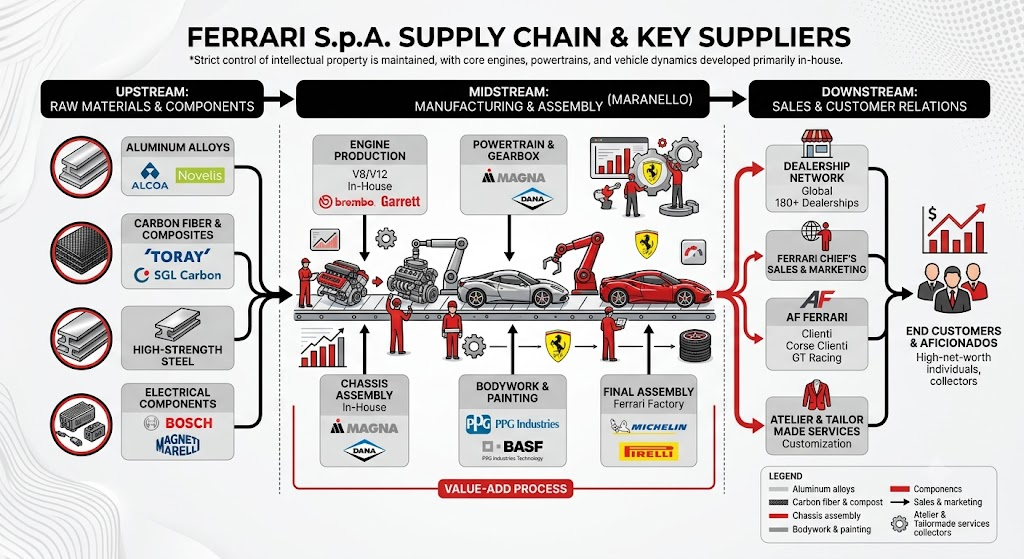
Ferrari’s supply chain relies on a tightly integrated, highly specialized tier-1 ecosystem combined with full in-house mastery of core IP, specifically engine design, powertrain integration, and chassis engineering.
Upstream Raw Materials & Components
- Carbon Fiber & Composite Structure: Advanced structural carbon fiber monocoques and body panels are co-developed with high-end composite specialists to maintain high torsional rigidity and lightweight vehicle dynamics.
- Metals & Alloys: Specialized aluminum alloys and high-strength steels are sourced for spaceframe architectures, engine blocks, and cylinder heads, subject to strict metallurgical tolerances.
Midstream Systems & Assembly
- Engine & Powertrain: Internal combustion V8/V12 engines and internal hybrid systems are cast, machined, and hand-assembled in-house at Maranello, ensuring complete control over engine acoustic and mechanical characteristics.
- Electronics & Hybrids: High-voltage batteries, inverter architectures, and hybrid propulsion management systems are developed through strategic co-engineering partnerships with leading automotive technology providers.
Downstream Logistics & Customization
- Vehicles are strictly built-to-order. Finished units flow through a highly exclusive network of franchised dealerships operating in over 60 markets, with heavy value-add via Maranello’s Atelier and Tailor Made customization facilities.
Key Suppliers
- Brembo: High-performance carbon-ceramic braking systems and specialized calipers.
- Magneti Marelli: Ignition components, electronic control units (ECU), and lighting systems.
- Shell: Strategic fuel and lubricant partner for technical R&D across Formula 1 and road production models.
- Michelin & Pirelli: Custom-compound high-performance tires engineered specifically for individual Ferrari chassis setups.
- Koni: Specialized damper and suspension components.
- Sachs / BorgWarner: Transmission clutches, turbocharging units, and hybrid powertrain components.
Competitor Analysis: Technical and Financial Comparison
Ferrari’s main competitors include Porsche, Automobili Lamborghini (Volkswagen Group), Aston Martin, and McLaren Automotive.
Technical Comparison
- Architecture & Powertrain:Ferrari leads in hybrid-ICE integration (e.g., V6/V8 twin-turbo PHEVs in the 296 and SF90 lines, and atmospheric V12s), transitioning toward high-voltage performance electrification. Lamborghini relies on VW Group shared platforms (MLB Evo for Urus) alongside bespoke hybrid architectures (Revuelto V12 PHEV, Temerario V8 PHEV). Porsche leverages high-volume scalable platforms (MSB, PPE) suitable for both GT sports cars and mass luxury SUVs/saloons. McLaren excels in ultralight carbon monocoque architecture (MCLA) but lags in software and hybrid system reliability.
- Software & Aerodynamics: Ferrari utilizes proprietary vehicle dynamics control systems (Side Slip Control – SSC) and F1-derived active aerodynamics, positioning its tech stack at the leading edge of dynamic track performance.
Financial Comparison
- Profitability & Margins: Ferrari operates more like a luxury house (Hermès) than an automotive OEM. It maintains an EBIT/operating margin of 28% to 29.5% and generates over $130,000 to $180,000 in net profit per vehicle. In contrast, Porsche’s operating margins face volatility due to EV transition costs and R&D impairments, while Lamborghini achieves solid operating margins (~20-25%) but lower net revenue per car (€301,000 vs. Ferrari’s €498,000 per unit). Aston Martin and McLaren remain financially constrained by debt loads and smaller capital budgets.
- Pricing Power & Order Backlog:Ferrari holds an order book extending 18-24 months out with zero inventory risk due to 100% build-to-order manufacturing and extensive customization add-ons (Personalization). Competitors frequently face dealership inventory pressure or promotional discounting.
Information Sources
- https://www.best-selling-cars.com/brands/2025-full-year-global-ferrari-worldwide-car-sales-by-market-and-model/
- https://www.mordorintelligence.com/industry-reports/supercars-market
- https://www.ferrari.com/en-EN/formula1/partners/brembo
- https://www.slashgear.com/2004309/most-profitable-luxury-car-brand/
- https://www.digitaljournal.com/article/productivity-and-efficiency-lamborghini-trumps-ferrari/
- https://www.hdinresearch.com/news/1041
Back to Ferrari