
Company History
Foundation and Early Motorsport Era (1929–1946)
Enzo Ferrari founded Scuderia Ferrari in 1929 in Modena as a race team operating primarily for Alfa Romeo. Following disputes and wartime production shifts during World War II, the company relocated its factory to Maranello in 1943. In 1947, Ferrari produced its first official road-and-race car, the 125 S, establishing its founding identity as a racing outfit that built road vehicles primarily to fund its motorsport ambitions.
The Fiat Era and Corporate Stabilization (1969–2014)
Facing severe financial strain from costly racing programs and expanding operational scale, Ferrari sold a 50% stake to Fiat in 1969, which later increased to 90% after Enzo Ferrari’s death in 1988. Fiat’s backing provided essential financial stability, enabling Ferrari to modernize production facilities, expand its global dealer network, and sustain dominance in Formula 1 during the late 1990s and 2000s.
Public Listing and Modern Expansion (2015–Present)
In 2015, Fiat Chrysler Automobiles (FCA) spun off Ferrari, listing it on the New York Stock Exchange and Borsa Italiana under the ticker RACE. As an independent entity, Ferrari accelerated its strategy of product diversification, introduced hybrid and luxury SUV models (such as the Purosangue), and scaled ultra-exclusive, limited-series vehicles to drive margin expansion.
Business Model and Strategy
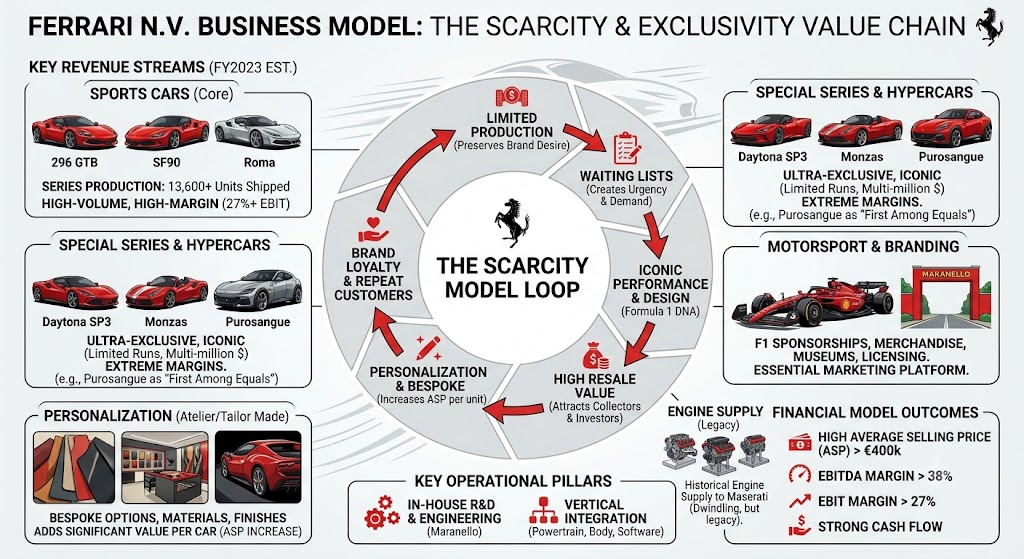
Ferrari operates on a high-margin, low-volume “scarcity model” designed to ensure that market demand systematically exceeds vehicle supply. Rather than competing on mass volume, Ferrari maximizes revenues through three distinct monetization engines:
- Product Range and Customization: Revenue is driven by core sports cars, limited-edition hypercars, and special series. Crucially, Ferrari extracts high margins via its “Personalization” programs, where clients spend heavily on custom finishes and materials, increasing average selling prices (ASPs) well beyond base figures.
- Motorsport and Sponsorship: Operating its Formula 1 team serves as the ultimate marketing platform, generating direct revenue via commercial sponsorships, official merchandise licensing, and driver agreements.
- Engine Supply and Brand Licensing: Ferrari monetizes its brand equity through lifestyle stores, theme parks, luxury goods licensing, and historical engine supply agreements.
In terms of financial performance, Ferrari reported total net revenues of €5.97 billion in FY2023, up 17.2% year-over-year, alongside an EBIT margin exceeding 27%. Net revenues grew further to approximately €6.67 billion in FY2024, underpinned by total shipments of roughly 13,600 units. The average selling price per vehicle routinely exceeds €400,000 when factoring in bespoke options, driving an EBITDA margin above 38%. Ferrari targets sustained 4–5% annual volume growth alongside aggressive price-mix optimization to maintain industry-leading returns.
- https://www.ferrari.com/en-EN/corporate/financial-data
- https://seat11a.com/blog-ferraris-unique-business-model-and-financial-performance/
AI Strategy, Budget, and Key Partnerships
Ferrari integrates Artificial Intelligence primarily as a performance-enhancement tool across design, precision manufacturing, and customer customization rather than positioning itself as an autonomous mobility company.
- Design and Aerodynamics: At the Ferrari Design Center, generative AI models simulate dynamic airflow and structural variants in parallel. By training machine learning models on vast aerodynamic datasets, engineering teams have reduced initial physical prototyping requirements and improved early design simulation efficiency by up to 60%.
- Manufacturing and Quality Control: In the Maranello factory, high-resolution computer vision systems perform real-time automated visual inspection on sub-assemblies and paint finishes to identify micro-defects instantly.
- Commercial and Personalization Systems: Ferrari utilizes AI-driven configurator platforms powered by machine learning to analyze client preferences and generate real-time 3D renderings of millions of custom interior and exterior combinations, boosting configuration speed by 20%.
- R&D Allocations and Partnerships: Ferrari allocates over €800 million annually to research and development, with a growing share directed toward software integration, battery analytics, and predictive AI systems. To support this digital transformation, Ferrari maintains strategic technology partnerships with technology leaders including Amazon Web Services (AWS) for cloud data analytics and telemetry processing, and Samsung Display for advanced digital cockpit interfaces.
Back to Ferrari