Company History
Foundation and Domestic Consolidation (1975–1987)
The company was formed in 1975 through the merger of two leading French anise-based spirits producers: Pernod (founded in 1805) and Ricard (founded in 1932). The initial focus was consolidating its dominance in the French aperitif market while laying the groundwork for international distribution.
European and Regional Expansion (1988–2000)
Pernod Ricard began aggressively acquiring international spirits makers to diversify away from its core French market. Key milestones included the 1988 acquisition of Irish Distillers (owner of Jameson) and the 1993 creation of a joint venture with Cuba Ron to globally market Havana Club rum.
Transformational Global M&A (2001–2014)
The group scaled into a global titan through three transformational deals: acquiring parts of Seagram in 2001 (adding Chivas Regal, Glenlivet, and Martell); acquiring Allied Domecq in 2005 (adding Beefeater, Ballantine’s, Kahlúa, and Mumm); and acquiring Vin & Sprit in 2008 (bringing Absolut Vodka into the portfolio). These moves established Pernod Ricard as the world’s second-largest spirits entity.
Premiumization and Portfolio Refinement (2015–Present)
Under the leadership of Chairman and CEO Alexandre Ricard (appointed in 2015), the company shifted focus toward “prestige and super-premium” assets. Recent moves include acquisitions of craft brands like Monkey 47 gin, Del Maguey mezcal, and Skrewball whiskey, alongside opening localized distilleries in key growth regions such as China (The Chuan).
Business Model and Growth Strategy
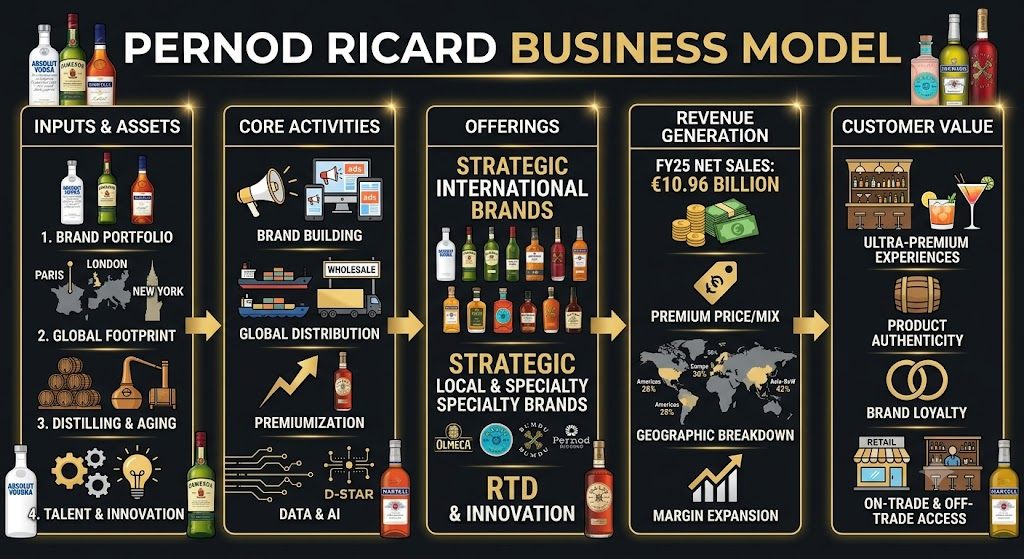
Pernod Ricard operates on a brand-owner and global distributor business model, generating revenue primarily through the manufacture, brand-building, and international wholesale distribution of premium spirits and wines. In FY25, the group reported total net sales of €10.96 billion.
The core of its monetization strategy relies on three main revenue pillars:
- Strategic International Brands: High-margin flagship brands (e.g., Jameson, Martell, Absolut, Chivas) driving the bulk of sales volume and pricing power globally.
- Strategic Local & Specialty Brands: Regionally focused brands (e.g., Seagram’s Imperial Blue in India, Olmeca in Mexico) and high-growth niche products (e.g., Malfy, Bumbu) designed to capture local market share and expanding middle-class consumption.
- Ready-to-Drink (RTD) & Category Expansion: Expanding into low-ABV and pre-mixed formats (such as the Absolut & Sprite collaboration) to capture casual drinking occasions.
Geographic Revenue Breakdown (FY25):
- Europe: Contributes ~€8.71 billion (with resilient performance in Western Europe and expansion in Eastern markets).
- Americas: Experienced a 3% organic decline, impacted by inventory adjustments and softer consumer demand in the US.
- Asia-Rest of World: Experienced a mixed dynamic—strong growth in India (+6% organic sales) offset by a steep 21% decline in China due to macroeconomic headwinds and distributor destocking.
Operational Margin & Cost Efficiency:
Pernod Ricard relies heavily on price/mix premiumization (encouraging consumers to trade up to more expensive bottles) to expand profit margins. The company achieved an organic operating margin expansion of +64 basis points in FY25, supported by a €900 million efficiency program completed between FY23 and FY25. Free Cash Flow reached €1.1 billion (+18%), driven by tighter working capital management.
Business Model Sources
- https://www.pernod-ricard.com/en/media/fy25-full-year-sales-and-results
- https://simplywall.st/stocks/fr/food-beverage-tobacco/epa-ri/pernod-ricard-shares/news/pernod-ricard-full-year-2025-earnings-in-line-with-expectati
AI Development Strategy, Budget, and Partnerships
Pernod Ricard treats Data and AI as core operational drivers rather than peripheral IT projects. The company operates a dedicated internal division of roughly 200 data and AI experts to build, deploy, and manage proprietary Key Digital Programs (KDPs) across its global footprint.
Key AI Implementation Programs:
- D-STAR (Sales Execution): An AI algorithm that analyzes millions of retail data points to provide sales teams with a prioritized weekly list of high-potential customer outlets and specific sales actions. In field A/B tests in France, stores where sales reps followed AI-driven recommendations demonstrated higher net market share and sales growth compared to control groups.
- Matrix (Marketing Spend Optimization): An AI tool designed to predict investment returns across various media channels. Matrix enabled the group to improve overall marketing effectiveness by 7% in FY24, allowing teams to trim ineffective spend while reallocating budget toward high-yield channels.
- Vista Rev-Up (Pricing & Promotion): Evaluates promotion scenarios to identify the ideal promotional frequency and pricing levels for every brand in local markets.
- Maestria (Consumer Granularity): Utilizes demographic and behavioral datasets to map consumer preferences at a granular level, helping allocate portfolio marketing resources.
Enterprise Adoption and Organizational Strategy:
Rather than limiting AI to tech teams, Pernod Ricard focuses on company-wide AI literacy. For instance, its Latin American operations partnered with consultancy PALO IT to run dynamic workshops, training over 266 non-technical employees, generating 600+ custom operational prompts, and establishing 240+ department-level AI implementation opportunities. To remove adoption friction, the group restructured KPIs: sales reps who followed AI recommendations were protected from penalties if targets were missed, whereas those who ignored AI insights faced closer performance scrutiny.
As a result of these initiatives, Pernod Ricard was ranked 1st in the beverage industry and 4th overall among global consumer goods companies in the 2024 Data & AI Human Capital Report by AlixPartners and Darwin X.
back to Pernod Ricard