Eni S.p.A.(Eni)is an Italian multinational energy company headquartered in Rome.The following provides an overview based on its recent financial and operational updates.
Q2 2026 Financial Highlights
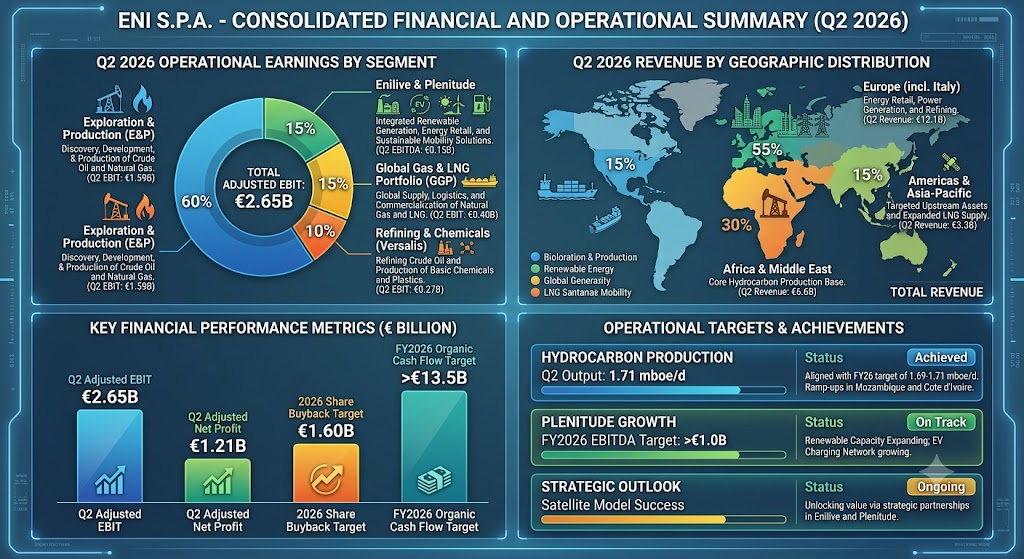
Eni reported strong operational and financial performance for Q2 2026,driven by solid production growth in its upstream segment and resilient performance across its transitional energy businesses.The company achieved an adjusted net profit of €1.21 billion for the quarter,supported by strong organic cash flow generation from operations.Capex remained disciplined,focusing on core upstream project startups and the expansion of renewable energy capacity under Plenitude.
Revenue Breakdown by Segment and Region
Eni classifies its core operations into several key business segments and geographic markets.
Exploration & Production(E&P)
- Revenue/Contribution: Accounted for approximately 60% of total group operational earnings.
- Business Overview: Responsible for the discovery,development,and production of crude oil and natural gas worldwide,with key operational hubs in North Africa,Sub-Saharan Africa,and the Middle East.
Enilive & Plenitude
- Revenue/Contribution: Accounted for approximately 15% of total segment earnings.
- Business Overview: Plenitude integrates renewable power generation,retail energy supply,and EV charging infrastructure.Enilive focuses on sustainable mobility solutions,including biorefining and bio-based fuel distribution.
Global Gas & LNG Portfolio(GGP)
- Revenue/Contribution: Accounted for approximately 15% of total segment earnings.
- Business Overview: Manages the supply,logistics,and commercialization of natural gas and liquefied natural gas(LNG)globally.
Refining & Chemicals(Versalis)
- Revenue/Contribution: Accounted for approximately 10% of total segment earnings.
- Business Overview: Refines crude oil into petroleum products and produces basic chemicals,plastics,and elastomers.
Geographic Distribution
- Europe(including Italy): Generates around 55% of total revenues,driven by natural gas distribution,refining,and energy retail customers.
- Africa & Middle East: Accounts for roughly 30% of revenue contribution,representing the major source of upstream hydrocarbon production.
- Americas & Asia-Pacific: Represents the remaining 15%,focused on targeted upstream assets and expanding LNG supply contracts.
Key Operational Changes and Future Outlook
Quarterly Operational Changes
Hydrocarbon production reached 1.71 million barrels of oil equivalent per day(boe/d)in Q2 2026,a YoY increase of 4.5%,propelled by the ramp-up of key projects in Mozambique,Cote d’Ivoire,and the North Sea.Adjusted EBIT stood at €2.65 billion,reflecting steady operational execution despite moderate softening in global Brent crude price benchmarks during the period.
Near-Term Catalyst Watch
For the upcoming quarter,key monitoring points include:
- Ramp-up velocity of new upstream project starts to maintain the 2026 production target range of 1.69–1.71 million boe/d.
- EBITDA contribution from Plenitude,which is on track to reach its full-year EBITDA target exceeding €1.0 billion.
- Cash flow allocation progress regarding the announced €1.6 billion share buyback program.
Future Strategic Outlook
Eni projects full-year 2026 organic cash flow before working capital to exceed €13.5 billion at an assumed Brent crude average of $80/bbl.The company continues to advance its “satellite model,”designed to unlock equity value by bringing strategic third-party investors into business units such as Enilive and Plenitude.
Stock Price Performance(Past 3 Months)
Over the past three months,Eni’s share price on the Borsa Italiana(BIT: ENI)traded within a steady range between €13.80 and €14.90 per share,reflecting a modest overall gain of approximately 3.2%.
- Market Drivers: The stock experienced upward momentum following the Q2 earnings release due to a higher-than-expected cash flow generation and the confirmation of the share buyback program expansion.
- Macro Environment: Gains were partially offset by broader energy sector headwinds,including fluctuating global oil prices and lingering margin pressure in European chemical and refining divisions.
Sources