
Market Position & Market Share
Eni S.p.A. is an integrated global energy company headquartered in Rome, Italy, operating across the entire energy value chain, including exploration and production(E&P), refining, chemicals, power generation, and renewable energy. It is recognized as one of the world’s major oil “supermajors.”
- Global Hydrocarbon Production: Eni produces approximately 1.7 million to 1.8 million barrels of oil equivalent per day(boe/d), positioning it among the top integrated international oil companies(IOCs) globally.
- Global Ranking: By market capitalization and total revenue, Eni generally ranks between 7th and 9th among publicly traded global oil and gas majors, competing closely with peers such as BP, TotalEnergies, Shell, ExxonMobil, and Chevron.
- Italian Market Dominance: In its domestic market of Italy, Eni holds the dominant position in gas distribution and retail fuel markets, maintaining a retail motor fuel market share of approximately 20% to 22%.
- Liquefied Natural Gas(LNG): Eni maintains a strong global footprint in LNG portfolio management, aiming to reach contracted LNG volumes exceeding 18 million tonnes per annum(MTPA).
Supply Chain & Key Suppliers
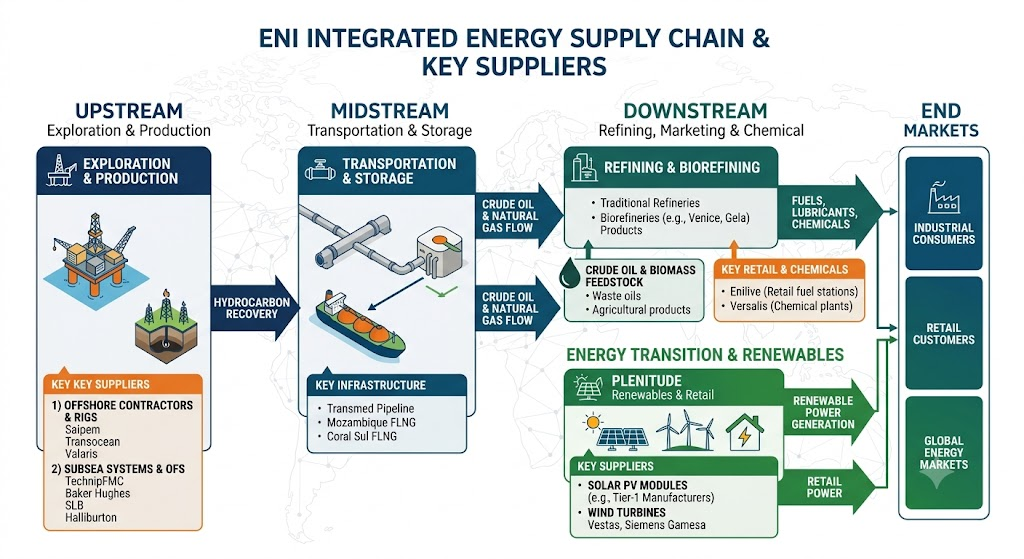
Eni operates a highly complex upstream, midstream, and downstream supply chain that relies on specialized global equipment vendors, engineering contractors, and logistical service providers.
- Upstream Operations(Exploration & Production):
- Offshore Equipment & Rig Contractors: Eni relies heavily on deepwater drilling operators such as Saipem(in which Eni holds a significant equity stake), Transocean, and Valaris for mobile offshore drilling units(MODUs).
- Subsea Production Systems(SPS) & Umbilicals: Subsea hardware and processing infrastructure are primarily sourced from TechnipFMC, Baker Hughes, and SLB(Schlumberger).
- Oilfield Services(OFS): Key service providers for well logging, reservoir evaluation, and completion include SLB, Halliburton, and Baker Hughes.
- Midstream Operations(Transportation & Infrastructure):
- Pipeline Infrastructure: Eni utilizes international pipeline networks through joint ventures, including the Trans-Mediterranean Pipeline(Transmed) connecting Algeria to Italy via Tunisia.
- Floating Production Storage and Offloading(FPSO): For major offshore developments(such as in West Africa and East Africa), Eni engages FPSO charterers and engineering firms such as MODEC, Yinson Holdings, and Saipem.
- Downstream & Energy Transition Supply Chain:
- Refining & Biorefining: Eni has converted traditional oil refineries into biorefineries(e.g., Venice and Gela). Key feedstock suppliers for biorefining include agricultural and waste oil suppliers for Hydrotreated Vegetable Oil(HVO) processing.
- Renewables & Plenitude: For its retail and renewable energy subsidiary(Plenitude), Eni procures solar PV modules and wind turbines from major global OEMs such as Vestas, Siemens Gamesa, and Tier-1 Asian solar manufacturers.
Competitor Analysis
Eni’s principal competitors are the international oil majors: Shell, TotalEnergies, BP, ExxonMobil, and Chevron. European peers(TotalEnergies and BP) represent the most direct operational and strategic benchmarks.
- Technological Capability Comparison:
- Exploration Efficiency: Eni is widely regarded as an industry leader in conventional fast-track exploration. Its proprietary supercomputing capabilities(utilizing the HPC cluster architecture) allow for advanced seismic imaging, enabling industry-leading exploration success rates and lower discovery costs per barrel compared to peers like BP and Shell.
- Deepwater & Floating LNG(FLNG): Eni excels in modular, fast-tracked FLNG deployments(e.g., Coral Sul FLNG in Mozambique and Congo LNG), competing directly with Shell’s deepwater technological capabilities.
- Decarbonization Technology: Eni focuses heavily on proprietary HVO technology(Ecofining™) and industrial-scale Carbon Capture and Storage(CCS) hubs(e.g., Liverpool Bay CCS in the UK), whereas TotalEnergies and Shell have focused more aggressively on large-scale utility solar and wind project acquisition.
- Financial Performance Comparison:
- Cost Structure & Breakeven: Eni maintains a low upstream organic breakeven price, targeting less than $35 to $40 per barrel for new projects, which is competitive with Chevron and TotalEnergies.
- Profitability & Margins: Eni typically operates at lower operating margins and return on average capital employed(ROACE) than US majors(ExxonMobil, Chevron) due to high exposure to European downstream refining volatility and domestic retail gas regulation, though its figures closely track BP.
- Capital Allocation & Leverage: Eni utilizes a satellite model(spinning off or bringing equity partners into distinct units like Plenitude and Enilive) to fund capital expenditures while keeping net leverage generally within its targeted band of 10% to 20%, offering competitive dividend payouts and share buyback programs relative to its market valuation.
Source:
- https://www.eni.com
- https://www.eni.com/en-IT/investors.html
- https://www.saipem.com
- https://www.iea.org
Back to Eni