
Company History
Foundation and Consolidation Era(1998–2007)
UniCredit was formed in 1998 through the merger of several major Italian banking groups, including Credito Italiano and Unibanca. The group pursued rapid international expansion across Central and Eastern Europe, culminating in the major acquisitions of Germany’s HypoVereinsbank(HVB) and Austria’s Bank Austria in 2005.
Post-Crisis Restructuring(2008–2020)
The 2008 global financial crisis and subsequent European sovereign debt crisis hit UniCredit severely, leaving it with a massive pile of non-performing loans and weak capital cushions. Under leadership shifts during the mid-2010s, the bank initiated rigorous balance-sheet cleanups, divested non-core assets(such as FinecoBank and Pioneer Investments), and raised €13 billion in rights issues to restore solvency.
Transformation and Strategic Expansion(2021–Present)
Appointed in 2021, CEO Andrea Orcel launched the “UniCredit Unlocked” strategy, reshaping the institution into a capital-light, highly efficient operating model with heavy share buybacks and organic capital generation. The current era is defined by aggressive Pan-European consolidation moves, highlighted by the acquisition of significant equity stakes in Germany’s Commerzbank and regional expansion across Southeastern Europe.
Business Model and Growth Strategy
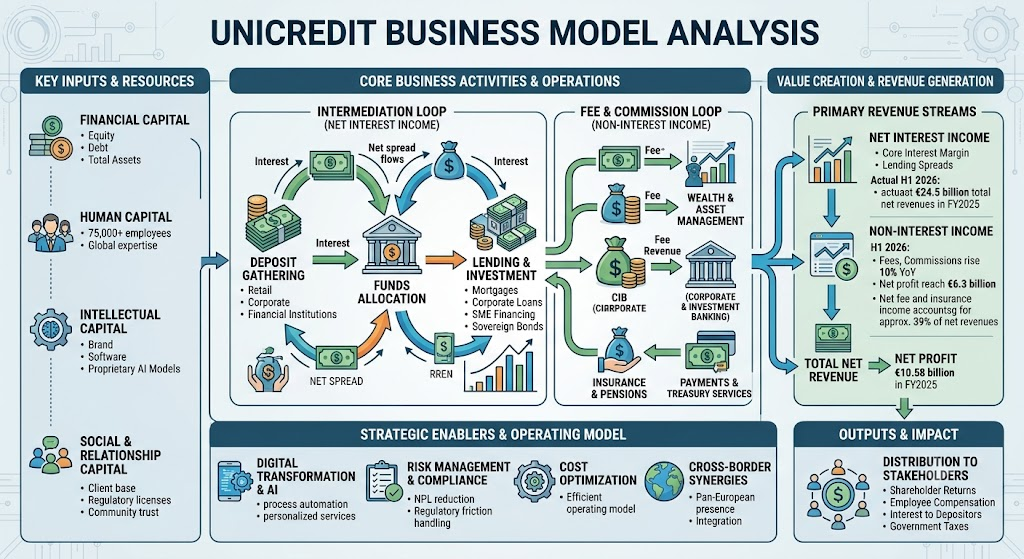
UniCredit generates revenue primarily through net interest income(NII) from commercial lending and non-interest fee income derived from wealth management, insurance, and investment banking services.
- Net Interest Income(NII): Represents the core spread between interest earned on customer loans or sovereign bonds and interest paid on retail/corporate deposits.
- Fee and Commission Income: Driven by wealth management, asset gathering, treasury services, and insurance distribution across its European footprint.
- Capital Efficiency & Operating Model: Focuses on aggressive cost-income ratio reduction and organic capital generation to support capital returns and selective M&A.
In FY2025, UniCredit generated approximately €24.5 billion in total net revenues, achieving a net profit of €10.58 billion. Revenue growth continued into 2026, with H1 2026 adjusted revenues rising 10% year-over-year and H1 net profit reaching €6.3 billion. Net fee and insurance income accounted for approximately 39% of net revenues in Q2 2026.
Sources
- https://www.freemalaysiatoday.com/category/business/2026/05/05/unicredit-posts-record-net-earnings-in-q1
- https://www.investing.com/news/transcripts/earnings-call-transcript-unicredit-posts-record-q2-2026-profit-shares-fall-47-93CH-4807947
- https://www.globalbankingandfinance.com/unicredit-posts-better-expected-results-commerzbank-bid/
AI Strategy, Budget, and Partnerships
UniCredit’s artificial intelligence framework is integrated into its broader digital transformation agenda under the “UniCredit Unlocked” technology modernization plan. Rather than isolating AI as an R&D concept, the group deploys AI to optimize core banking operations, fraud detection, and credit scoring.
- Strategic Focus & Implementation: AI models are deployed across automated credit processing, real-time transaction monitoring for anti-money laundering(AML), personalized wealth management recommendations, and customer service chatbots.
- Technology Budget: UniCredit committed over €2.8 billion toward technology and digital investments under its strategic cycle, funding cloud migration, infrastructure modernization, and advanced analytics capabilities.
- Key Partners & Ecosystem: The bank relies on strategic cloud infrastructure and software partnerships with Microsoft(Azure) and Amazon Web Services(AWS) to build scalable machine learning environments and internal generative AI tools for employees.
Back to UniCredit