
Company History
Phase I: Foundation and Pirelli Heritage (1879–2005)
The company originated in 1879 as Pirelli Cavi e Sistemi, operating as the cable manufacturing unit of the Italian tire maker Pirelli. Over more than a century, it expanded internationally, producing submarine telegraph lines, high-voltage underground cables, and pioneer fiber-optic networks.
Phase II: Spin-off and Public Listing (2005–2010)
In 2005, Goldman Sachs acquired Pirelli’s cable division, rebranding the entity as Prysmian Group. In 2007, Prysmian completed its initial public offering (IPO) on the Borsa Italiana. By 2010, Goldman Sachs fully exited its stake, turning Prysmian into a pure public company with a diversified shareholder base.
Phase III: Global Consolidation (2011–2023)
Prysmian established market dominance through large-scale M&A. In 2011, it acquired Dutch cable maker Draka for €840 million. In 2018, Prysmian executed a $3 billion acquisition of US-based General Cable, expanding its global footprint to over 50 countries and reaching revenues exceeding €10 billion.
Phase IV: Energy Transition and AI Expansion (2024–Present)
In 2024, Prysmian acquired US building wire producer Encore Wire for €3.9 billion to capture North American residential and commercial infrastructure demand. The company heavily reoriented its portfolio toward high-voltage direct current (HVDC) power transmission, renewable interconnectors, and optical infrastructure for AI data centers.
Business Model and Growth Strategy
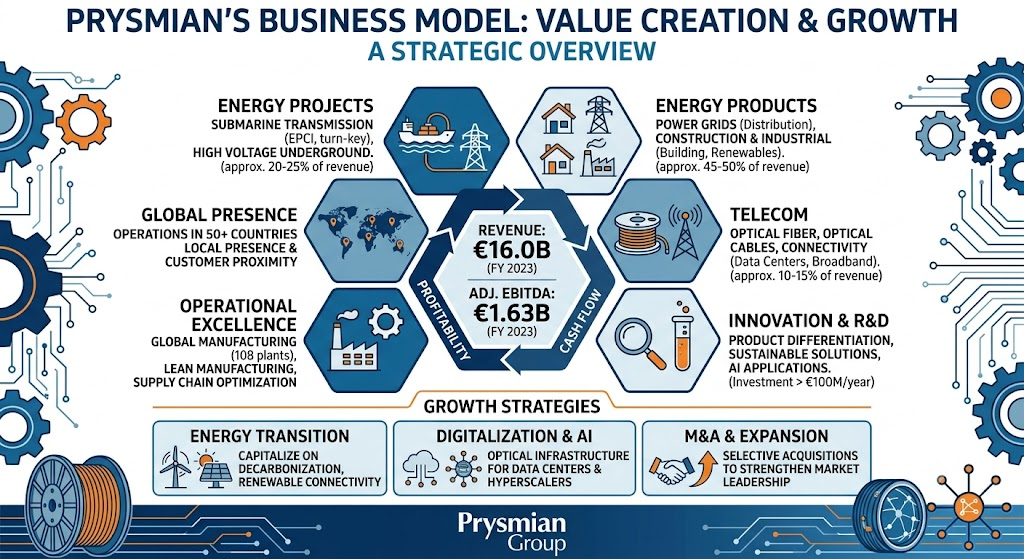
Prysmian generates revenue primarily by designing, manufacturing, installing, and servicing complex cable systems across four main segments: Transmission, Power Grid, Electrification, and Digital Solutions.
The core revenue engine relies on a mix of long-term turnkey project contracts and high-volume product sales. In Transmission, Prysmian executes multi-year engineering, procurement, construction, and installation (EPCI) contracts for offshore wind farms and cross-border interconnectors, operating its own fleet of specialized cable-laying vessels (e.g., Leonardo da Vinci). In Power Grid and Electrification, the business is volume-driven, supplying utilities, industrial plants, building contractors, and data centers. To protect profitability against commodity fluctuations, Prysmian utilizes pass-through pricing mechanisms that adjust contract prices based on market rates for copper and aluminum.
Financial performance reflects this strategy. For full-year 2025, Prysmian generated a record adjusted EBITDA of €2.398 billion on revenue growth fueled by high-margin transmission projects, with an adjusted EBITDA margin of 14.2%. Free cash flow reached €1.171 billion, supported by an organic growth rate of 4.3% and a transmission order backlog of €17 billion. For 2026, the company projects adjusted EBITDA between €2.625 billion and €2.775 billion, alongside a free cash flow target between €1.300 billion and €1.400 billion. Growth strategy revolves around premiumization (focusing on high-margin HVDC and high-density fiber), expansion in North America (enhanced by the integration of Encore Wire and Channell), and scaling sustainable solutions to represent 47% to 49% of group revenues.
Sources
- https://www.prysmian.com/it/media/comunicati-stampa/prysmian-continua-la-crescita-e-l-espansione-dei-margini-nel-4q25-2025-anno-migliore-di-sempre
- https://tedmag.com/prysmian-reports-record-2025-financial-results/
- https://www.investing.com/news/transcripts/earnings-call-transcript-prysmian-q3-2025-revenue-and-ebitda-rise-sharply-93CH-4318828
AI Development Strategy, Budget, and Partnerships
Prysmian’s AI strategy is two-fold: providing the physical hardware required for hyperscale AI data center infrastructure and deploying internal AI technologies to optimize manufacturing operations.
On the product side, Prysmian targets the massive bandwidth and power transmission demands created by AI workloads. The company develops high-density optical fiber solutions, bend-insensitive ribbon cables, and specialized connectivity equipment designed for high-performance AI computing clusters. To capture this demand, Prysmian committed a €1.25 billion capital expenditure budget through 2031 to expand optical cable and fiber production, effectively doubling its manufacturing output capacity in the United States. A major strategic partnership underpinning this push is a supply agreement with Molex valued up to €5.5 billion, aimed at supplying advanced optical connectivity for next-generation AI data centers and supporting Prysmian’s target of €10 billion in digital infrastructure revenue by 2035.
Internally, Prysmian deploys AI and machine learning tools across its manufacturing plants and supply chain management. The company utilizes predictive maintenance AI to reduce equipment downtime in cable extrusion, computer vision systems for automated quality control of optical fiber, and AI-driven load forecasting to optimize logistics and raw material procurement.
Back to Prysmian