
Company History
Phase 1: Foundation and Early Era (1934–1995)
The company traces its origin to Decca Records USA, established in 1934. MCA (Music Corporation of America) acquired Decca in 1962, laying the groundwork for a entertainment conglomerate. Through decades of catalog acquisitions and internal distribution expansion, MCA Music Entertainment developed into a major North American industry player.
Phase 2: Consolidation and Universal Branding (1996–2020)
In 1996, MCA rebranded as Universal Music Group. Vivendi acquired UMG in 2000, initiating an aggressive era of global consolidation. UMG absorbed PolyGram in 1999 and EMI’s recorded music unit in 2012, cementing its status as the world’s largest music group and expanding its catalog dominance across global markets.
Phase 3: Streaming Era and Corporate Independence (2021–Present)
In September 2021, Vivendi spun off UMG, listing it publicly on the Euronext Amsterdam stock exchange. Under CEO Lucian Grainge, UMG transitioned from fighting digital platforms to driving streaming monetization models, expanding its presence in emerging markets and positioning itself around platform licensing and artificial intelligence.
Business Model and Growth Strategy
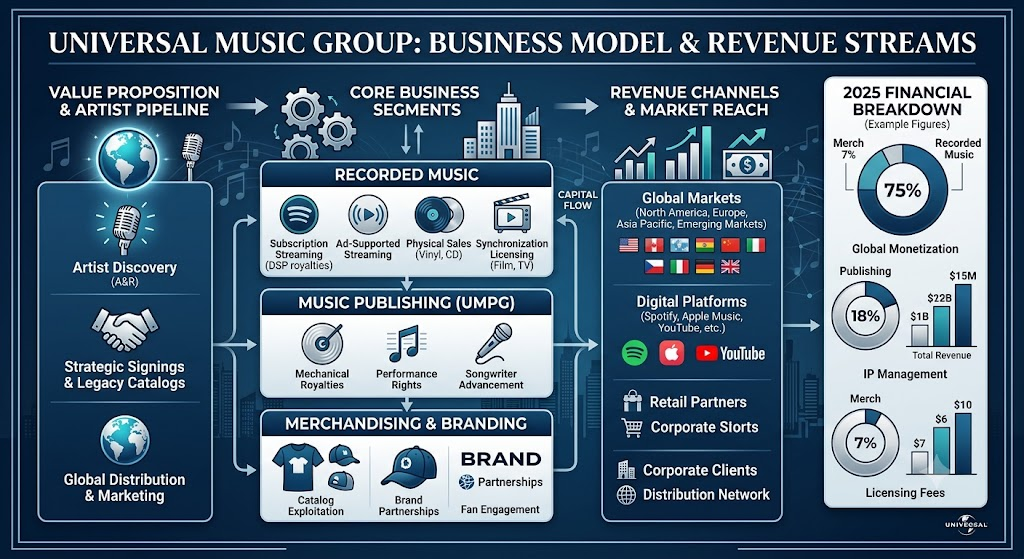
Universal Music Group operates as a integrated intellectual property (IP) monetizer. It generates revenue by acquiring, creating, managing, and distributing music rights globally. Its business divides into three core operating segments:
- Recorded Music: Generates revenues through digital streaming subscriptions, ad-supported streaming, physical sales (vinyl, CDs), and licensing/synchronization fees.
- Music Publishing: Managed via Universal Music Publishing Group (UMPG), this segment collects royalties for songwriters whenever music is broadcast, streamed, performed, or reproduced.
- Merchandising and Other: Focuses on direct-to-consumer merchandise sales, brand partnerships, and touring management.
Financial Performance:
For full-year 2025, UMG generated €12.51 billion in total revenue (up 5.7% YoY) with an Adjusted EBITDA of €2.81 billion. In H1 2026, UMG generated €6.19 billion in revenue, representing a 10.8% growth in constant currency. Recorded Music subscription revenues were driven by price increases across major streaming platforms under UMG’s “Streaming 2.0” initiative, alongside the consolidation of Downtown Music Holdings.
Growth Strategy:
- Streaming 2.0: UMG restructures deals with DSPs (Spotify, Apple Music, YouTube) to prioritize deep artist engagement and premium content over generic ambient audio, directly driving higher royalty yields.
- Catalog Acquisition & M&A: UMG deploys capital to acquire high-value legacy artist catalogs and strategic platforms, such as the acquisition of Downtown Music Holdings in 2026 to boost label services and digital distribution.
- High-Margin Physical Formats: UMG leverages high-margin vinyl and direct-to-consumer super-fan monetization strategies, driving double-digit physical growth in key markets like the U.S. and Japan.
Business Model Information Sources
- https://www.universalmusic.com/universal-music-group-n-v-reports-financial-results-for-the-fourth-quarter-and-full-year-ended-december-31-2025/
- https://www.universalmusic.com/universal-music-group-n-v-reports-financial-results-for-the-first-quarter-ended-march-31-2026/
- https://www.prnewswire.com/news-releases/universal-music-group-nv-reports-financial-results-for-the-second-quarter-and-half-year-ended-june-30-2026-302839242.html
AI Strategy, Budget, and Partnerships
UMG approaches artificial intelligence through a dual strategy: protecting artist intellectual property against unauthorized scraping while licensing catalog rights to build commercial monetization engines. Rather than treating AI strictly as internal R&D overhead, UMG integrates AI investments into its operational capital expenditure and strategic partnership ecosystem.
Strategic AI Framework & Partnerships:
- YouTube Partnership: UMG partnered with YouTube to establish joint AI principles and launch the YouTube Music AI Incubator. This framework ensures artists are compensated and credited when generative AI tools utilize their likeness or sound signatures.
- Commercial AI Licensing: UMG has partnered with AI platforms like Klarna, BandLab Technologies, and Endel to co-develop commercial applications. These cover ethical AI generation, hyper-personalized audio, and AI-driven workflow optimization for independent creators.
- Legal Enforcement & Rights Protection: UMG leads litigation efforts against unauthorized generative AI providers that train models on copyrighted recordings without prior permission.
Deployment & Monetization:
UMG uses AI algorithms internally for predictive analytics, optimizing playlist distribution, artist discovery (A&R), and royalty tracking. Economically, UMG positions its master catalog as essential training data, seeking compensation structures through new licensing streams rather than allowing unmonetized content generation.
Back to Uniuversal Music