
Market Position and Market Share
Michelin holds the #1 position in the global tire industry by overall revenue, market capitalization, and brand value.
- Global Market Rank: #1 worldwide (narrowly ahead of Bridgestone).
- Global Market Share: Approximately 14.1% of the total worldwide tire market revenue.
- Brand Value: Ranked as the world’s most valuable and strongest tire brand, valued at $8.76 billion.
- Segment Dominance: Leads key premium segments, including high-diameter passenger car tires(18+ inches), specialty off-highway tires(mining, agriculture), aviation tires, and electric vehicle(EV) original equipment(OE) fitments.
Supply Chain Analysis and Key Suppliers
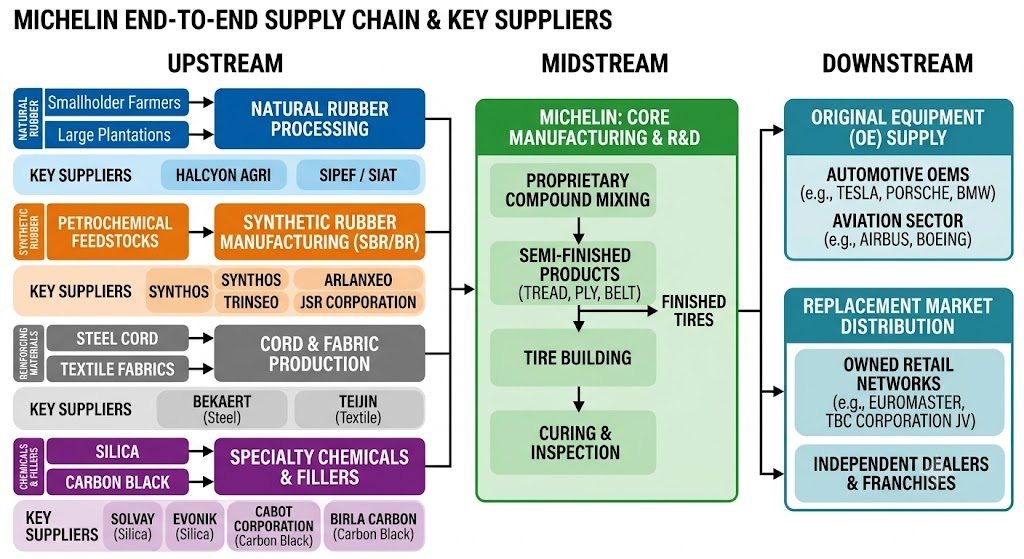
Michelin operates an integrated and diversified global supply chain due to the complex raw material requirements of tire manufacturing (over 200 distinct raw components per tire).
- Upstream Raw Material Sourcing:
- Natural Rubber: Sourced primarily from Southeast Asia (Thailand, Indonesia) and West Africa (Ivory Coast). Michelin procure raw rubber through independent processors (Tier 1) and utilizes platforms like Rubberway to trace environmental and social compliance across smallholder farms.
- Synthetic Rubber & Chemicals: Key petrochemical feedstocks such as butadiene and styrene-butadiene rubber(SBR) are supplied by global chemical majors including Synthos, BASF, and Dow Chemical.
- Silica & Fillers: Highly dependent on premium specialty silica for low rolling-resistance compounds, supplied by Solvay and Evonik. Specialty carbon black is sourced from Cabot Corporation and Birla Carbon.
- Steel Cord & Textile Reinforcements: High-tensile steel wire for tire beads and belts is sourced from global specialists like Bekaert. Textile cord matrices(nylon, polyester, aramid) are sourced from technical fiber makers like Teijin.
- Manufacturing & Midstream Operations:
- Michelin maintains internal, proprietary compounding and fabric/steel cabling manufacturing capabilities.
- Rubber compounds and steel/textile cord processing are kept strictly in-house to protect proprietary material blends.
- Downstream Distribution Networks:
- Operates a multi-channel go-to-market structure consisting of direct Original Equipment Manufacturer(OEM) supply to automotive groups (e.g., Porsche, BMW, Tesla) and extensive replacement market networks via owned distributors (e.g., Euromaster in Europe, TBC Corporation joint venture in North America) alongside independent dealers.
Competitor Analysis: Technical and Financial Comparison
Michelin competes primarily in the tier-1 premium market against Bridgestone, Continental, and Goodyear.
- Technical Comparison:
- Michelin vs. Bridgestone: Michelin focuses heavily on tread longevity, sustained wet-grip performance as tires wear, and lower rolling resistance through advanced silica-polymer matrix mixing. Bridgestone emphasizes structural durability, air-free/run-flat technologies, and sensory digital tire platforms(ENLITEN technology). Michelin currently leads in EV-specific low-rolling-resistance fitments.
- Michelin vs. Continental: Continental leads in software-hardware integration by coupling sensor-embedded tires directly with vehicle electronic control units(ECUs) and autonomous driving systems. Michelin counters with its MICHELIN Connected Solutions ecosystem for commercial fleets and proprietary airless tire technology(UPTIS).
- Financial Comparison:
- Profitability:Michelin consistently achieves industry-leading Sector Operating Margins(typically 12% to 13%), outperforming Bridgestone(~10% to 11%), Continental Tire Division(~8% to 10%), and Goodyear(~4% to 6%).
- Pricing Power: Michelin possesses the strongest pricing power in the industry, enabling it to pass raw material inflation directly onto consumers due to brand premiumization and low customer price sensitivity in replacement markets.
- Capital Allocation: While Goodyear remains heavily debt-laden following its Cooper Tire acquisition, Michelin maintains a strong balance sheet with a conservative Net Debt/EBITDA ratio, allowing aggressive R&D reinvestment(~3.5% to 4% of net sales).
Information Sources
- https://www.michelin.com/en/expertise/designing-innovative-materials
- https://www.michelinman.com/auto/auto-tips-and-advice/tires-101/how-are-tires-made
- https://purchasing.michelin.com/en/supply-chain-assessment/
- https://www.kenresearch.com/industry-reports/global-tire-market
- https://brandirectory.com/reports/tyres/2025
- https://tyre-trends.com/news/michelin-retains-crown-as-worlds-most-valuable-tyre-brand
back to michelin