Company History
Foundation and Industrial Innovation (1889–1945)
Founded in 1889 by brothers Édouard and André Michelin in Clermont-Ferrand, France, the company initially produced rubber products for farm equipment. In 1891, Michelin patented the removable pneumatic tire for bicycles, which eliminated hours of repair time. By 1895, they introduced pneumatic tires to motor vehicles. To encourage motoring and drive tire demand, the brothers launched the first Michelin Guide in 1900.
The Radial Tire Revolution and Global Expansion (1946–1999)
In 1946, Michelin patented the radial tire—a groundbreaking technological breakthrough offering superior road handling, durability, and fuel efficiency. Radial technology allowed Michelin to dominate European manufacturing and successfully enter North America. The company aggressively expanded through acquisitions, most notably purchasing the American tire maker Uniroyal-Goodrich in 1990.
Diversification and “With, Around, and Beyond Tires” Era (2000–Present)
In the 21st century, Michelin shifted strategy toward sustainable mobility and services. Facing intense competition in standard tire manufacturing, the group pivoted to fleet telematics, sensor-enabled tires, hydrogen fuel cell technology (via its Symbio joint venture), and flexible composite materials, aiming to generate significant non-tire revenue while maintaining its premium tire manufacturing baseline.
Business Model and Strategy
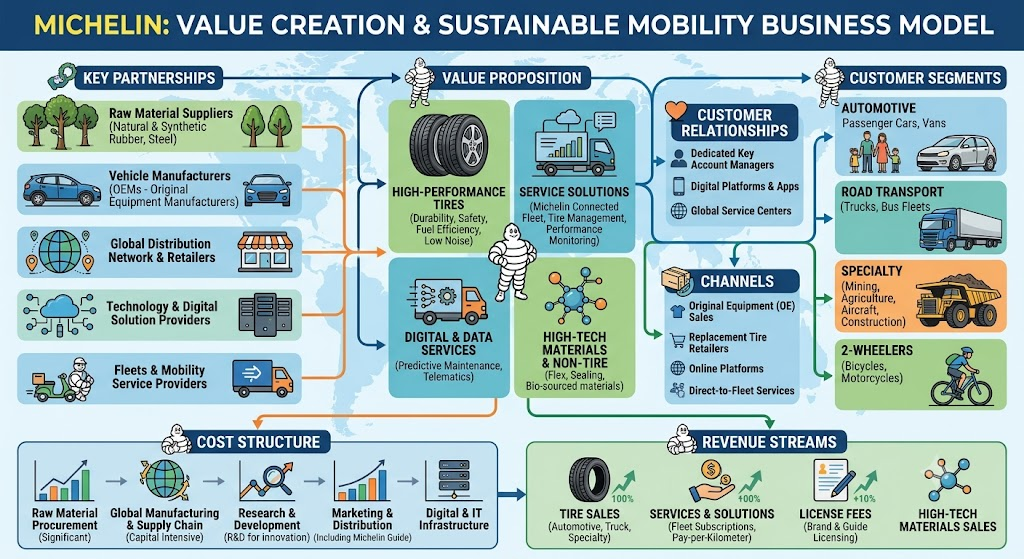
Michelin generates revenue primarily through the sale of high-performance tires, complemented by fleet management services, high-tech materials, and lifestyle brand licensing. The group reports sales across three primary segments:
- Automotive and Two-Wheel (Passenger Car & Light Truck Tires): Represents roughly 50% of group revenue, focusing on premium replacement markets, high-rim diameter tires (18-inch+), and electric vehicles (EVs), which consume tires faster due to higher vehicle weight and torque.
- Road Transportation (Commercial Truck Tires & Fleet Services): Accounts for approximately 25-30% of sales. Revenue comes from tire sales and subscription-based “pay-per-kilometer” fleet maintenance programs (Michelin Connected Fleet).
- Specialties (Mining, Off-the-Road, Aviation, Agricultural, and Materials): Generates roughly 20-25% of revenue but carries the highest profit margins. Michelin commands a dominant market share in massive earthmover and mining tires.
Financially, Michelin delivered approximately €28.4 billion ($30.5 billion) in annual sales in recent fiscal years, maintaining a segment operating income margin around 12% to 13%. Its core strategy—termed “Michelin in Motion”—targets 20% to 30% of total revenue from non-tire businesses (such as medical devices, high-tech composites, and green mobility) while maintaining value-over-volume pricing in its core tire lines to preserve profitability over raw volume expansion.
- https://www.michelin.com/en/publications/group/annual-results-2024
- https://www.moderntiredealer.com/suppliers/news/55267983/michelin-posts-2024-results
- https://companiesmarketcap.com/michelin/revenue/
AI Strategy, Budget, and Partnerships
Michelin integrates Artificial Intelligence (AI) directly into its manufacturing, product development, and fleet management operations rather than viewing AI as a standalone product. The company’s digital strategy focuses on industrial IoT (Internet of Things), generative AI, and predictive analytics.
Strategic Implementations and Use Cases
- Industrial AI & Visual Inspection: Michelin deploys computer vision models across its factories globally. AI algorithms analyze tire X-ray scan images during production to detect microscopic surface or structural defects, reducing human inspection errors and decreasing scrap material rates.
- Smart Tires & Predictive Fleet Analytics: Through “Michelin MEMS” (Michelin Earthmover Management System) and RFID-embedded smart tires, real-time temperature and pressure data are fed into AI models to predict tire wear and prevent catastrophic blowouts in commercial fleets and heavy mining vehicles.
- R&D and Material Science Simulation: Michelin uses machine learning to simulate chemical compound behavior and tread pattern aerodynamics, reducing physical prototype testing iterations by up to 50%.
Partnerships and Tech Infrastructure
- Microsoft: Michelin heavily utilizes Microsoft Azure OpenAI Service and Microsoft 365 Copilot across its workforce. Generative AI solutions are built on Azure to assist factory workers with maintenance documentation retrieval and streamline supply chain reporting.
- Accenture & Cloud Ecosystems: Michelin works alongside enterprise partners like Accenture to modernize its data lake architecture and scale AI deployments across more than 120 production plants worldwide.
While Michelin does not isolate a standalone monetary line item for “AI budget” in its financial disclosures, it channels its multi-hundred-million-euro annual digital transformation and R&D budget (totaling over €1 billion annually across R&D) directly into cloud infrastructure, automation, and enterprise AI scaling.
Back to Michelin