
Corporate History
1993: The Cross-Border Merger
Reed Elsevier was created in 1993 through the merger of Reed International, a British paper and publishing company, and Elsevier NV, a prominent Dutch scientific publisher. The combined entity dominated traditional paper-based professional printing.
2000–2010: Digital Transformation
Recognizing the decline of print media, the group aggressively shed legacy consumer publishing assets and trade magazines. It pivoted toward digital delivery networks, building out subscription platforms like LexisNexis for legal professional workflows and ScienceDirect for academic literature.
2015–Present: Rebranding and Analytics Focus
In 2015, Reed Elsevier rebranded to RELX plc to signal its full evolution into an analytics and decision-tools enterprise. In 2018, the dual-listed structure in London and Amsterdam was simplified into a single parent company, RELX plc, listed on the London Stock Exchange. The group subsequently integrated machine learning, risk-scoring algorithms, and generative AI across all core business lines.
Business Model and Growth Strategy
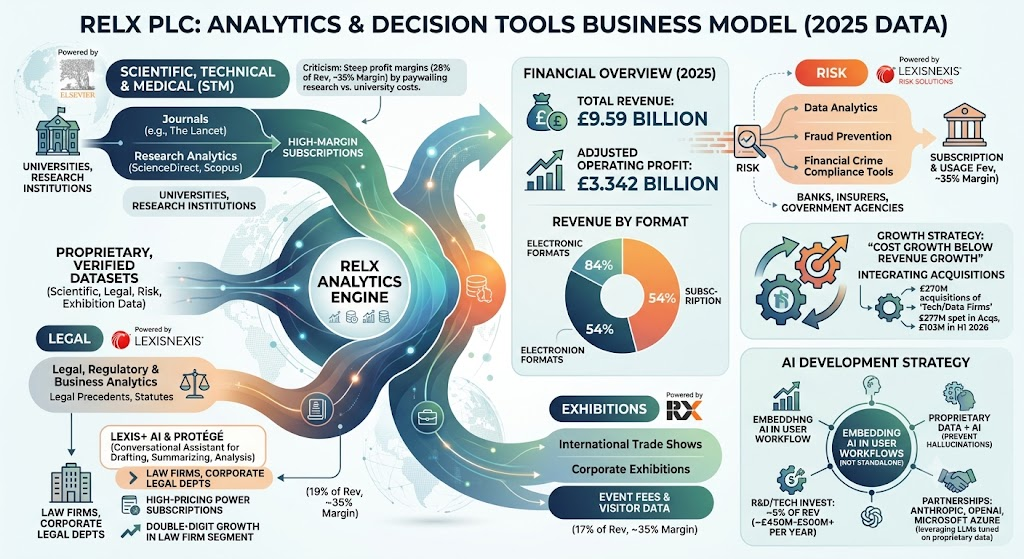
RELX generates revenue by capturing recurring, high-margin subscriptions and usage-based data fees from professional institutions. The company operates like a specialized software-as-a-service (SaaS) provider rather than a content provider.
The corporate breakdown relies on four main pillars:
- Risk (36% of Revenue): Provides data analytics, fraud prevention, and financial crime compliance tools (e.g., LexisNexis Risk Solutions) to banks, insurers, and government agencies.
- Scientific, Technical & Medical (28% of Revenue): Operated under Elsevier, publishing journals like The Lancet and providing research analytics through platforms like ScienceDirect and Scopus.
- Legal (19% of Revenue): Driven by LexisNexis, providing legal, regulatory, and business information analytics for law firms and corporate legal departments.
- Exhibitions (17% of Revenue): Runs international trade shows and corporate exhibitions.
In 2025, RELX generated £9.59 billion in revenue with an adjusted operating profit of £3.342 billion, resulting in an operating margin of 34.8%. Electronic formats accounted for 84% of total revenue, with subscription-based models delivering 54% of sales.
The underlying growth strategy hinges on a discipline termed “cost growth below revenue growth”. RELX constantly acquires small, specialized data/tech firms (spending £270 million on acquisitions in 2025 and £103 million in H1 2026) to integrate unique data assets into its analytical engines.
Business Model Data Sources
- https://www.relx.com/investors/key-financial-data
- https://www.tradingview.com/symbols/LSE-REL/financials-segments/
- https://www.investing.com/news/company-news/relx-2025-slides-7-revenue-growth-margins-expand-as-digital-transformation-continues-93CH-4502006
AI Development Strategy, Budget, and Partnerships
RELX embeds artificial intelligence directly into the core user workflows of its subscription platforms rather than marketing standalone AI models. The core strategy focuses on coupling proprietary, verified data sets (such as millions of court rulings or peer-reviewed medical papers) with generative AI to prevent “hallucinations” in critical professional settings.
Key highlights of their AI execution include:
- Lexis+ AI and Protégé: In the Legal sector, RELX launched Lexis+ AI and its upgraded conversational assistant framework, Protégé. These tools draft legal briefs, summarize precedents, and analyze legal documents. The double-digit growth in the law firm subsegment in 2025 and 2026 was largely driven by these AI products.
- R&D and Capital Allocation: RELX does not report AI research as an isolated line item, but it reinvests roughly 5% of its total revenue annually into technology and software development (amounting to over £450-£500 million per year).
- Partnerships and Infrastructure: RELX partners heavily with primary cloud and LLM infrastructure leaders. Rather than building foundational LLMs from scratch, RELX leverages models from providers such as Anthropic, OpenAI, and Microsoft Azure, tuning these models on its private, domain-specific databases to build domain-tailored enterprise software.
Back to RELX