
Company History
Early Foundations (1860s – 1980s)
The company’s roots trace back to two separate European retail pioneers: Albert Heijn in the Netherlands (founded in 1887) and Delhaize Frères et Cie in Belgium (founded in 1867). Both companies expanded aggressively in their domestic markets, transitioning from small grocery shops into dominant supermarket chains. During the late 20th century, both entities expanded into international markets, notably acquiring various regional grocery chains across the US East Coast.
Rapid Expansion and Corporate Rebuilding (1990s – 2015)
During the 1990s and early 2000s, Royal Ahold expanded rapidly globally via debt-fueled international acquisitions. However, in 2003, Ahold was hit by a major accounting scandal involving its US Foodservice subsidiary, leading to overstated profits, executive resignations, and massive stock drops. Following a period of debt restructuring and divestment of non-core assets, both Ahold and Delhaize Group emerged as leaner, highly focused grocery operators.
Merger and Modern Transformation (2016 – Present)
In July 2016, Royal Ahold and Delhaize Group completed a €26 billion merger of equals, creating Koninklijke Ahold Delhaize N.V. The merger combined their supply chains and technological capabilities while maintaining decentralized regional store banners. In recent years, the company has focused on omnichannel growth, acquiring local competitors (such as Profi in Romania), divesting non-core e-commerce operations (e.g., FreshDirect), and modernizing its brick-and-mortar footprint.
Business Model and Growth Strategy
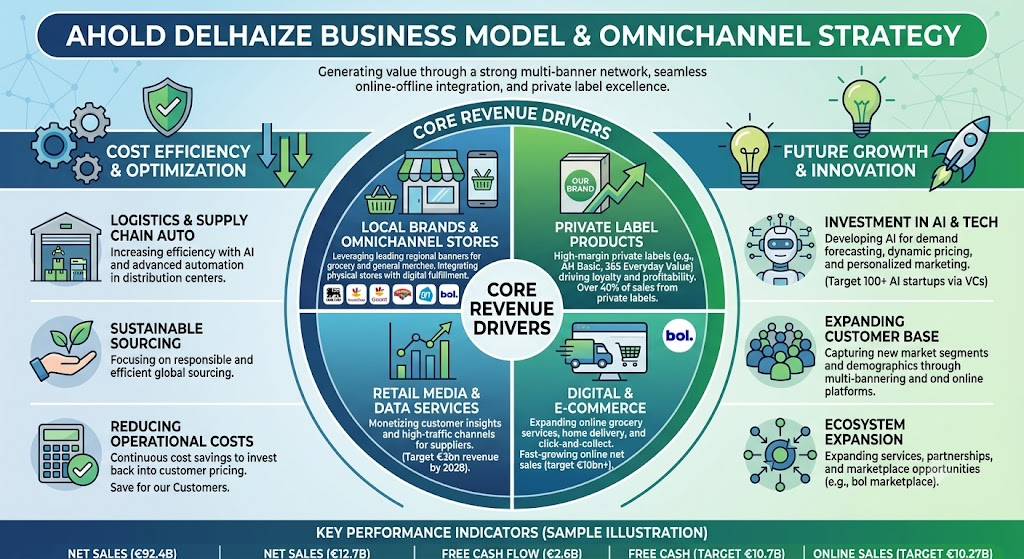
Ahold Delhaize operates a multi-banner, omnichannel food retail model, generating revenue primarily through physical grocery stores, e-commerce fulfillment, retail media, and private-label sales.
- Segment Revenue BreakdownThe business generates revenue across two primary geographic segments:
- The United States: Represents roughly 60% of total revenue, driven by brands like Food Lion, Stop & Shop, and Giant Food.
- Europe: Represents roughly 40% of revenue, led by Albert Heijn (Netherlands/Belgium), Delhaize (Belgium), Alfa Beta (Greece), and bol (e-commerce).For FY2025, the group reported total net sales of €92.4 billion, delivering an underlying operating margin of 4.0% and generating €2.6 billion in free cash flow.
- High-Margin Growth VectorsTo offset low-margin grocery retail (where operating margins typically sit between 3% and 4%), Ahold Delhaize relies on three core revenue drivers:
- Own Banners & Private Label: Private labels (e.g., 365 Everyday Value, AH Basic) account for over 40% of sales, offering higher gross margins than national CPG brands.
- E-Commerce & Omnichannel Operations: Online net sales surpassed €10 billion (reaching €10.27 billion in FY2025), leveraging store-fulfillment hubs and specialized distribution networks.
- Retail Media Networks (Edge & Gambit): Utilizing store foot-traffic and customer loyalty data, the company monetizes targeted advertising for CPG brand partners. Ahold Delhaize targets €3 billion in high-margin retail media revenues by 2028.
- Efficiency & Cost Optimization StrategyUnder its “Save for Our Customers” program, the company targets €5 billion in cumulative cost savings through supply chain automation, store-level energy efficiency, and back-office optimizations. These savings are directly reinvested into price cuts to maintain price competitiveness against hard discounters.
Sources for Business Model Information
- https://www.fruitnet.com/eurofruit/ahold-delhaize-reports-on-positive-2025/270513.article
- https://www.amati-associates.com/ahold-delhaize-2025-results-profitability-ecommerce-strategy/
- https://strategy.transforml.co/ahold-delhaize-strategy-cascade-analysis
- https://reports.retail-week.com/the-innovation-report-2024/in-profile-a-z/
AI Strategy, Budget, and Partnerships
Ahold Delhaize treats artificial intelligence as a core driver for operational productivity, inventory precision, and customer hyper-personalization.
- AI Capabilities and Applications
- Demand Forecasting & Supply Chain: AI algorithms analyze weather, calendar shifts, and local trends to optimize store replenishment, significantly reducing food waste and stock-outs across its 9,500+ stores.
- Customer Experience & Personalization: Brands like Albert Heijn utilize generative AI tools (such as “Steijn” and “Scan & Kook”) to offer personalized meal planning, dynamic pricing, and intent-based product search.
- Internal Productivity: The group deployed proprietary enterprise tools like “MaxiGPT” for employee workflows and “Amigo” for warehouse logistics optimization.
- Strategic Partnerships and Investments
- Big Tech Collaborations: The company works closely with Microsoft Azure and AWS for scalable cloud infrastructure, big data governance, and generative AI deployments.
- Joint Venture Capital (W23 Global): Ahold Delhaize is a founding partner in W23 Global, a $125 million (£98.9m) five-year corporate venture capital fund launched alongside Tesco, Woolworths, Empire, and Shoprite. The fund specifically invests in early-stage AI, robotics, and supply chain tech startups transforming global grocery retail.
- Engineering Expansion: The group opened a dedicated digital technology studio in Bucharest with 250+ software engineers focusing on AI, e-commerce, data architecture, and mobile loyalty platforms.
Back to Ahold Delhaize