
Company History
Founding and Early Mergers (1836–1986)
The company’s roots trace back to 1836, when Jan-Berend Wolters founded a educational publishing house in Groningen, Netherlands. Over the 19th and 20th centuries, several Dutch educational and legal publishing firms emerged, including Noordhoff (1858) and Samsom. In 1968, Wolters and Noordhoff merged to form Wolters-Noordhoff. Following subsequent consolidation, the company operated as Wolters-Samsom by 1983, expanding into international legal and technical publishing.
Forming Wolters Kluwer and Global Expansion (1987–2002)
In 1987, competitor Elsevier attempted a hostile takeover of Kluwer, another major Dutch publisher. To block the acquisition, Kluwer merged with Wolters-Samsom to establish Wolters Kluwer N.V. Throughout the late 1980s and 1990s, Wolters Kluwer embarked on a rapid international acquisition spree, purchasing key legal, medical, and financial publishers in Europe and North America, including CT Corporation, CCH (Commerce Clearing House), and Lippincott Williams & Wilkins.
Digital Transformation and Software Pivot (2003–Present)
Recognizing the decline of traditional print publishing, Wolters Kluwer initiated a massive structural shift under former CEO Nancy McKinstry and continued under current leadership. The group shed its trade, educational, and non-core print assets to reinvest heavily in cloud software, legal tech, and clinical decision support systems. Today, it operates primarily as a SaaS and expert solutions company across five divisions: Legal & Regulatory, Tax & Accounting, Health, Financial & Corporate Compliance, and Corporate Performance & ESG.
Business Model and Growth Strategy
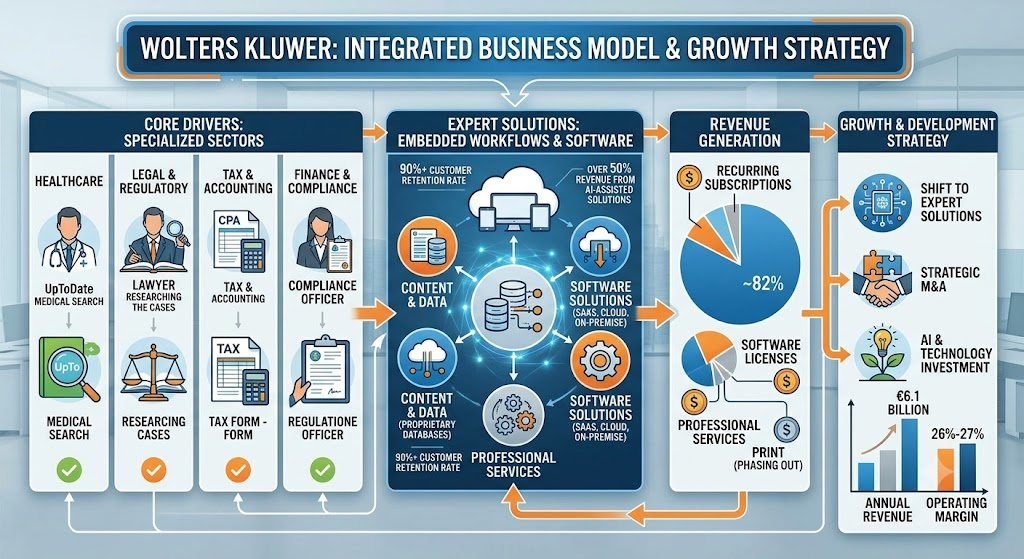
Wolters Kluwer operates primarily as a Business-to-Business (B2B) Software-as-a-Service (SaaS) and professional information provider. Rather than selling generic software or simple legal text, the company monetizes “expert solutions”—combining proprietary domain databases (legal codes, tax frameworks, medical literature) with embedded workflow tools.
Revenue Mechanics and Financial Metrics
- Recurring Revenue Dominance: Approximately 80% to 82% of total group revenues stem from recurring subscriptions and software maintenance contracts, ensuring high cash flow predictability and strong multi-year retention rates (typically above 90%).
- Scale & Financial Performance: In 2025, Wolters Kluwer reported annual revenues of €6.1 billion, maintaining operational profit margins consistently around 26% to 27%.
- Organic Growth & M&A: Growth is driven by a dual strategy—generating 5% to 7% organic growth from software subscriptions while executing bolt-on acquisitions to capture emerging workflow niches (e.g., acquiring Enablon for ESG reporting or Tagetik for corporate performance management).
Growth Strategy
The company’s strategic agenda focuses on “Shift to Expert Solutions.” Wolters Kluwer aggressively phases out low-margin print products and reallocates capital toward high-growth digital segments. By embedding its tools directly into daily enterprise workflows—such as clinical electronic health records (EHR) via UpToDate or tax submission pipelines via CCH—the company creates immense customer stickiness and high switching costs.
Sources for Business Model
- https://www.wolterskluwer.com/en/news/wolters-kluwer-transforms-trusted-legal-content-into-structured-v2
- https://en.wikipedia.org/wiki/Wolters_Kluwer
AI Strategy, Budget, and Key Partnerships
Wolters Kluwer approaches Artificial Intelligence not as a standalone product, but as an embedded capability across its entire software suite to automate research, drafting, and risk assessment.
AI Investment & R&D Budget
Wolters Kluwer routinely reinvests approximately 8% to 10% of its annual revenue (over €500 million annually) back into product development and technology infrastructure, with a growing majority dedicated to Generative AI, Retrieval-Augmented Generation (RAG) frameworks, and machine learning models. Over 50% of its total digital revenue now involves AI-assisted capabilities or embedded expert logic.
Strategic Implementations
- Legal AI Workspaces: The company launched Libra, an all-in-one Legal AI workspace that converts proprietary legal archives, practical guidance, and case rulings into structured, AI-ready knowledge graphs. This allows legal professionals to perform contextual legal research and draft documents with fully traceable, hallucination-free citations.
- Healthcare Decision Support: UpToDate integrates generative AI search tools that summarize medical consensus directly at the point of care, synthesizing millions of clinical studies for physicians.
- Tax & Accounting Automation: Platforms like CCH iKnowConnect utilize domain-specific AI to analyze regional and international tax codes across 17 countries, offering automated advisory insights and workflow automation.
Partnerships & Technology Ecosystem
Wolters Kluwer partners closely with major cloud and AI infrastructure providers:
- Microsoft: Uses Microsoft Azure cloud infrastructure and Azure OpenAI Services to build enterprise-grade enterprise legal and financial AI tools while maintaining strict privacy standards.
- Academic & Domain Experts: Collaborates with a network of thousands of practicing legal experts, medical professionals, and authors who continuously curate and validate the underlying knowledge bases that feed the company’s AI models.
Back to Wolters Kluwer