Market Position and Market Share
Kering SA is a major French multinational luxury goods conglomerate, recognized as the world’s third-largest luxury group by revenue, positioned behind LVMH Moët Hennessy Louis Vuitton and Richemont. The company operates a portfolio of high-end fashion, leather goods, jewelry, and eyewear houses, including flagship brands such as Gucci, Yves Saint Laurent, Bottega Veneta, Balenciaga, and Alexander McQueen.
- Global Rank: #3 luxury group worldwide.
- Global Luxury Market Share: Approximately 4.5% to 5.5% of the global personal luxury goods market (based on total sector valuation of ~€350–360 billion).
- FY2024 Revenue:€17.194 billion (representing a 12% decline YoY).
- FY2025 Revenue:€14.675 billion (representing a 13% decline YoY due to broader luxury sector slowdown and brand repositioning).
- Flagship Revenue Contribution (FY2024):
- Gucci: €7.650 billion (~44.5% of total group revenue).
- Yves Saint Laurent:€2.881 billion (~16.8%).
- Bottega Veneta:€1.713 billion (~10.0%).
- Kering Eyewear & Beauté: €1.941 billion (~11.3%).
- Other Houses (Balenciaga, McQueen, Brioni, Boucheron, etc.): €3.221 billion (~18.7%).
Supply Chain Analysis and Key Suppliers
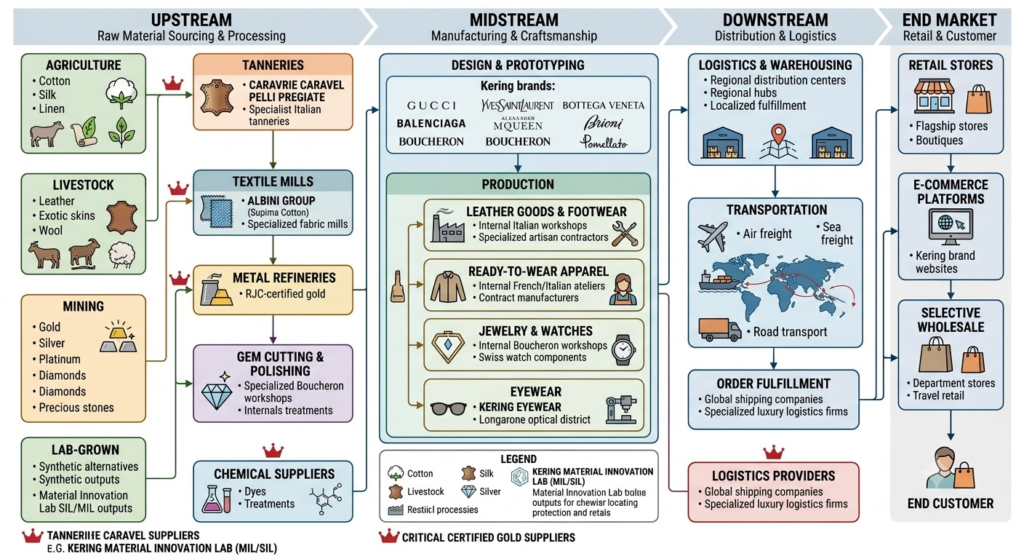
Kering operates an integrated supply chain designed to preserve craft heritage, ensure raw material traceability, and protect proprietary production techniques.
- Upstream Sourcing (Raw Materials):
- Leather & Skins:Leather accounts for ~44% of Kering’s raw material volume and over 55% of total procurement spending.Sourcing is heavily concentrated in Western Europe (France, Italy, Netherlands, Spain) and North America.Kering owns directly managed tanneries, including Caravel Pelli Pregiate for exotic skins.
- Precious Metals & Stones: 100% of the gold used across watches and jewelry is certified responsibly sourced (RJCs CoC certified). Kering operates the Sustainable Innovation Lab (SIL) for jewelry and precious materials.
- Textiles & Fibers: Through its Material Innovation Lab (MIL) in Milan, Kering sources sustainable silk, organic cotton, and bio-based fibers. Key supplier partners include Albini Group (organic cotton with Oritain isotopic tracing) and Supima.
- Midstream Manufacturing & Craftsmanship:
- In-House Production: Approximately 55–60% of leather goods and key apparel lines are manufactured in proprietary facilities, primarily located in Italy (Tuscany, Lombardy, Veneto) and France.
- Contract Manufacturers: Specialized artisan workshops (subcontractors) in Italy handle embroidery, footwear assembly, and specialized hardware molding under strict audit programs (Kering Standards).
- Eyewear Division:Kering Eyewear controls end-to-end design, development, and supply chain management, relying on specialized manufacturing hubs in the Longarone optical district in Italy.
- Downstream Distribution:
- Direct-to-Consumer (DTC): Directly operated store networks and brand e-commerce generate ~85-90% of retail revenue across key houses.
- Wholesale Restructuring:Kering has systematically curtailed wholesale distribution partners (-22% to -28% YoY cuts) to maintain price integrity and brand exclusivity.
Competitor Analysis
Kering competes directly against tier-one luxury conglomerates (LVMH, Richemont) and pure-play luxury brands (Hermès, Chanel).
Technical & Strategic Comparison
- Brand Portfolio Diversity: LVMH holds a diversified portfolio across 75+ houses across 5 sectors (Wines/Spirits, Fashion/Leather, Perfumes/Cosmetics, Watches/Jewelry, Selective Retailing). In contrast, Kering is heavily reliant on soft luxury (Fashion & Leather Goods), with Gucci historical earnings contributing >50% of operating profits.
- Supply Chain & Manufacturing Ownership:Hermès maintains extreme vertical integration with over 60–70% of manufacturing done in internal French ateliers, resulting in constrained supply and high pricing power. Kering relies slightly more on external Italian supplier networks for seasonal scaling.
- Technology & Digital Infrastructure:
- E-Commerce & Clienteling: Kering leads in AI-driven supply chain forecasting and digital clienteling tools across its store network.
- Traceability & Material Science: Kering’s Material Innovation Lab (MIL) and forensic chemical tracing (partnering with Oritain) give it a technical advantage in sustainable supply chain compliance compared to peers.
- In-House Eyewear Platform: Kering Eyewear provides an internal insourced operational model, unlike competitors who traditionally license optical lines to third parties like Luxottica.
Financial Comparison
| Financial Metric | Kering SA (KER) | LVMH SE (MC) | Hermès (RMS) |
| FY2024 Revenue | €17.19 B | €84.7 B | €15.2 B |
| Recurring Operating Margin | 14.9% | ~25.6% | ~40.5% |
| Net Income Margin | ~6.6% | ~14.8% | ~28.0% |
| Debt-to-Equity Ratio | ~113% | ~64% | ~13% |
| Primary Revenue Driver | Gucci (~44%) | Louis Vuitton / Dior | Leather Goods / Birkin |
| Pricing Power Index | Moderate (Transitioning) | High | Exceptionally High |
Information Sources
- https://www.kering.com/en/group/discover-kering/
- https://www.kering.com/en/sustainability/innovating-for-tomorrow/raw-materials/
- https://www.nasdaq.com/press-release/kering-press-release-2024-annual-results-2025-02-11
- https://www.kering.com/en/news/first-half-2025-results-072925/
- https://www.fashionbi.com/insights/how-kering-s-revenue-fell-13-in-2025-as-the-luxury-market-slowed
- https://www.xtb.com/int/market-analysis/news-and-research/hermes-the-undisputed-master-of-luxury
- https://zh.wikipedia.org/wiki/開雲
Back to Kering