Market Position and Market Share
Compagnie de Saint-Gobain S.A. is the global leader in light and sustainable construction. Headquartered in France, the group operates across 76 countries with over 160,000 employees, reporting annual revenues exceeding €47 billion.
- Global Rank: Ranked #1 worldwide in heavy building materials and architectural solutions.
- Gypsum & Plasterboards: Global #1 position. Saint-Gobain holds an estimated 25.5% global market share in gypsum product manufacturing (via brands like CertainTeed, British Gypsum, and Placo).
- Flat Glass & Flat Glass Processing: Ranked #1 in Europe and #2 globally for architectural flat glass and automotive glazing (Sekurit).
- Insulation Solutions: Ranked #1 globally in mineral wool and technical insulation (ISOVER).
- Construction Chemicals:Top 3 globally, rapidly expanding market share following major strategic acquisitions such as GCP Applied Technologies, Chryso, Cemix, and Fosroc.
Supply Chain Analysis and Key Suppliers
Upstream (Raw Materials & Energy Procurement)
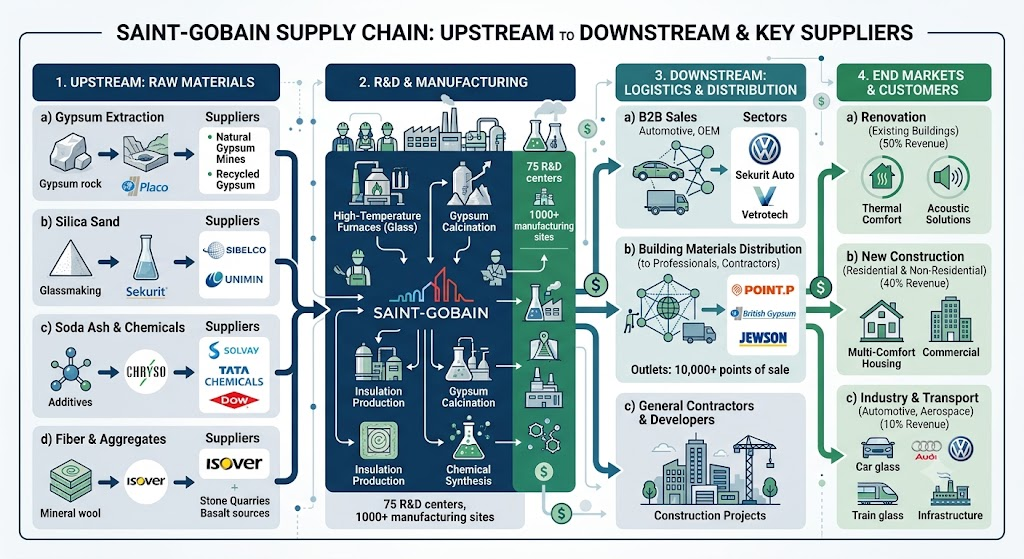
Saint-Gobain relies on heavy extraction and industrial chemical supply chains. Key inputs and suppliers include:
- Natural Minerals & Aggregates: Gypsum, silica sand, soda ash, limestone, and basalt. Key global soda ash suppliers include Solvay, Genesis Energy, and Tata Chemicals.
- Industrial Chemicals & Polymers: Resins, silicones, and cement additives for construction chemicals. Key suppliers include BASF, Dow Chemical, and Wacker Chemie.
- Energy Dependencies: High dependence on natural gas and electricity for high-temperature glass melting furnaces and gypsum calcination kilns. Key energy partners include Engie, EDF, and Hydro-Québec.
Downstream (Distribution Channels & End-Markets)
Saint-Gobain operates a unique dual model as both a manufacturer and distributor:
- Merchant & Distribution Channels: Direct ownership of major building merchant networks in Europe (e.g., Point.P, Jewson) serving professional builders and contractors.
- Direct B2B Integration: Direct supply chains to OEMs in the automotive sector (furnishing glass for major automakers like Volkswagen Group, Stellantis, and BMW) and life sciences (silicone tubing/single-use fluid management).
- End-Markets: Split roughly into residential renovation (~50%), new residential construction (~20%), non-residential building (~20%), and infrastructure/industry (~10%).
Competitor Analysis: Technical and Financial Comparison
Saint-Gobain competes with specialized product leaders and broad-line building material conglomerates.
Technical Comparison
- Saint-Gobain vs. Holcim / CRH: While Holcim and CRH focus heavily on heavy materials (cement, aggregates, ready-mix concrete), Saint-Gobain specializes in light construction (drywall, insulation, glass, mortars). Saint-Gobain focuses R&D on low-carbon glass, decarbonized gypsum production, and thermal insulation efficiency.
- Saint-Gobain vs. Sika AG: In construction chemicals, Sika leads globally in concrete admixtures and waterproofing. Saint-Gobain has aggressively built technical parity through its Chryso and Fosroc acquisitions, emphasizing circular formulations and low-carbon cement additives.
- Saint-Gobain vs. Kingspan & Owens Corning: In insulation, Kingspan leads in high-efficiency rigid polyurethane board solutions. Saint-Gobain retains technical leadership in acoustic and thermal glass wool / stone wool solutions with superior fire resistance.
Financial Comparison
- Revenue & Scale: Saint-Gobain generates ~$50B (€47B+) in annual revenue, significantly outscaling pure-play competitors like Sika (~$12B) and Kingspan (~$9B), while matching heavy-side conglomerates like Holcim (~$30B) and CRH (~$35B).
- Profitability: Saint-Gobain’s structural profile shift (“Lead & Grow” strategic plan) has elevated its operational EBITDA margin target to above 15.0%. While lower than high-margin pure plays like Sika (EBITDA margin ~19-20%), it represents significant operational outperformance compared to traditional flat-glass and cement peers.
- Free Cash Flow Conversion:Maintains a strong free cash flow conversion ratio of ~65%, facilitating active portfolio rotation (acquiring high-margin specialty chemicals while divesting lower-margin distribution assets).
Information Sources
- https://www.saint-gobain.com/en/corporate-responsibility/our-pillars/climate-change
- https://www.ibisworld.com/united-states/company/compagnie-de-saint-gobain/9717/
- https://www.glassonweb.com/news/saint-gobain-reports-growth-across-all-regions-and-strong-second-quarter-outperformance-first
- https://www.saint-gobain.com/sites/saint-gobain.com/files/media/document/CP_Resultats_2025_VA_t.pdf
- https://www.theclimatedrive.org/tr/action-library/offer-local-manufacturing-for-single-use-products
Back to Saint Gobain