
Company History
Phase 1: State Monopoly and Royal Origins (1665–1830s)
Founded in 1665 by Jean-Baptiste Colbert under King Louis XIV as the Manufacture royale des glaces de miroirs, the enterprise was established to break the Venetian monopoly on mirror manufacturing. Its flagship facility in the village of Saint-Gobain produced the glass for the Hall of Mirrors at the Palace of Versailles. Over the 18th century, it maintained a dominant royal privilege, perfecting the cast-plate glass process.
Phase 2: Industrial Expansion and Internationalization (1830s–1970s)
Following the French Revolution and the privatization of market competition, Saint-Gobain transformed into a modern industrial joint-stock company. It expanded across Europe and diversified into industrial chemicals, fertilizers, and glass containers. Throughout the mid-20th century, the company advanced automated glass manufacturing methods, including adopting the Float Glass process licensed from Pilkington.
Phase 3: Nationalization, Restructuring, and Strategic Refocus (1970s–2018)
In 1982, Saint-Gobain was briefly nationalized by the French government before being reprivatized in 1986. During the late 1980s and 1990s, the group systematically divested its legacy chemical and paper divisions to focus strictly on building materials and industrial distribution. Key acquisitions during this era, such as British Plaster Board (BPB) in 2005, solidified its position as a global leader in plasterboard and interior solutions.
Phase 4: Transformation to Sustainable Construction Leader (2018–Present)
Under its strategic plans—”Transform & Grow” and the recent “Lead & Grow”—Saint-Gobain decentralized its organizational matrix into regional business units to enhance local market agility. The company accelerated portfolio optimization through major portfolio additions (such as Chryso, GCP Applied Technologies, and FOSROC) while divesting lower-margin distribution assets to focus heavily on high-margin, low-carbon light construction solutions.
Business Model and Strategy
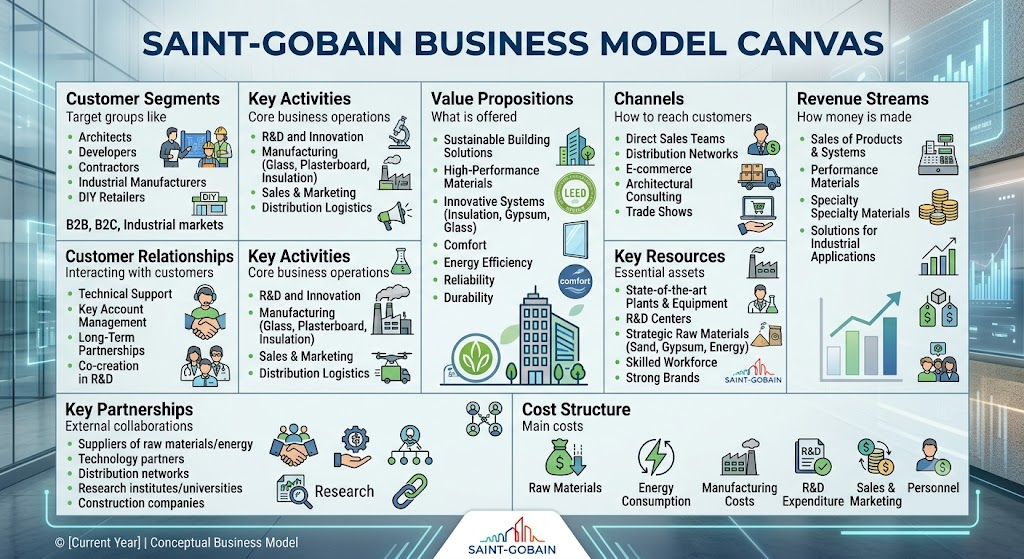
Saint-Gobain generates revenue by manufacturing and selling high-performance building systems, specialized industrial materials, and interior solutions. Rather than operating merely as a raw materials supplier, the company monetizes integrated “systems” (such as combined insulation, plasterboard, and acoustic seals) that command premium margins over commodity materials.
Revenue Engine and Profitability Mechanisms
The company generates over €45 billion in annual sales, structured around two primary segments:
- Americas and Asia-Pacific Growth Markets: High-growth geographic divisions delivering higher operating margins due to rapid urbanization and light-construction adoption.
- Northern and Southern Europe: Mature markets focused primarily on renovation, retrofitting, and energy efficiency upgrades driven by European Union decarbonization standards.
Saint-Gobain operates on an asset-light margin expansion model. In recent years, management has achieved sustained double-digit operating margins (historically targeting between 9% and 11%+) by optimizing its price-over-cost spread. The company offsets raw material inflation through dynamic pricing power, given that its technical solutions represent a small fraction of a building’s total cost but are critical for regulatory compliance.
Strategic Execution
Under the “Lead & Grow 2030” strategy, Saint-Gobain commits approximately €12 billion in capital expenditure and targeted bolt-on acquisitions to capture market share in high-margin sectors such as construction chemicals and modular building solutions. Furthermore, its divestment strategy actively liquidates low-margin building distribution businesses to reallocate capital into high-return specialty manufacturing.
- https://www.saint-gobain.com/en/news/full-year-2025-results
- https://www.worldconstructionnetwork.com/news/saint-gobain-lead-grow-plan/
- https://www.saint-gobain.com/en/group/lead-grow-our-strategic-plan
AI Strategy, Budget, and Partnerships
Strategic Focus and Implementation
Saint-Gobain integrates artificial intelligence into two core operational vectors: process decarbonization/manufacturing optimization and generative supply chain/R&D execution.
- Smart Manufacturing & Predictive Quality: The company utilizes machine learning algorithms across its float-glass furnaces and plasterboard plants to monitor heat distribution, predict equipment failure, and reduce energy consumption. Real-time computer vision systems inspect glass and board production lines to detect micro-defects at high speeds, reducing waste scrap.
- Generative AI in Material Science: Saint-Gobain leverages generative AI models to accelerate the discovery of sustainable material formulations, optimizing low-carbon cement additives and glass compositions with reduced melting points.
Budget Allocation and Incubations
While overall IT and digital transformation expenditure is embedded within its capital allocation framework, digital deployment forms a core part of the €12 billion expansion and growth investments planned through 2030. A significant portion of AI innovation is funded through NOVA, Saint-Gobain’s corporate venture capital arm. NOVA directly invests in and collaborates with early-stage tech startups specializing in artificial intelligence, computer vision, and industrial IoT for construction tech.
Key Partnerships and Ecosystems
- Start-Up Ecosystem (NOVA): Rather than building all technology proprietary in-house, Saint-Gobain relies on co-development partnerships with tech start-ups via NOVA to scale targeted digital solutions across its global plant footprint.
- Enterprise Technology Collaborations: Saint-Gobain deploys enterprise-grade generative AI interfaces (including internal tools like the Saint-Gobain AI ChatBot) built on enterprise cloud infrastructure to assist employees in administrative, sales, and supply-chain decision-making processes.
Back to Saint Gobain