
Danone Development History
- Founding and Early Expansion (1919–1965): Founded by Isaac Carasso in Barcelona as a small yogurt producer, Danone integrated early on with medical distribution. It expanded into France in 1929 before merging with BSN (Boussois-Souchon-Neuvesel) in 1973 under Antoine Riboud, transforming from a glassmaker into a premier packaged food group.
- Global Diversification and Portfolio Focus (1990s–2006): During the 1990s and early 2000s, Danone aggressively expanded into international markets across Asia, Latin America, and Eastern Europe. The group divested its grocery, beer, and biscuit businesses to strictly focus on four health-oriented pillars: Dairy, Waters, Infant Nutrition, and Medical Nutrition.
- Strategic Acquisitions and ESG Shift (2007–2020): Danone acquired Royal Numico in 2007 to solidify its position in specialized nutrition, followed by the $12.5 billion acquisition of WhiteWave Foods in 2017 to lead the global plant-based sector. Under CEO Emmanuel Faber, Danone prioritized ESG initiatives, becoming an “Entreprise à Mission” in 2020.
- Renew Danone Strategy and Operational Realignment (2021–Present): Following governance disputes and margin stagnation, Antoine de Saint-Affrique took over as CEO in 2021. The firm launched the “Renew Danone” strategic roadmap, focusing on portfolio rationalization, asset sales, operational execution, and reinvestment in core categories to restore consistent volume-led growth.
Business Model and Growth Strategy
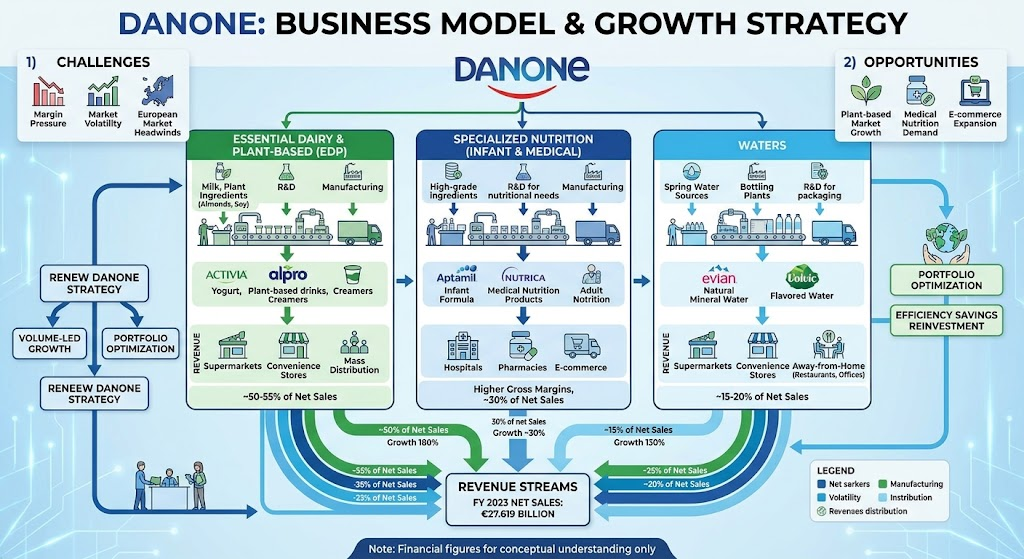
Danone generates revenue primarily through the mass manufacturing, marketing, and global distribution of consumer packaged goods across three principal reporting segments: Essential Dairy and Plant-Based (EDP), Specialized Nutrition (Infant and Medical Nutrition), and Waters. The EDP division generates the largest share of net sales (typically around 50% to 55%), earning money through high-volume supermarket retail channels. Specialized Nutrition generates higher gross profit margins (accounting for roughly 30% of net sales), monetization occurring through hospital networks, pharmacies, and e-commerce platforms servicing infant formula and adult medical nourishment. The Waters division contributes approximately 15% to 20% of net sales through retail and away-from-home channels.
In fiscal year 2023, Danone reported consolidated net sales of €27.619 billion, driven by an LFL (like-for-like) sales growth of +7.0%, underpinned by a +8.4% pricing effect offsetting a -1.4% volume/mix decline. The operating margin on recurring operations stood at 12.6%. The company’s growth strategy centers on its “Renew Danone” framework, targeting annual LFL sales growth between 3% and 5% and operating income growth outpacing net sales. Rather than relying solely on price increases, Danone focuses on volume-led expansion by underperforming SKU rationalization, selective bolt-on acquisitions, scaling up high-margin infant and medical nutrition products in Greater China and North America, and driving efficiency savings through its “Local First” operating model to reinvest into brand equity.
- https://www.danone.com/investors/reports-and-presentations.html
- https://www.danone.com/media/press-releases-list/2023-full-year-results.html
AI Development Strategy, Budget, and Partnerships
Danone’s artificial intelligence strategy focuses on optimizing supply chain demand forecasting, accelerating product innovation, enhancing dairy farm precision, and driving operational efficiency across global manufacturing plants. Rather than developing foundational AI models internally, Danone leverages strategic enterprise software partnerships and dedicated digital acceleration funds. While Danone does not break out a standalone line item for AI in its public financial reports, the initiative is embedded within its multi-hundred-million-euro annual IT and capital expenditure budgets aimed at digital transformation and plant modernization.
- Supply Chain and Demand Forecasting: Danone partnered with Microsoft to deploy Azure AI and machine learning capabilities across its global supply chain network. By integrating predictive analytics, Danone reduced demand forecasting errors by 20%, significantly lowering inventory holding costs and food waste.
- Smart Manufacturing and Industrial IoT: In partnership with Schneider Electric and PTC, Danone implemented AI-driven predictive maintenance and digital twin solutions in its dairy and bottling plants (such as the Opole site in Poland, recognized as a World Economic Forum Lighthouse plant). Real-time monitoring algorithms optimize energy consumption and improve overall equipment effectiveness (OEE).
- Consumer Research and Product R&D: Danone utilizes AI-driven sentiment analysis platforms (partnering with specialized generative AI software providers) to mine consumer health trends, enabling R&D teams to accelerate the development cycle of functional probiotics and plant-based formulations.
- Precision Farming Collaboration: Through partnerships with agtech firms and milk suppliers, Danone deploys AI algorithms to process sensor data from dairy herds, optimizing feed efficiency, cow health, and reducing methane emissions at the farm level.
Back to Danone