The history of ENGIE(formerly GDF Suez) can be divided into four major stages, tracing its evolution from state-owned gas utilities to a global leader in low-carbon energy transition:
1. Foundations & State-Owned Utilities(1858-2007)
- Origins of Suez(1858): Originally founded in France to construct the Suez Canal, Suez evolved over the decades into a multinational leader in water, environmental, and energy services.
- Establishment of Gaz de France(1946): Created through nationalization following WWII, GDF long held a state monopoly over gas import, transmission, and distribution in France.
2. Mega-Merger & Creation of GDF Suez(2008-2014)
- The Historic Merger(2008): Backed by the French government, GDF merged with Suez’s energy divisions to form GDF Suez, creating one of the world’s largest energy utility groups.
- Global Expansion(2010-2012): The group acquired International Power(UK) and expanded its power generation footprint across Latin America, Asia, and the Middle East.
3. Rebranding & Decarbonization Pivot(2015-2019)
- Rebranded as ENGIE(2015): The group changed its name to ENGIE to signal a total commitment to decarbonization, digitalization, and decentralized energy systems.
- Asset Divestments: ENGIE aggressively sold off its coal-fired power plants and upstream oil/gas exploration assets, redirecting capital into renewables and energy efficiency.
4. Business Simplification & Pure-Play Green Leader(2020-Present)
- Structural Strategic Refocus(2020-2021): The group carved out its non-core specialized technical services(creating Equans, which was later sold) to focus purely on core infrastructure and energy networks.
- Accelerating Net-Zero Targets: ENGIE set a firm goal to reach net-zero carbon by 2045, heavily expanding investments in utility-scale solar, wind, green hydrogen, and renewable gas infrastructure worldwide.
Business Model(How ENGIE Makes Money)
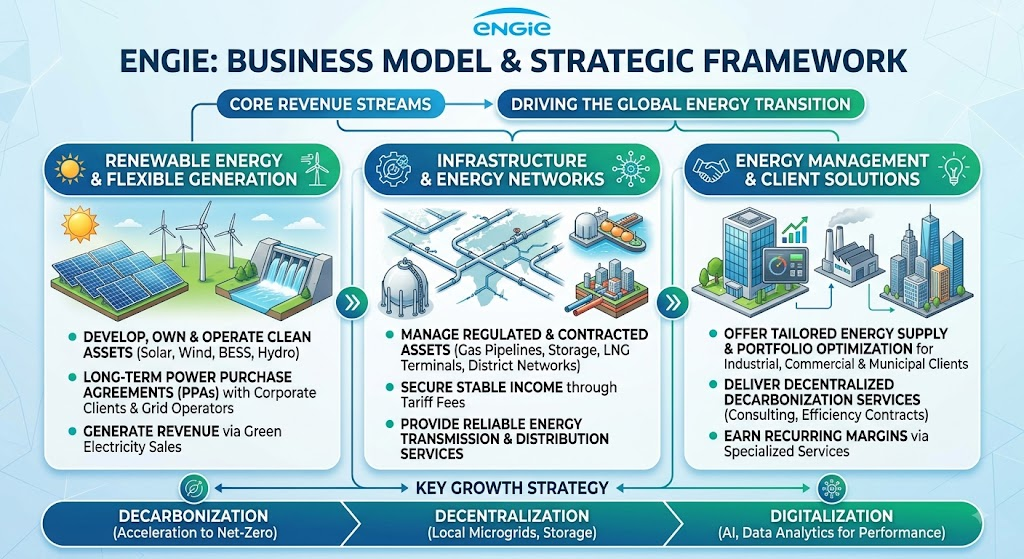
ENGIE generates revenues and earnings through three core business segments:
- Renewable Energy & Flexible Generation: Developing, owning, and operating solar, wind, battery energy storage systems(BESS), and hydropower assets. Revenues are generated by selling green electricity to corporate clients via long-term Power Purchase Agreements(PPAs) and grid operators.
- Infrastructure & Energy Networks: Managing essential regulated or long-term contracted assets, including natural gas transmission and distribution pipelines, underground storage facilities, LNG terminals, and urban district heating/cooling networks. Income is earned through stable tariff fees and long-term transmission and storage service contracts.
- Energy Management & Client Solutions: Offering tailored energy supply, portfolio optimization, risk management, and decentralized decarbonization services to industrial clients, commercial businesses, and municipalities. Margins are secured via specialized consulting, energy efficiency contracts, and recurring operational service agreements.
Strategic Framework
ENGIE’s corporate strategy centers on leading the global transition toward a carbon-neutral economy through three key pillars:
- Decarbonization: Accelerating renewable capacity additions, phasing out coal generation, expanding green hydrogen and biomethane, and adhering to a strict Net-Zero carbon emissions target by 2045.
- Decentralization: Investing heavily in localized microgrids, energy storage solutions, and distributed generation to enhance energy system flexibility and supply resilience for regional markets.
- Digitalization: Utilizing advanced data analytics, artificial intelligence, and specialized digital platforms to optimize asset performance, monitor carbon footprints, and maximize energy efficiency across all operations.
ENGIE’s AI Strategy & Application Footprint
ENGIE leverages Artificial Intelligence as a core operational engine to accelerate the energy transition and optimize complex asset networks:
- Renewable Forecasting & Grid Dispatch: Utilizing AI and machine learning algorithms paired with weather big data to predict solar and wind generation output, optimizing real-time charge/discharge strategies for Battery Energy Storage Systems(BESS).
- Predictive Maintenance: Deploying IoT sensors across wind turbines, solar panels, and gas infrastructure. AI models monitor equipment health in real time to detect anomalies and schedule maintenance before failures occur, reducing operational downtime.
- Enterprise Generative AI Integration: Rollout of secure, enterprise-grade AI assistants(such as Microsoft Copilot environments) across its global workforce to streamline contract reviews, internal documentation, and technical knowledge management.
- Decarbonization Services: Units like ENGIE Impact and GEMS employ AI algorithms to assist commercial and industrial clients with carbon footprint tracking, corporate PPA risk management, and dynamic facility energy optimization.
Key Tech Partners & Ecosystem
ENGIE builds its AI and digital infrastructure through strategic partnerships with leading technology firms:
- Microsoft:
- Azure & Enterprise AI: Migrating extensive data assets to Microsoft Azure and deploying enterprise-grade Generative AI solutions across business units.
- Google Cloud:
- Wind Power Analytics: Partnered with Google Cloud to leverage AI for predicting wind power generation accuracy, improving market bidding strategies in power trading.
- C3 AI:
- An early enterprise client of C3 AI, utilizing its software platform for predictive maintenance and enterprise energy analytics.
- Schneider Electric:
- Collaborative development in smart grid solutions, microgrid controllers, and AI-driven energy management software.
Budget & Financial Commitments
- Digital & IT Capital Expenditure: ENGIE allocates hundreds of millions of Euros annually toward digital transformation, cloud infrastructure, cybersecurity, and AI projects.
- OpEx / CapEx Allocation: Digital and AI technologies typically account for approximately 5% to 10% of ENGIE’s overall corporate IT and operational development spend.
- Venture Investments (ENGIE New Ventures): ENGIE’s corporate venture capital arm actively invests tens of millions of Euros into early-stage startups focused on AI-driven energy dispatch, microgrid management, and carbon accounting software.
Source:
- https://www.engie.com/en/our-activities/renewables-and-flex-power/
- https://www.engie.com/en/our-activities/energy-management-supply-customers/businesses-industries-and-local-authorities/
- https://www.engie.com/en/investors/esg-strategy-and-commitments/
- https://umbrex.com/resources/company-profiles/engie-sa/
Back to Engie