
Phase 1: Foundation & The “New Look” Revolution (1946–1957)
Background & Brand Inception
In the aftermath of World War II, European fashion was dominated by practical, boxy, and fabric-sparing utilitarian garments. In 1946, backed by French textile magnate Marcel Boussac, Mr. Christian Dior founded his eponymous haute couture house at 30 Avenue Montaigne in Paris, aiming to restore elegance, femininity, and glamour to post-war women.
The World-Shaking “New Look”
On February 12, 1947, Dior unveiled his debut haute couture collection. Carmel Snow, Editor-in-Chief of Harper’s Bazaar, famously exclaimed: “It’s such a new look!”—and the historic label was born.
- Design Signature: The iconic Bar Jacket featured soft, rounded shoulders, an extremely cinched waist, padded hips, and an expansive A-line pleated skirt that used meters of luxurious fabric, creating an hourglass silhouette reminiscent of a blooming flower.
- Historical Impact: It decisively broke away from wartime austerity and re-established Paris as the fashion capital of the world. That same year, Parfums Dior was launched alongside its debut fragrance, Miss Dior.
- Commercial Success: By the time of Christian Dior’s sudden passing from a heart attack in 1957, his house accounted for over 50% of total French haute couture exports.
Phase 2: Successor Masters & Commercial Expansion (1957–1989)
Following the founder’s sudden death, the brand transitioned from a single designer’s vision into a structured global business empire through the leadership of two prominent creative heads.
The Yves Saint Laurent Era (1957–1960)
A 21-year-old Yves Saint Laurent took over as head designer. His debut Trapeze Line abandoned rigid corsetry in favor of fluid, flared silhouette cuts. It preserved Dior’s elegance while offering freedom to a new generation of women, successfully steering the company through a potential crisis.
The Marc Bohan Era (1960–1989)
Marc Bohan led creative direction for nearly three decades, establishing a highly stable commercial foundation:
- Aesthetic Shift: Introduced the famed Slim Look, characterized by clean, streamlined, and wearable cuts favored by figures like Audrey Hepburn and Princess Grace of Monaco.
- Business Expansion: In 1967, Bohan launched the ready-to-wear line “Miss Dior” and Baby Dior. He also aggressively expanded international licensing, transforming Dior into a globally recognized luxury emblem.
Phase 3: LVMH Integration & The High-Drama Era (1989–2016)
During this period, Dior underwent major corporate restructuring, fully integrating into the global luxury conglomerate ecosystem while exploring creative extremes ranging from theatrical romanticism to modern minimalism.
Integration into the LVMH Group
In 1989, LVMH Chairman Bernard Arnault brought Dior couture and perfumes under unified control. Gianfranco Ferré, an Italian designer with an architectural background, took over, introducing sculptural tailoring and opulent grandeur.
John Galliano’s Theatrical Era (1996–2011)
British designer John Galliano brought unprecedented theatrical drama, romanticism, and spectacle to Dior:
- Visual Extravaganza: He fused historical costume, Eastern motifs, and street subcultures with traditional haute couture craftsmanship, turning runway shows into theatrical events.
- Iconic Breakthrough: In 1995, the First Lady of France gifted the “Chouchou” handbag to Diana, Princess of Wales. She fell in love with it, leading to the bag being renamed Lady Dior in 1996—a flagship bestseller to this day.
Raf Simons’ Minimalist Pivot (2012–2015)
Belgian designer Raf Simons brought a modern, minimalist aesthetic. He reinterpreted classic Dior silhouettes through contemporary lines, architectural structures, and fresh color palettes, appealing to a younger demographic.
Phase 4: Feminism, Streetwear Fusion & Modern Luxury Empire (2016–Present)
Dior evolved from a traditional couture house into a global luxury empire actively engaging with contemporary social dialogue and streetwear culture.
Maria Grazia Chiuri: Feminism & Global Bestsellers (2016–Present)
As the first female Creative Director in Dior’s history, Maria Grazia Chiuri reshaped the brand’s identity and market positioning:
- Brand Message: She integrated feminist empowerment into the brand narrative, debuting with the viral “We Should All Be Feminists” statement T-shirt and emphasizing wearable, empowering designs for modern women.
- Commercial Powerhouses: Reimagined archival motifs to launch massive hits like the Book Tote, revived Saddle Bag, and 30 Montaigne line, driving record revenue growth across womenswear and leather goods.
Kim Jones: Modernizing Dior Men (2018–Present)
Taking over Dior Men, Kim Jones redefined luxury menswear silhouettes:
- Artistic Collaborations: He frequently collaborates with contemporary artists like KAWS, Hajime Sorayama, and Daniel Arsham, blending street culture with haute couture tailoring.
- Market Influence: The introduction of the men’s Saddle bag adaptation and high-end sneaker collections established Dior Men as a dominant force in modern luxury menswear.
Business Model & Growth Strategy Analysis
Christian Dior(a flagship brand of the LVMH Group) stands as one of the world’s premier luxury fashion houses. Its commercial success rests on a delicate balance between traditional haute couture craftsmanship and aggressive, modern commercial expansion.
1. Core Business Model
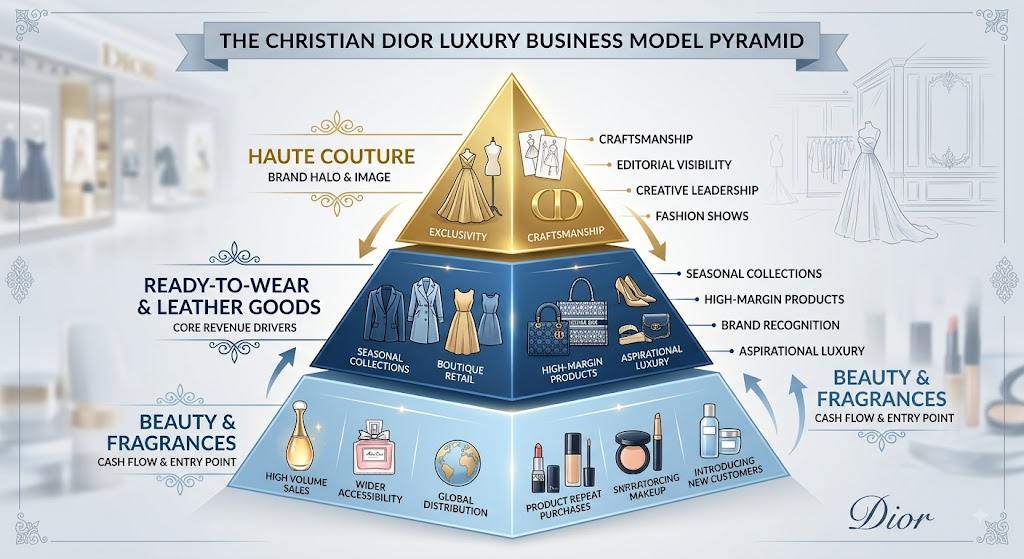
Dior’s business model relies on a pyramid-shaped value cascade combined with strict direct-to-consumer(DTC) channel control. This guarantees immense monetizing power while preserving the brand’s exclusivity and prestige.
1. Product Pyramid & Profit Matrix
- Top (Brand Halo): Haute Couture
- Role: Serves as the brand’s reputational engine rather than a primary profit driver.
- Impact: Anchors Dior at the absolute peak of the luxury hierarchy, bestowing a high-end luxury premium on all downstream categories.
- Middle (Core Revenue & Margin): Leather Goods, Ready-to-Wear & Fine Jewelry
- Role: Iconic handbags(e.g., Lady Dior, Saddle, Book Tote) and ready-to-wear lines.
- Impact: Delivers high gross margins and strong brand recognition. Represents the primary financial engine for Fashion & Leather Goods.
- Base (High-Frequency Entry Point): Beauty & Fragrances (Parfums Christian Dior)
- Role: Entry-level luxury items like Sauvage fragrance, Miss Dior, and Rouge Dior lipsticks.
- Impact: Accessible price points attract aspirational consumers, generating consistent cash flow and serving as the first gateway into the Dior universe.
2. Direct-to-Consumer(DTC) Channel Control
Dior maintains stringent control over distribution, generating the vast majority of its revenue through directly operated stores(DOS) and its official e-commerce site:
- Immersive Flagship Experiences: Destinations like 30 Avenue Montaigne in Paris blend boutiques with museums, haute cuisine, and gardens, elevating shopping into a rich cultural experience.
- Wholesale Reduction: Dior cut third-party wholesale distribution, strictly managing pricing, promotions, and customer data to safeguard brand equity and price integrity.
2. Growth Strategies
1. Dual Creative Leadership & Category Driving
Dior employs a dual-creative-director model to target distinct consumer segments with precision:
- Womenswear (Maria Grazia Chiuri):
- Strategy: Weaves feminist empowerment and modern practicality into the brand’s core, creating viral staples(Book Tote, revived Saddle) that resonate strongly with modern women.
- Menswear (Kim Jones):
- Strategy: Fuses haute couture tailoring with streetwear culture and contemporary art(collaborations with KAWS, Hajime Sorayama, Nike), transforming traditional menswear into high-hype luxury fashion.
2. Archival Reimagination & “Iconic” Bestseller Strategy
Dior excels at reimagining its nearly 80-year heritage archive:
- Monetizing Heritage: By updating historical codes—such as the 1947 Oblique pattern, the 1995 Lady Dior, and the 2000s Saddle Bag—Dior turns heritage assets into evergreen, long-term cash flow drivers.
3. Cultural Marketing & Experiential Storytelling
- Global Exhibition Tours: High-profile museum exhibitions like Christian Dior: Designer of Dreams elevate the brand to the realm of art and cultural heritage rather than mere commercial retail.
- Luxury Resort Lifestyle: Seasonal pop-ups and beach clubs(e.g., Dioriviera in Amalfi, Bali) embed the brand directly into the lifestyle of Very Important Clients(VICs).
4. Digital Transformation & High-Net-Worth Client(VIC) Management
- Omnichannel Ecosystem: Dior led early luxury e-commerce adoption and virtual fitting initiatives while utilizing data-driven insights for targeted client engagement.
- Private Salon Services: At the physical level, Dior provides dedicated private salons and bespoke fitting experiences for VICs, ensuring customer retention and high average spend.
Summary
Dior’s commercial formula is straightforward yet powerful: use haute couture and art-level storytelling to preserve top-tier prestige, leverage leather goods to generate high profit margins, and capture the broader market via beauty and fragrances. This ecosystem makes Dior one of the two main growth pillars within the LVMH Group alongside Louis Vuitton.
Source:
- https://live.euronext.com/en/product/equities/FR0000130403-XPAR
- https://www.dior-finance.com/en/historique-copie-en
- https://www.lvmh.com/en/investors/key-figures
- https://www.worldfinance.com/strategy/bernault-arnaults-lvmh-to-take-over-christian-dior-for-13bn
Back to Dior