
Overall Market Position
VINCI is one of the world’s largest infrastructure development and concessions giants, as well as the largest construction and concessions group in Europe by revenue. The group consistently ranks among the top global peers in market capitalization and revenue, and is a major component of both the French CAC 40 index and the European Stoxx Europe 50 index.
Market Position & Share by Business Pillar
1. Concessions(VINCI Concessions)
- Airport Operations(VINCI Airports): The world’s largest private airport operator. Manages over 70 airports across 14 countries(including London Gatwick Airport and Lisbon Airport), ranking first globally among private operators in annual passenger volume.
- Motorways(VINCI Highways): The largest motorway concession operator in France. Operating network entities such as ASF and Cofiroute, it manages over 4,400 km of concessions, representing more than 50% market share of France’s total concession motorway network.
2. Energy & Technical Services(VINCI Energies & Cobra IS)
- European Leadership: VINCI Energies is a leading player in Europe for electrical grid infrastructure, industrial automation, and ICT network services.
- Renewable Energy & Power Grids: Following the acquisition of Spain’s Cobra IS in 2021, the group became a top-tier EPC contractor and developer for renewable energy projects, high-voltage grids, and energy transition initiatives across Europe and Latin America.
3. Construction & Engineering(VINCI Construction)
- Europe’s No. 1 Construction Contractor: Consistently ranks 1st in Europe and among the top international contractors globally according to Engineering News-Record(ENR) and European industry rankings. Alongside Bouygues and Eiffage, VINCI stands as one of France’s “Big Three” engineering giants, holding a dominant market position in domestic civil engineering and major public works.
Source:
VINCI Competitive Position & Outlook
PitchBook VINCI Company Profile
Supply Chain Architecture Overview
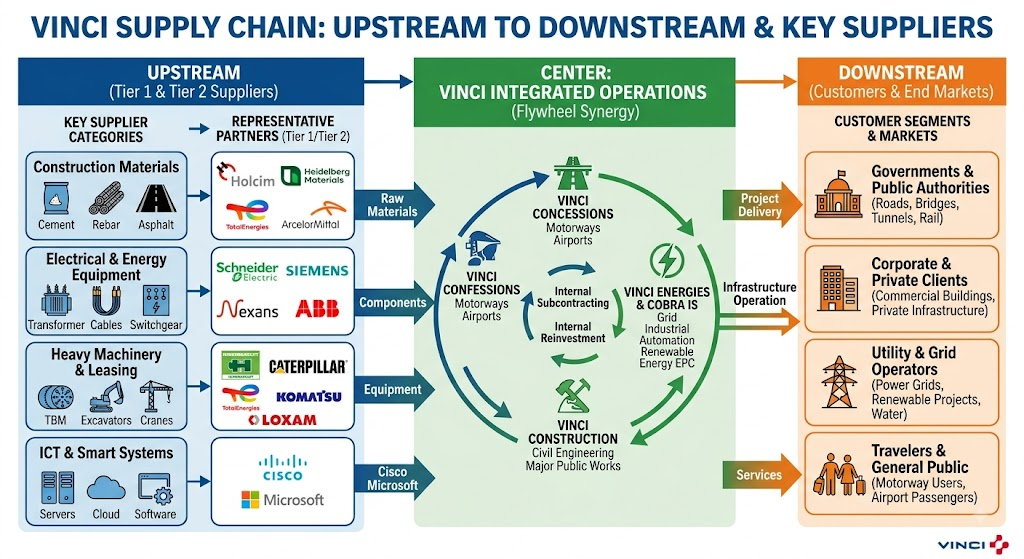
VINCI operates a highly decentralized and tiered/localized supply chain framework. Because its activities span across heavy civil construction, energy technology services, and concession operations, the group’s supply chain is exceptionally broad and localized, avoiding reliance on any single critical supplier.
Key characteristics of VINCI’s procurement and supply chain management include:
- Localized Sourcing & SME Partnerships: To reduce Scope 3 carbon footprints and support local economies, raw materials and subcontracting services are sourced regionally, partnering with global industrial leaders alongside local small-and-medium enterprises(SMEs).
- Sustainable & Low-Carbon Procurement: VINCI enforces strict ESG and Scope 3 emissions screening criteria, prioritizing suppliers of low-carbon cement, recycled asphalt, and green energy equipment.
- Diversified Purchasing Categories: Procurement covers raw construction materials, heavy machinery leasing, specialized electrical gear, ICT infrastructure, and specialized subcontracting.
Key Supplier Categories & Representative Partners
While VINCI’s overall vendor list includes tens of thousands of regional suppliers, its primary equipment, material, and system suppliers can be categorized as follows:
1. Construction Materials & Low-Carbon Solutions
- Material Categories: Cement, concrete, bitumen, structural steel, and recycled aggregates.
- Key Partners / Suppliers:
- Holcim & Heidelberg Materials: Key suppliers of low-carbon cement and ready-mix concrete.
- TotalEnergies: Supply of bitumen, asphalt binders, and fuel products required for heavy equipment.
- ArcelorMittal: Supply of structural steel and rebar for large-scale infrastructure projects.
2. Electrical, Grid & Energy Equipment
- Material Categories: High/low-voltage transformers, switchgear, power cables, sub-stations, and automation controls.
- Key Partners / Suppliers:
3. Heavy Machinery & Equipment Rental
- Material Categories: Tunnel boring machines(TBMs), excavators, cranes, and bare-rental equipment fleets.
- Key Partners / Suppliers:
- Herrenknecht: Customized tunnel boring machines(TBMs) for underground metro and tunnel infrastructure.
- Caterpillar & Komatsu: Heavy earthmoving equipment, loaders, and excavators.
- Loxam & Kiloutou: Specialized heavy equipment and construction vehicle rental networks.
4. ICT & Smart Systems Architecture
- Material Categories: Cloud infrastructure, network hardware, airport terminal management, and motorway tolling systems.
- Key Partners / Suppliers:
Source:
VINCI Universal Registration Document – Responsible Purchasing Guidelines
Umbrex VINCI Key Supplier Analysis
Competitor Landscape
VINCI faces competition from major international and regional players across three primary tiers:
Integrated Concessions & Construction Giants(Direct Peer Group)
- Bouygues(France): Competes directly in building construction, civil engineering, and energy technical services, while diversifying into telecommunications and media.
- Eiffage(France): The 3rd largest construction group in France, operating the APRR motorway concession and competing head-to-head with VINCI in its domestic market.
- ACS Group(Spain): A top global contractor and concession operator(owner of Hochtief in Germany), posing heavy competition in North America and Latin America.
- Ferrovial(Spain): Focuses heavily on airport and toll road concessions(e.g., stake in London Heathrow, 407 ETR in Canada), directly mirroring VINCI’s concession strategy.
Specialized Energy & Technology Service Providers
- SPIE & Equans(owned by Bouygues): Compete against VINCI Energies in electrical infrastructure, industrial automation, and ICT network solutions.
Financial Competitiveness
1. Revenue Scale & Global Geographical Reach
- Tier-1 Global Revenue Scale: Consolidated revenue stands at approximately €74.6B, significantly outperforming peers such as Eiffage(~€23B) and ACS(~€36–40B), providing massive economies of scale.
- Geographical Risk Diversification: International business accounts for nearly 60% of total revenue. Unlike competitors like Eiffage(over 90% European concentration), VINCI’s footprint spans North America, Latin America, Europe, and Asia.
2. Profitability & Segment Margin Structure
- Hybrid Margin Architecture: Concessions generate high EBITDA margins(65%+ for toll roads and airports), whereas Construction operates on lower margins(EBIT margin around 4%) and Energy Solutions delivers steady EBIT margins around 7.5–8.0%.
- Superior Combined Operating Margin: Group EBITDA margin reaches ~18.1% and EBIT margin ~12.8%. This is vastly superior to pure-play construction contractors(EBIT margins typically 2–5%), offering far greater earnings resilience.
3. Free Cash Flow Generation & Balance Sheet Strength
- Record Cash Flow Creation: Free cash flow reached a record €7.0B. This unmatched cash generation provides ample capital to self-fund new concession acquisitions without heavy equity dilution.
- Manageable Capital Structure: Net financial debt sits around €19B (~1.4x EBITDA). Because this debt is backed by long-term, inflation-indexed concession contracts, VINCI maintains a lower cost of capital and higher credit rating than pure engineering peers.
Technical & Operational Competitiveness
1. Specialized Civil Engineering Capabilities
- Geotechnical & Structural Moats(Soletanche Freyssinet): VINCI Construction’s specialized subsidiaries lead globally in geotechnical engineering, bridge prestressing, and structural rehabilitation. This expertise eliminates low-bid price competition in high-complexity projects(subsea tunnels, deep foundations, long-span bridges).
- Large Tunnel Boring Machine(TBM) Execution: Deep collaborative experience with TBM suppliers enables VINCI to act as a principal contractor for massive urban transit schemes, such as the Grand Paris Express.
2. HVDC Grids & Renewable Energy EPC
- Cobra IS & Dragados Offshore Integration: The acquisition of Cobra IS expanded VINCI’s technical capacity to design and build high-voltage direct current(HVDC) offshore converter platforms for North Sea wind farms, alongside utility-scale solar/wind farms and grid infrastructure.
- Data Centers & Microgrids: VINCI Energies leverages multi-technical capabilities to secure long-term recurring maintenance and integration contracts for industrial automation, data centers, and smart grids.
3. Smart Asset Operations & Decarbonization
- Digital Infrastructure Operations: VINCI Airports implements AI passenger flow prediction and biometric boarding systems, while VINCI Highways deploys free-flow tolling.
- Asset Green-Topping: Accelerating EV ultra-fast charger deployment, on-site solar generation, and SAF(Sustainable Aviation Fuel) facilities improves VINCI’s ESG scoring during government public-private partnership(PPP) re-tendering processes.
Competitive Summary & Risk Profile
Core Strategic Advantages
- Dual-Engine Closed-Loop Flywheel: High-margin concession cash flow funds project investments, while internal construction/energy capabilities execute asset build-outs and upgrades.
- High Order Book Visibility: Massive order book backlog(~€70B) allows VINCI to practice selective bidding, prioritizing margin expansion over contract volume.
Principal Risks & Challenges
- Taxation & Regulatory Risk: Government interventions, such as special corporate taxes or infrastructure levies on motorway operators in France, impact net income.
- Concession Expiry Re-bidding Pressure: Legacy motorway concessions face expiration in the coming decade, requiring sustained capital deployment to acquire new long-term assets(e.g., international airports).
Sources: