
1899–1999: Founding & Early Growth
- 1899: Founded by engineers Alexandre Giros and Louis Loucheur as SGE(Société Générale d’Entreprises).
- 20th Century: Deepened operations in French and European infrastructure, electric power, and public utility projects.
2000–2009: Rebranding & Strategic Expansion
- 2000: SGE rebranded as VINCI and merged with GTM(Grands Travaux de Marseille), becoming a world-leading construction and engineering group.
- 2006: Acquired major motorway concessions, including ASF(Autoroutes du Sud de la France), establishing its core dual-engine model of “Concessions + Construction”.
2010–2019: Global Diversification & Airport Footprint
- 2010: Acquired Cegelec to expand VINCI Energies’ technical service offerings.
- 2010s: Established VINCI Airports to aggressively expand global concession operations, acquiring rights to dozens of international airports, including London Gatwick Airport.
2020–Present: Energy Transition & Sustainable Future
- 2021: Completed the acquisition of Cobra IS(the energy business of Spain’s ACS Group), significantly boosting capabilities in renewable energy development and power grid infrastructure.
- Present: Actively driving the green transition by delivering sustainable infrastructure and energy solutions across nearly 100 countries.
Business Model(How VINCI Makes Money)
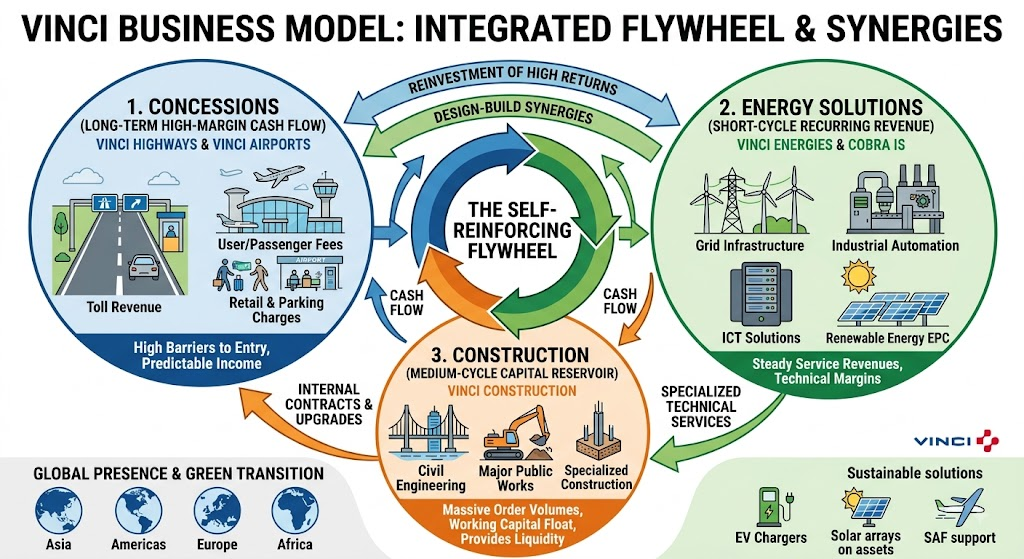
VINCI’s revenue engine relies on the self-reinforcing flywheel between Concessions and Energy & Construction. By pairing short-, medium-, and long-term business cycles, the group achieves high resilience and continuous monetization:
1. Concessions: Long-Term, High-Margin Cash Flow
- Motorways & Airports(VINCI Highways & VINCI Airports): Generates revenue via toll fees from drivers, user/passenger fees from airlines, retail concession fees, and parking charges. Although capital-intensive upfront, these assets carry high barriers to entry and produce long-term, highly predictable, and high-margin cash flows.
2. Energy Solutions & Technology Services: Short-Cycle Recurring Revenue
- VINCI Energies & Cobra IS: Delivers power grid infrastructure, industrial automation, ICT solutions, and renewable energy EPC project management. These contracts have shorter lead times and low capital intensity, generating steady recurring service revenues and technical margins.
3. Construction & Infrastructure: Medium-Cycle Capital Reservoir
- VINCI Construction: Handles civil engineering, major public works, specialized construction, and building projects. While operating margins are relatively lower, it produces massive order volumes and working capital float, supplying liquidity across the group.
4. Capital Allocation & the Synergistic Flywheel
- Cash generated from construction and energy services(short-to-medium cycle) is reinvested into high-return concession assets(long cycle). Conversely, when concession assets require design, construction, or upgrades, VINCI leverages its internal construction and energy units to capture full value-chain synergies.
Development Strategy
1. International Expansion & Portfolio Diversification
- Actively reducing reliance on the domestic French market, with international revenue now exceeding 55%. VINCI expands its global footprint and extends the average duration of its concession portfolio through selective acquisitions(e.g., London Gatwick Airport, Spain’s Cobra IS energy division).
2. Capturing the Energy Transition & Green Infrastructure
- Capitalizing on global decarbonization trends by scaling solar PV, wind power, and smart grid infrastructure. Simultaneously green-topping existing concession assets—such as installing EV ultra-fast chargers, setting up solar arrays on site, and supporting sustainable aviation fuels(SAF)—to enhance long-term asset value.
3. Selective Bidding & Decentralized Governance
- Adopting a “highly selective” bidding strategy in its contracting businesses to focus on high-margin, complex, and maintenance-driven projects rather than low-bid volume chasing. This is paired with a highly decentralized management structure that empowers local teams to respond flexibly to market demands.
Source:
VINCI Official Business Model & Strategy
VINCI Universal Registration Document
Back to Vinci