Equinor holds a pivotal market position and strong market share across several core sectors in the global energy landscape:
1. Largest Natural Gas Supplier in Europe
Following global geopolitical shifts and reduced Russian gas supplies, Norway became Europe’s primary natural gas supplier. Equinor, serving as the backbone of Norway’s energy sector, handles the majority of the nation’s gas exports, currently supplying approximately 25% to 30% of Europe’s total natural gas demand. This makes Equinor the single most critical corporate supplier for European energy security and power stability
2. Absolute Dominance on the Norwegian Continental Shelf(NCS)
In domestic oil and gas exploration and production(E&P), Equinor maintains absolute market dominance
- Production Market Share: Controls approximately 70% of total oil and gas production and operations on the Norwegian Continental Shelf(NCS).
- Global Output: Maintains total equity production above 2 million barrels of oil equivalent per day(mboe/day), consistently ranking among the top global oil and gas majors.
3. Global Pioneer in Floating Offshore Wind
Leveraging decades of offshore engineering expertise, Equinor has established a high competitive moat in renewable energy:
- Floating Wind Leadership: Developed and operates Hywind Scotland(the world’s first commercial floating offshore wind farm) and Hywind Tampen(the world’s largest floating offshore wind farm), securing a globally leading technical position and market share in deep-water offshore wind.
- Large-Scale Green Power Expansion: Actively participating in mega-projects like Dogger Bank in the UK(one of the world’s largest offshore wind developments), rapidly expanding its commercial green power capacity.
4. First-Mover in Commercial Carbon Capture & Storage(CCS)
Equinor occupies a tier-one market position in commercial carbon management:
- Spearheads the Northern Lights project, the world’s first cross-border, open-source commercial CO2 transport and storage infrastructure venture.
- Pioneer in offering cross-border carbon storage services, providing commercial decarbonization solutions to heavy industries(such as steel and cement) across Europe and capturing first-mover advantage in Europe’s emerging carbon service market.
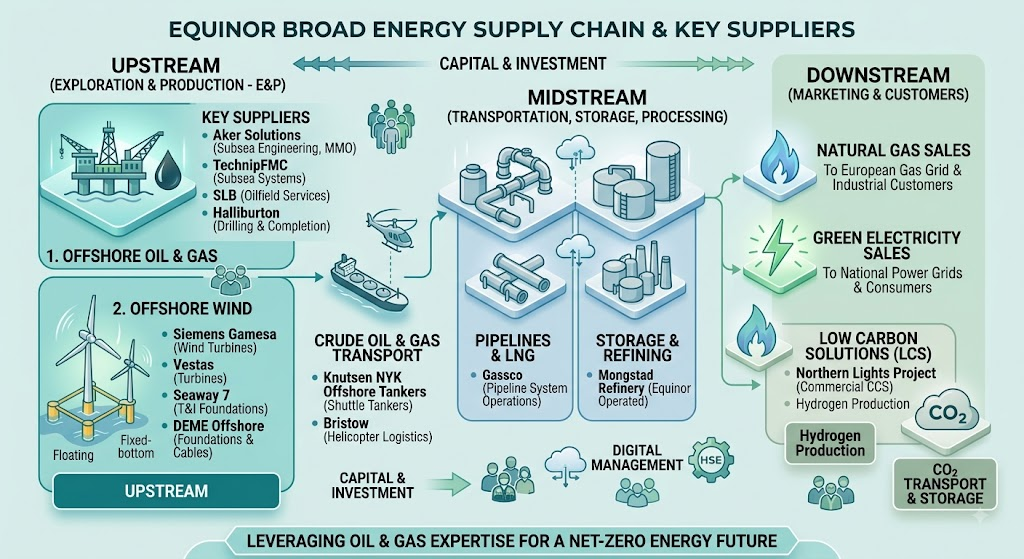
Equinor operates a highly technology-intensive, safety-critical, and digitized supply chain that spans traditional upstream oil and gas exploration, midstream logistics, and emerging renewable energy and low-carbon infrastructure.
Supply Chain Architecture & Operational Overview
- Digitized Procurement & Vendor Management: Equinor utilizes digital management systems such as SAP Ariba and Icertis to automate supply chain workflows and minimize manual processing costs via electronic catalogs(Provide), while enforcing strict Health, Safety, and Environment(HSE) and ethical compliance standards across all vendors.
- Strong Reliance on Norwegian Domestic Industrial Base: For operations across the Norwegian Continental Shelf(NCS), Equinor relies heavily on long-term framework contracts with major Norwegian engineering and maintenance partners to ensure asset safety, field life extension, and operational integrity.
- Dual-Track Infrastructure Integration: The procurement network is actively transitioning from conventional subsea engineering, drilling rigs, and marine logistics to include offshore wind foundations, turbine units, and carbon capture and storage(CCS) pipeline technologies.
Key Suppliers by Sector
- Subsea Engineering, MMO & Infrastructure:
- Aker Solutions: A core long-term partner providing subsea production equipment, offshore platform maintenance and modifications(MMO), and subsea tie-in services.
- Aibel & Wood Group: Awarded multi-billion-dollar framework contracts for long-term maintenance, modification, and operational support across offshore platforms and onshore facilities.
- TechnipFMC & SLB OneSubsea: Suppliers of subsea production systems(SPS), umbilical cables, and complex deepwater field architecture.
- Drilling Rigs & Oilfield Services:
- SLB(Schlumberger), Baker Hughes, and Halliburton: Provide drilling technology, well logging, completion equipment, and reservoir digitalization services across Equinor’s global assets.
- Offshore Wind & Renewable Equipment:
- Siemens Gamesa & Vestas: Primary original equipment manufacturers(OEMs) for offshore wind turbines and associated technical maintenance contracts.
- Seaway 7 & DEME Offshore: Transport and installation contractors for offshore wind foundations, substations, and submarine power cables.
- Maritime Logistics & Transport:
- Knutsen NYK Offshore Tankers(KNOT): Operates shuttle tankers for North Sea crude oil offloading and transportation.
- Aviation Contractors(e.g., Bristow, CHC): Manage offshore helicopter transport services, carrying hundreds of thousands of personnel annually to offshore platforms.
Detailed Competitive Analysis: Equinor vs. Global Energy Supermajors
Equinor’s primary competitors are the international integrated oil majors (Supermajors): Shell, TotalEnergies, BP, ExxonMobil, and Chevron. The following analysis evaluates Equinor’s competitive standing across financial performance and technological capabilities.
1. Financial Competitiveness Analysis
Financial Metrics & Peer Comparison
| Financial Metric | Equinor (EQNR) | Shell (SHEL) | TotalEnergies (TTE) | BP (BP) | Industry Context & Competitive Analysis |
| Return on Equity (ROE) | ~23.6% | ~14.3% | ~15.7% | Volatile / Lower | Top-tier in industry. Primarily driven by high profitability from low-cost fields on the Norwegian Continental Shelf (NCS). |
| Free Cash Flow (FCF) Generation | Exceptionally Strong ($20B+ cumulative multi-year targets) | Strong (>$20B annually) | Strong (>$18B annually) | Moderate (Burdened by debt) | Equinor maintains cash flow resilience through strict Capex discipline and low operating costs. |
| Balance Sheet & Leverage | Extremely Robust (Net debt ratio ~11.9%) | Moderate | Low-to-Moderate | Relatively High | Highly defensive capital structure; breakeven cash flow is achieved even at low Brent crude prices (~$50/bbl). |
| Capital Distribution & Yield | High Dividends + Share Buybacks | Steady Buybacks | Stable Dividends & Buybacks | Constrained Buybacks | Majority state ownership (~67%) guarantees a highly reliable and attractive shareholder distribution policy. |
Core Financial Strengths & Risks
- Core Strengths:
- Ultra-Low Lifting Costs: Equinor’s upstream production costs on the Norwegian Continental Shelf (NCS) remain around $6/boe, generating significantly higher unit margins than most global peers.
- Capital Efficiency (ROACE): Long-term Return on Average Capital Employed (ROACE) target is maintained at 13%–15%+, making Equinor one of the most capital-disciplined majors in the industry.
- Financial Risks & Drawbacks:
- High Tax Environment: Subject to Norway’s 78% marginal petroleum tax rate, which caps net post-tax margins despite strong gross profits.
- Concentrated Asset Base: Revenue scale ($100B–$110B range) is smaller than Shell or TotalEnergies, offering slightly less geographical asset diversification against localized risks.
2. Technological Competitiveness Analysis
Equinor has established a high moat in specialized deepwater and low-carbon technologies while balancing scale competition from peers:
1. Deepwater & Subsea Engineering
- Subsea Production & Platform Electrification: Pioneer in powering offshore platforms with shore-to-power renewable electricity (e.g., Johan Sverdrup field). This reduces upstream operational carbon intensity to under 6.3 kg CO2/boe, well below the global industry average of 15–20 kg CO2/boe.
- Peer Comparison: Achieved asset electrification and automated remote control earlier than peers like Shell or ExxonMobil.
2. Floating Offshore Wind Leadership
- Technology Pioneer: Operates Hywind Scotland and Hywind Tampen, positioning Equinor as a global pioneer in floating wind. Floating technology enables deployment in water depths exceeding 60 meters, unlocking deep-sea wind resources worldwide.
- Peer Comparison: While TotalEnergies and Shell are expanding in fixed-bottom wind, Equinor holds proprietary operational datasets and engineering moats in floating hull designs and dynamic subsea cabling.
3. Carbon Capture and Storage (CCS) & Hydrogen
- Commercial Scale Storage: Leads the Northern Lights project, building Europe’s first cross-border, open-source commercial CO2 transport and offshore storage infrastructure.
- Peer Comparison: ExxonMobil focuses heavily on onshore US CCS opportunities, whereas Equinor leverages Norway’s subsea geological storage assets to capture a first-mover advantage in Europe’s cross-border industrial decarbonization market.
3. Strategic Summary
- Vs. US Majors (ExxonMobil / Chevron): While US majors double down on traditional fossil fuel expansion, Equinor focuses on maximizing high-margin oil & gas cash flows while selectively directing capital into European power and CCS infrastructure.
- Vs. European Majors (Shell / TotalEnergies / BP): Having observed peers struggle with low-margin renewable projects, Equinor maintains strict capital discipline by recalibrating renewable Capex to prioritize high-return offshore projects, sustaining a superior ROACE (13%–15%+).
Source:
- https://www.equinor.com/news/archive/2018-09-26-strengthening-subsea-collaboration
- https://www.offshore-energy.biz/10-billion-awards-spree-seven-players-split-equinors-multibillion-dollar-contracts-cake/
- https://www.equinor.com/news/archive/20220211-extends-agreements-norwegian-suppliers
- https://www.equinor.com/about-us/key-information-for-suppliers
- https://www.seaway7.com/
- https://www.siemensgamesa.com/global/en/home.html
Back to Equinor