Anheuser-Busch InBev(AB InBev) maintains an undisputed leadership position in the global beer industry. A detailed analysis of its market standing and share includes:
1. Global Market Position & Share
- World’s Largest Brewer: AB InBev ranks first globally, controlling approximately 27% of the global beer market by volume(meaning nearly 1 out of every 4 beers sold worldwide originates from the group).
- Revenue Leadership: With annual revenues reaching nearly $60 billion(approx. $59.77 billion), its operational scale far exceeds major peers such as Heineken and Carlsberg.
2. Regional Dominance
- Latin America: Serves as the primary driver of volume and profit, holding dominant market shares well over 50% across key markets including Mexico, Brazil, Argentina, and Colombia.
- North America: Remains the leading player in the US beer market, capturing a market share of nearly 30%(accounting for around 28.6% of total US beer industry revenues).
- Asia Pacific: Expands through its subsidiary Budweiser APAC, maintaining the #1 market share in South Korea(powered by its Cass brand) and leading the premium and super-premium beer segments in China.
3. Brand Portfolio & Competitive Moat
- Premium Brand Monopoly: Portfolio features over 500 brands, with global flagship brands like Budweiser, Corona, and Stella Artois consistently occupying the top spots in global valuable beer brand rankings.
- Scale Economies Barrier: Unrivaled global supply chain and distribution networks—complemented by its proprietary BEES B2B platform—create a formidable cost advantage and market penetration capability that competitors cannot easily match.
Sources
- https://www.ab-inbev.com/
- https://www.foodtalks.cn/en/news/55117
- https://en.wikipedia.org/wiki/AB_InBev
Anheuser-Busch InBev(AB InBev) maintains an undisputed leadership position in the global beer industry. A detailed analysis of its market standing and share includes:
1. Global Market Position & Share
- World’s Largest Brewer: AB InBev ranks first globally, controlling approximately 27% of the global beer market by volume(meaning nearly 1 out of every 4 beers sold worldwide originates from the group).
- Revenue Leadership: With annual revenues reaching nearly $60 billion(approx. $59.77 billion), its operational scale far exceeds major peers such as Heineken and Carlsberg.
2. Regional Dominance
- Latin America: Serves as the primary driver of volume and profit, holding dominant market shares well over 50% across key markets including Mexico, Brazil, Argentina, and Colombia.
- North America: Remains the leading player in the US beer market, capturing a market share of nearly 30%(accounting for around 28.6% of total US beer industry revenues).
- Asia Pacific: Expands through its subsidiary Budweiser APAC, maintaining the #1 market share in South Korea(powered by its Cass brand) and leading the premium and super-premium beer segments in China.
3. Brand Portfolio & Competitive Moat
- Premium Brand Monopoly: Portfolio features over 500 brands, with global flagship brands like Budweiser, Corona, and Stella Artois consistently occupying the top spots in global valuable beer brand rankings.
- Scale Economies Barrier: Unrivaled global supply chain and distribution networks—complemented by its proprietary BEES B2B platform—create a formidable cost advantage and market penetration capability that competitors cannot easily match.
Sources
- https://www.ab-inbev.com/
- https://www.foodtalks.cn/en/news/55117
- https://en.wikipedia.org/wiki/AB_InBev
A detailed competitive analysis of Anheuser-Busch InBev(AB InBev) against its primary peers(such as Heineken and Carlsberg), including financial and technical perspectives, is as follows:
1. Global Competitive Landscape Overview
- AB InBev: The undisputed global beer market leader, controlling approximately 27% global volume market share. It dominates the industry through economies of scale and a massive premium brand portfolio(Budweiser, Corona, Stella Artois).
- Heineken: The world’s second-largest brewer, holding roughly 12-13% market share. It leverages its single flagship Heineken brand to drive strong global expansion across Europe and Southeast Asia while aggressively pushing zero-alcohol offerings(Heineken 0.0).
- Carlsberg: The third-largest global group, focusing heavily on Western Europe, Eastern Europe, and selected Asian markets. Guided by its “Sail’28” strategy, it emphasizes premiumization and cost discipline.
2. Financial Competitiveness
Revenue Scale & Profitability
- Revenue Scale: AB InBev generates approximately $60 billion in annual revenue, significantly outstripping Heineken(~$36-38 billion) and Carlsberg(~$11-12 billion), giving it overwhelming scale advantages in procurement, production, and marketing.
- EBITDA Margins: Driven by Zero-Based Budgeting(ZBB), AB InBev maintains rigorous cost control, achieving a Normalized EBITDA Margin of 34-38%—substantially higher than Heineken and Carlsberg, which typically range between 20-24%.
- Free Cash Flow & Debt Profile: Following its historic acquisition of SABMiller, AB InBev carried high net debt. However, generating over $8-10 billion in robust free cash flow annually allows the company to continuously deleverage and improve capital allocation efficiency.
3. Technology & Digital Transformation Competitiveness
AB InBev significantly leads traditional beverage peers in technology deployment and digital ecosystem building, centered around three main pillars:
B2B Digital Ecosystem(BEES Platform)
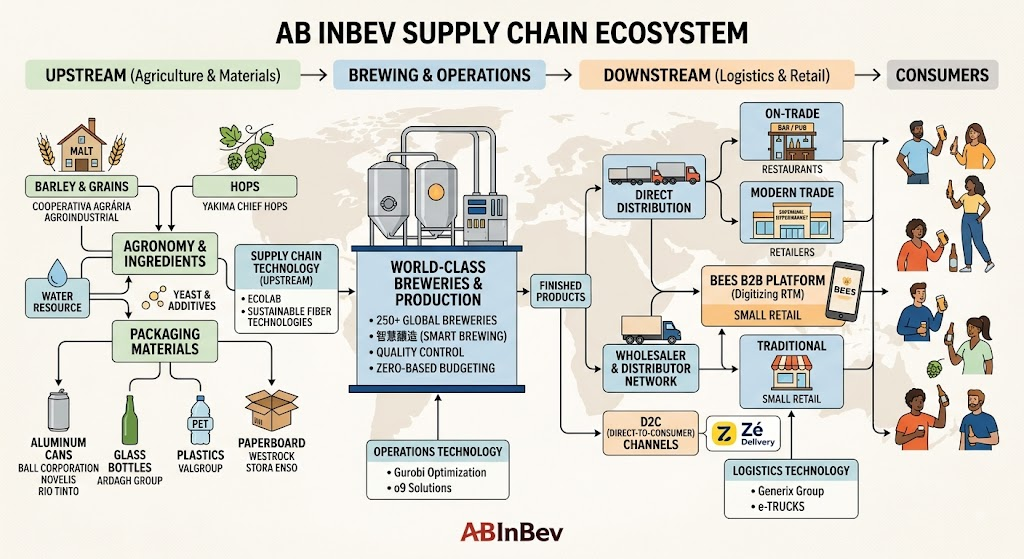
- Ecosystem Scale: Its proprietary B2B e-commerce platform, BEES, operates in over 28 countries, boasting over 3 million monthly active users(MAUs) among small retailers and approaching $50 billion in annual Gross Merchandise Value(GMV).
- Business Model Evolution: Transforms sales representatives from simple order-takers into commercial advisors. Uses machine-learning algorithms to provide personalized inventory recommendations and flexible credit services(FinTech), raising retailer retention and average order values.
- BEES Marketplace Expansion: Opens its platform to non-competing consumer packaged goods(CPG) vendors, creating platform service revenue and valuable data assets unreachable by traditional brewers.
D2C Consumer Technology
- On-Demand Delivery Networks: Developed Zé Delivery in Latin America(and TaDa Delivery globally), promising chilled beer delivery within 30 minutes and gathering real-time consumer purchasing data and drinking occasion insights.
- Smart Appliances: Deploys PerfectDraft smart home draft systems in mature markets to capture premium at-home consumption occasions.
Supply Chain & Brewing Innovation(GITEC & Algorithms)
- Supply Chain Optimization Engines: Integrates Gurobi Optimization and o9 Solutions decision engines for end-to-end capacity planning, logistics routing, and inventory minimization across 250+ breweries worldwide.
- Brewing & Packaging R&D: The Global Innovation and Technology Center(GITEC) in Leuven, Belgium leads low-carbon packaging development(such as low-carbon aluminum cans with Rio Tinto), agricultural fiber packaging alternatives, and green brewing processes.
4. Competitive Moat & Risks
Core Competitive Strengths(Moat)
- Cost & Scale Moat: Massive production volume combined with zero-based budgeting grants an unrivaled unit cost structure that peers cannot easily replicate.
- Digital Route-to-Market Moat: The BEES platform creates high digital switching costs, effectively locking in digital distribution access to millions of mom-and-pop retail stores and bars.
Key Risks & Challenges
- Mature Market Volume Pressures: Mainstream beer volumes in North America and Western Europe face headwinds, requiring continuous reliance on premiumization and non-alcoholic brews(e.g., Corona Cero) to drive value growth.
- Geographic & Currency Volatility: High profit dependence on Latin America and emerging markets exposes returns to local currency devaluation and inflation dynamics.
Sources
- https://www.ab-inbev.com/about-us/what-we-do/innovation
- https://www.bees.com/about
- https://www.ab-inbev.com/news-media/news-stories/three-for-bees-article
- https://ciandt.com/sg/en/case-study/bees-ab-inbev-ambev-b2b-hive
- https://www.genpact.com/case-studies/ab-inbev-a-digital-transformation-worth-toasting
Back to AB InBev