
Safran holds a dominant market position with high entry barriers across the global aerospace and defense supply chain:
1. Aerospace Propulsion
- Narrowbody Engine Market: Global No. 1
- Through CFM International (its 50/50 joint venture with GE Aerospace), Safran maintains long-standing market leadership in narrowbody (single-aisle) commercial aircraft engines.
- Market Share: Captures over 60% global market share in the narrowbody segment (including the Airbus A320 family and Boeing 737 family).
- Platform Coverage:
- Boeing 737 MAX: LEAP-1B is the exclusive (100%) engine supplier.
- COMAC C919: LEAP-1C is currently the exclusive (100%) Western engine provider.
- Airbus A320neo: LEAP-1A competes with Pratt & Whitney, securing roughly 60% market selection rate.
2. Aerospace Equipment & Systems
Safran ranks No. 1 or No. 2 globally across several critical aerospace systems:
- Landing Gear Systems: Global No. 1
- Safran Landing Systems is the world’s largest manufacturer of landing gear for commercial and military aircraft.
- Wheels & Carbon Brakes: Global No. 1
- Commands over 50% market share in carbon braking systems for mainline commercial jets (over 100 seats).
- Power Transmission Systems: Global No. 1
- Holds over 30% global market share in power transmission systems for commercial airliners over 100 seats.
- Cabin Interiors & Aircraft Seats: Top 3 Globally
- Following the acquisition of Zodiac Aerospace, Safran became a top global supplier of passenger seats, first-class suites, and interior equipment.
3. Overall Industry Position
- World’s 3rd Largest Aerospace Supplier (ranking just behind GE Aerospace and RTX Corporation / Pratt & Whitney).
- Defense Optronics & Navigation: Leading European defense supplier, holding the No. 1 position in Europe for military inertial navigation and optronics equipment.
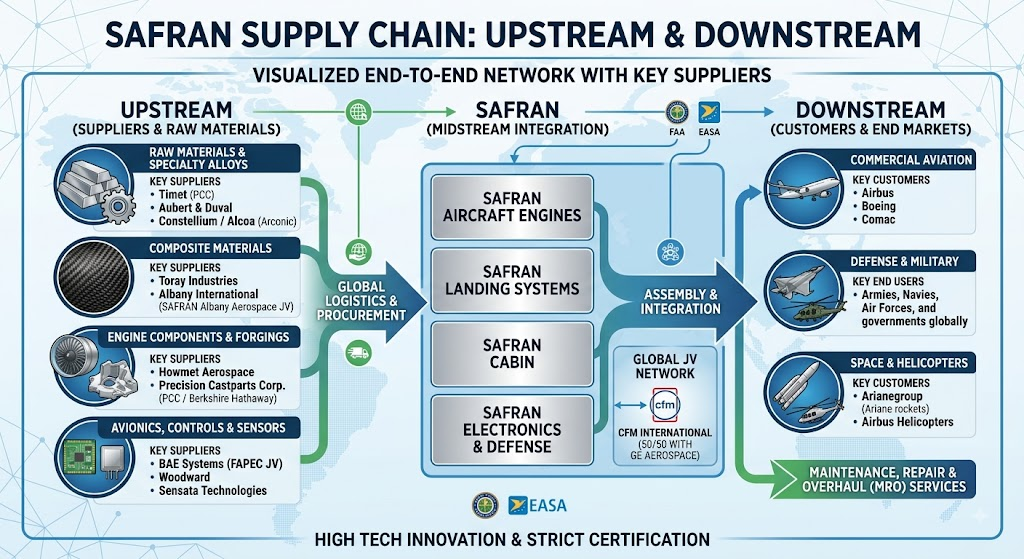
As the world’s 3rd largest aerospace equipment and engine manufacturer, Safran operates a global supply chain characterized by exceptionally high technological barriers, rigorous regulatory certifications, and long-term strategic supplier partnerships.
Supply Chain Overview
- High Entry Barriers & Strict Certification: Aerospace components directly impact flight safety. Suppliers must pass stringent, years-long qualification processes with civil aviation authorities(such as the FAA and EASA) and Safran itself.
- Tiered Supply Chain Structure:
- Tier 1 Suppliers: Deliver complete integrated subsystems(e.g., full-authority digital engine control systems, primary structures).
- Tier 2 & 3 Suppliers: Provide advanced raw materials(specialty alloys, carbon fiber composites) and precision-machined parts(castings, forgings, sensors).
- Intertwined Network with GE Aerospace: Through its 50/50 joint venture CFM International, Safran’s propulsion supply chain is deeply integrated with GE Aerospace, sharing global assembly, testing, and forging networks.
Key Suppliers by Category
1. Raw Materials & Specialty Alloys
Aerospace engines and landing gears require materials capable of withstanding extreme temperatures and structural stress:
- Timet(Titanium Metals Corporation) / PCC: Supplies titanium alloys and high-grade specialty metals used in engine fan blades, structural frames, and landing gear components.
- Aubert & Duval: A French metallurgy specialist providing high-performance forgings, engine disc blanks, drive shafts, and specialty steel.
- Constellium / Alcoa(Arconic): Supplies aerospace-grade, high-strength aluminum alloys and sheets for aerostructures and equipment housings.
2. Composite Materials
A major technological milestone of the LEAP engine is its 3D-woven carbon fiber composite fan blades:
- Toray Industries: Supplies high-strength aerospace-grade carbon fiber raw yarns and prepregs.
- Albany International: Operates a joint venture with Safran(Safran Albany Aerospace), using proprietary 3D-weaving technology to manufacture carbon fiber fan blades and fan woven cases for LEAP engines.
3. Engine Components, Castings & Forgings
- Howmet Aerospace: Supplies precision single-crystal turbine blade castings designed for high-temperature hot sections, as well as heavy-duty aerospace fasteners.
- Precision Castparts Corp.(PCC / Berkshire Hathaway): Provides complex, large-scale titanium and nickel-based investment castings, structural engine frames, and superalloy components.
4. Avionics, Engine Controls & Sensing Systems
- BAE Systems: Collaborates with Safran via FAPEC(a joint venture) to design and produce Full Authority Digital Engine Control(FADEC) systems—the primary processing unit for aircraft engines.
- Woodward: Supplies critical fuel metering units, main fuel pumps, control valves, and actuators for engine fuel systems.
- Sensata Technologies: Provides high-precision pressure, temperature, and position sensors integrated across engine controls and flight systems.
Safran operates within a highly consolidated competitive landscape in aerospace propulsion and equipment. The detailed analysis across competitive mapping, financial performance, and technological architecture is outlined below.
1. Competitor Mapping & Industry Positioning
- GE Aerospace (GE): Functions as both a key strategic partner and a potential competitor. Through their 50/50 joint venture, CFM International, Safran and GE share revenues from the LEAP engine family; however, GE maintains independent product lines in widebody (twin-aisle) commercial engines and certain military segments.
- RTX Corporation / Pratt & Whitney: Represents Safran’s primary direct competitor in the narrowbody engine market. Pratt & Whitney’s Geared Turbofan (GTF) engine competes head-to-head with Safran’s LEAP engine on the Airbus A320neo platform. Additionally, RTX’s Collins Aerospace division competes with Safran in cabin interiors and aircraft systems.
- Rolls-Royce: Specializes in widebody engines (such as the Trent series) and military aviation, creating strategic differentiation from Safran’s focus on single-aisle aircraft.
- Honeywell: Competes with Safran in adjacent aerospace categories, including landing gear, braking systems, auxiliary power units (APUs), and avionics.
2. Financial Competitiveness Comparison
| Financial Dimension | Safran | GE Aerospace | RTX / Pratt & Whitney |
| Operating Margin | 18.4% (Above industry average) | ~19%–20% (Top tier in aerospace) | Lower (Impacted by GTF recall compensations) |
| Earnings Structure | Highly reliant on high-margin MRO services offsetting lower OE margins | Supported by a massive installed base driving recurring service revenue | Strong aftermarket revenue, but offset by significant recent warranty and recall expenses |
| Cash Flow Stability | Strong free cash flow (€2.62B in H1 2026) | Exceptionally high free cash flow conversion and a clean balance sheet | Cash flow volatility due to defense headwinds and commercial engine recall costs |
- Financial Summary: Safran effectively distributes R&D costs and capital expenditures through the CFM International architecture. Compared to Pratt & Whitney, which faced billions in inspection and compensation costs due to powder metal defects in GTF engines, Safran maintains superior operational quality and cash flow stability.
3. Technology Roadmap & Product Competitiveness
(1) Narrowbody Engine Technology: LEAP vs. GTF
- Architectural Differences:
- LEAP (Safran / CFM): Features a traditional dual-shaft direct-drive architecture combined with 3D-woven carbon fiber composite fan blades (Safran’s proprietary technology) and Ceramic Matrix Composites (CMCs). Its key advantages lie in structural simplicity, high reliability, and shorter maintenance turnaround times.
- GTF (Pratt & Whitney): Utilizes a Geared Turbofan architecture with a reduction gearbox that allows the fan and low-pressure turbine to operate at optimal independent speeds. While offering theoretical fuel efficiency gains, it entails greater structural complexity and thermal stress challenges.
- Reliability & Market Selection Rate:
- Dispatch Reliability: LEAP maintains an industry-leading dispatch reliability exceeding 99.9%. In contrast, GTF engines faced temporary groundings and accelerated inspections due to hot-section component durability issues and powder metal flaws.
- Market Share: LEAP holds a 100% exclusive position on the Boeing 737 MAX and COMAC C919 platforms, and secures approximately 60% selection rate on the Airbus A320neo family, giving Safran over 60% global market share in the narrowbody sector.
(2) Next-Generation Propulsion Roadmap: RISE vs. GTF Advantage
- CFM RISE Program (Safran / GE): Features an Open Fan (unducted) architecture that eliminates the traditional fan nacelle, maximizing fan diameter to target a 20% reduction in fuel burn and CO2 emissions compared to current engines, with entry into service planned for the mid-2030s.
- GTF Advantage (Pratt & Whitney): Enhances the existing geared architecture with upgraded hot-section coatings and improved aerodynamics to boost thrust and durability, aiming to restore fleet confidence.
(3) Aerospace Equipment & Materials Technology
- Safran maintains global leadership and deep patent barriers in carbon braking systems and landing gear engineering. Its carbon brake disks offer several times the wear life of conventional steel brakes while reducing overall weight by nearly 40%, making them standard equipment across mainstream commercial fleets.
Source:
- https://umbrex.com/resources/company-profiles/safran-sa-2/
- https://sifterfund.com/en/the-beauty-of-safrans-business-model-lies-in-its-predictability/
- https://pestel-analysis.com/blogs/growth-strategy/safran-group
- https://www.safran-group.com/pressroom/ge-aviation-and-safran-launch-advanced-technology-demonstration-program-sustainable-engines-extend-2021-06-14-0
- https://www.cfmaeroengines.com/rise
Back to Safran