
Founded in 1836, Schneider Electric has evolved over nearly two centuries from a traditional heavy industry manufacturer into a global leader in energy management and automation. Its history can be divided into five major phases:
Phase 1: Heavy Industry & Railways (1836–1891)
Founded by brothers Adolphe and Joseph-Eugène Schneider in France, the company initially focused on steel, heavy machinery, rail equipment, and armaments, serving as a key player in the European Industrial Revolution.
Phase 2: Entry into the Electrical Market (1891–1980)
In 1891, Schneider entered the emerging electrical industry. After World War II, the group gradually abandoned armaments to focus on heavy electrical equipment, electric railways, and infrastructure development.
Phase 3: Focus on Electricity & Automation (1981–1999)
The company divested its non-core steel assets and underwent major transformation through strategic acquisitions (including Telemecanique, Square D, and Merlin Gerin). It reshaped itself into an expert in power distribution and industrial automation, officially renaming to Schneider Electric in 1999.
Phase 4: Expansion into Critical Power & Energy Management (2000–2015)
With key acquisitions such as APC in 2007 (a leader in Uninterruptible Power Supply systems) alongside building automation and software firms, Schneider expanded its footprint into data centers, critical power, and smart buildings, establishing an end-to-end energy management ecosystem.
Phase 5: Digitalization, Software & Sustainability (2016–Present)
Schneider launched its EcoStruxure IoT-enabled architecture and acquired British industrial software giant AVEVA. Today, the company leads digital automation by combining IoT, AI, and software services to help global enterprises achieve net-zero carbon targets and sustainability goals.
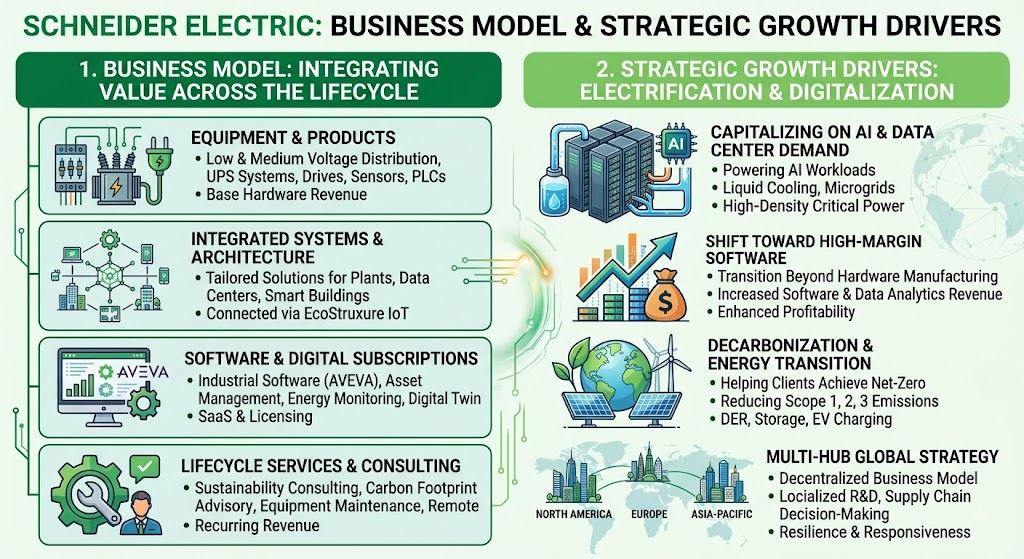
Schneider Electric’s business model and growth strategy revolve around the dual engines of Electrification and Digitalization, designed to help corporate clients maximize energy efficiency and achieve net-zero sustainability goals.
1. Business Model
Schneider generates recurring and predictable revenue by integrating hardware, software, and lifecycle services:
- Equipment & Product Sales: Provides fundamental hardware components, including low and medium-voltage power distribution equipment, Uninterruptible Power Supply(UPS) systems, variable speed drives, sensors, and PLCs.
- Integrated Systems & Architecture: Connects connected products, edge control, and software systems via its EcoStruxure IoT platform to deliver tailored management systems for industrial plants, data centers, and smart buildings.
- Software & Digital Subscriptions: Incorporates industrial software (such as AVEVA) to offer asset management, energy monitoring, and digital twin solutions through high-margin SaaS subscriptions and licensing models.
- Lifecycle Services & Consulting: Delivers long-term value through sustainability consulting, carbon footprint advisory, equipment retrofit maintenance, and remote monitoring services.
2. Strategic Growth Drivers
To maintain its market leadership, Schneider focuses on four core strategic pillars:
- Capitalizing on AI & Data Center Demand: Addresses the massive power consumption and cooling challenges of AI workloads by supplying liquid cooling technologies, microgrids, and high-density critical power architecture.
- Shift Toward High-Margin Software & Services: Continuously increases the revenue share from software, data analytics, and consulting services to enhance profitability beyond traditional hardware manufacturing.
- Decarbonization & Energy Transition: Assists enterprises in reducing Scope 1, 2, and 3 emissions while actively expanding into distributed energy resources(DER), battery storage management, and EV charging infrastructure.
- Multi-Hub Global Strategy: Operates a decentralized business model with major hubs across North America, Europe, and Asia-Pacific. This structure localizes R&D and supply chain decision-making, improving operational resilience and responsiveness to local markets.
Source:
- https://www.se.com/ww/en/about-us/investor-relations/
- https://www.se.com/ww/en/about-us/strategy/
- https://www.se.com/ww/en/work/solutions/system/ecostruxure/
- https://www.aveva.com/
Back to Schneider