TotalEnergies holds a commanding position in the global energy landscape, with market standing and market share details outlined below:
1. Global Integrated Energy Supermajor
- Supermajor Status: Ranks alongside Shell, ExxonMobil, Chevron, and BP as one of the world’s premier multinational integrated energy supermajors.
- Global Footprint: Operates across 120 to 130 countries and territories worldwide, supported by a global workforce exceeding 100,000 employees.
2. Liquefied Natural Gas(LNG) Market Position & Share
- Top Global LNG Player: Ranks as the world’s 2nd largest investor-owned LNG player and 3rd largest LNG participant overall.
- Global Market Share & Volume: Commands approximately 10% of the global LNG market share, with an annual sales volume around 40 million metric tons(Mt).
- Key U.S. Exporter: Serves as one of the largest exporters of U.S. LNG to Europe and global markets, exporting over 10 million tons from the U.S. in 2024.
3. Renewable Energy & Low-Carbon Power Leadership
- Energy Transition Pioneer: Widely recognized among traditional oil majors as one of the most proactive and strategically clear drivers of the low-carbon power transition.
- Generation Scale Target: Targets scaling total electricity generation to 100–120 TWh by 2030, with 70% derived from solar and wind power.
4. Upstream Hydrocarbons & Downstream Marketing
- Daily Hydrocarbon Output: Maintains a total hydrocarbon production rate of around 2.4 million barrels of oil equivalent per day(Mboe/d).
- Downstream Retail Network: Operates over 15,000 service stations globally, maintaining high market share and brand recognition across Europe, Africa, and other key markets.
Source URLs:
- https://totalenergies.com/company/ambition/multi-energy-strategy/natural-gaz
- https://bg.totalenergies.com/en/who-we-are/totalenergies-worldwide
- https://marinefuels.totalenergies.com/products-and-services/liquefied-natural-gas
- https://umbrex.com/resources/company-profiles/totalenergies/
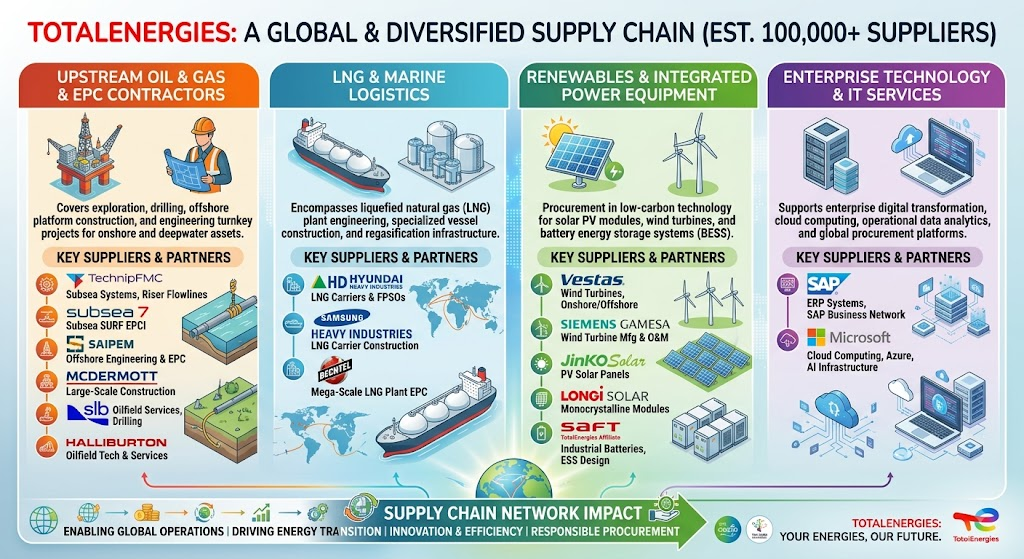
TotalEnergies maintains a global supply chain network comprising over 100,000 goods and service suppliers worldwide, with annual procurement spending reaching tens of billions of dollars. Its supply chain spans traditional hydrocarbon operations as well as emerging low-carbon technologies, categorized into four primary segments and key suppliers:
1. Upstream Oil & Gas & EPC Contractors
- Supply Chain Overview: Covers exploration, drilling, offshore platform construction, and Engineering, Procurement, and Construction(EPC) turnkey projects for onshore and deepwater assets.
- Key Suppliers & Partners:
- TechnipFMC & Subsea 7: Key providers of subsea architecture, umbilicals, risers, and flowlines(SURF).
- Saipem & McDermott: Major contractors for large-scale offshore engineering and EPC delivery.
- SLB(formerly Schlumberger) & Halliburton: Core providers of oilfield services, well drilling, and reservoir appraisal technologies.
2. LNG & Marine Logistics
- Supply Chain Overview: Encompasses liquefied natural gas(LNG) liquefaction plant engineering, specialized vessel construction(such as LNG carriers), and regasification infrastructure.
- Key Suppliers & Partners:
- HD Hyundai Heavy Industries & Samsung Heavy Industries: Primary shipbuilders for LNG carriers and floating production assets.
- Bechtel: Main EPC contractor for mega-scale LNG liquefaction facilities.
3. Renewables & Integrated Power Equipment
- Supply Chain Overview: As TotalEnergies advances its energy transition, procurement in low-carbon technology has expanded rapidly across solar PV modules, wind turbine generators, and battery energy storage systems(BESS).
- Key Suppliers & Partners:
- Vestas & Siemens Gamesa: Primary suppliers for onshore/offshore wind turbines and maintenance services.
- JinkoSolar & LONGi Solar: Major suppliers of photovoltaic(PV) solar panels and modules.
- Saft(TotalEnergies Affiliate): In-house development, manufacturing, and integration of industrial battery energy storage systems.
4. Enterprise Technology & IT Services
- Supply Chain Overview: Supports enterprise digital transformation, cloud computing, operational data analytics, and supply chain procurement platforms across global operations.
- Key Suppliers & Partners:
Source URLs:
- https://totalenergies.com/suppliers
- https://totalenergies.com/sustainability/creating-shared-value/supply-chain
- https://totalenergies.ca/en/discover-totalenergies/suppliers
TotalEnergies’ competitors in the global energy market are divided into three main camps. The competitive landscape and analysis of its strengths and weaknesses are as follows:
Three Main Competitor Camps
1. US Oil Majors
- ExxonMobil and Chevron
- Competitive Focus: US-based players focus heavily on traditional upstream oil and gas core operations, emphasizing strict capital discipline and high-return upstream assets (such as the Permian Basin in the U.S. and Guyana oil fields).
- Comparison with TotalEnergies: US majors outperform in upstream oil and gas returns and market capitalization, but lag significantly behind TotalEnergies in renewable energy and low-carbon power investments.
2. European Peers
- Shell and BP
- Competitive Focus: European peers face stringent European decarbonization policies and investor pressure, actively seeking energy transitions. Shell holds a leading position in LNG and global trading, while BP actively advances its carbon-neutrality layout.
- Comparison with TotalEnergies: TotalEnergies adopts a “Two-Pillar Strategy”, maintaining high-cash-flow oil and gas assets while more directly and massively building out “Integrated Power” low-carbon assets compared to Shell and BP (who rely more on light-asset joint ventures), providing higher transition strategic continuity and execution capability.
3. National Oil Companies (NOCs)
- Saudi Aramco and ADNOC
- Competitive Focus: Possess the world’s lowest production costs and massive resource reserves, gradually expanding into global LNG and downstream operations.
- Comparison with TotalEnergies: NOCs set the industry cost floor, but TotalEnergies leverages deep historical partnerships in the Middle East (such as Qatar and the UAE) to deeply participate in their large-scale LNG and oil and gas development projects.
TotalEnergies’ Core Competitive Advantages
- Leading Upstream Cost Control: Among supermajors, it boasts extremely low unit production costs (approx. $5.0/boe) and organic cash breakeven points ($26.4/b), demonstrating strong resilience in low-oil-price environments.
- LNG Value Chain Dominance: As one of the top three global LNG players and a major leader in U.S. LNG exports and European imports, it possesses superior cross-regional price arbitrage capabilities.
- Low-Carbon Power Scaling Strength: Through its unique Integrated Power segment, it directly holds and operates renewable and flexible generation assets, establishing the clearest low-carbon growth pathway among traditional oil and gas supermajors.
Competitive Challenges and Risks
- Return on Average Capital Employed (ROACE) Challenges in Low-Carbon Power: Compared to high-margin traditional oil and gas, returns on renewables and power retail are generally lower, and massive capital expenditures face the test of electricity market price volatility.
- Geopolitical and Regulatory Pressure: Carbon emission regulations at its European headquarters are stricter than those of U.S. competitors, and its operational footprint spans multiple countries with higher political and economic risks.
Source URLs:
- https://strategy.transforml.co/totalenergies-strategy-cascade-analysis
- https://www.owler.com/company/totalenergies/competitors
- https://pestel-analysis.com/blogs/competitors/bp
Back to Totalenergies