
The history of TotalEnergies can be divided into four major stages:
1. Foundation & Overseas Expansion(1924–1953)
- 1924: Founded as Compagnie Française des Pétroles(CFP) by the French government to establish an independent national energy supply.
- Middle East Expansion: Early operations focused on acquiring shares in the Iraq Petroleum Company and developing Middle Eastern oil fields.
2. Globalization & Brand Establishment(1954–1998)
- Launch of Total Brand: In 1954, the downstream refined product brand “Total” was introduced, expanding operations across Europe, Africa, and global markets.
- Renamed Total: Officially renamed Total SA in 1991, continuing to expand global investments in upstream exploration and downstream refining.
3. Mega-Mergers & Consolidation(1999–2019)
- Major Acquisitions: Merged with Belgium’s Petrofina(1999) and France’s Elf Aquitaine(2000) to form TotalFinaElf, becoming one of the top four global oil majors.
- 2003: Reverted its name to Total SA, solidifying its position as a global energy supermajor.
4. Energy Transition & Diversification(2020–Present)
- Rebranded to TotalEnergies: Renamed TotalEnergies in 2021 to signal its transition into a broad, integrated energy company.
- Low-Carbon Pivot: Accelerated growth in Liquefied Natural Gas(LNG), solar, wind, green hydrogen, and biofuels, aiming for net-zero carbon emissions by 2050.
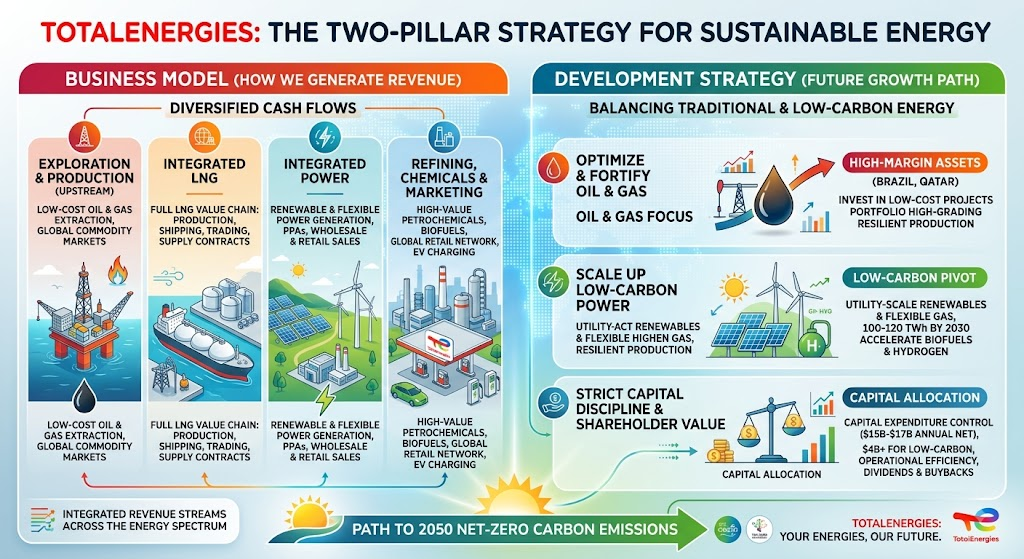
TotalEnergies’ revenue generation model and growth strategy are built on a “two-pillar” approach: anchoring cash flows through tradition, while pivoting aggressively toward low-carbon energy.
Business Model(How They Make Money)
As an integrated energy supermajor, TotalEnergies generates revenue across four primary operational segments:
1. Exploration & Production(Upstream)
- Revenue Mechanism: Extracts crude oil and natural gas in low-cost regions for global commodity markets. By maintaining low unit production costs, it generates significant, highly profitable baseline cash flows despite global oil price volatility.
2. Integrated LNG
- Revenue Mechanism: Operates a fully integrated value chain from upstream gas reserves(e.g., Qatar, U.S.) to liquefaction, maritime shipping, and regasification terminals. Revenue comes from long-term supply contracts supplemented by global trading desks that exploit regional price arbitrage.
3. Integrated Power
- Revenue Mechanism: Combines utility-scale renewable power generation(solar and wind) with flexible gas-fired generation(Gas-to-Power). Profits are generated by selling electricity through corporate Power Purchase Agreements(PPAs), wholesale power markets, and direct retail sales to commercial and residential customers.
4. Refining & Chemicals & Marketing(Downstream)
- Revenue Mechanism: Refines crude oil into high-value petrochemicals, specialty chemicals, and biofuels. Retail margin is captured through a global network of thousands of TotalEnergies service stations offering fuel, EV fast-charging, and convenience services.
Development Strategy
TotalEnergies executes a “Two-Pillar Strategy” balancing core hydrocarbons with the energy transition:
1. Optimize and Fortify Oil & Gas
- Focus on High-Margin Assets: Prioritizes investment in low-cost, high-yield deepwater oil projects(e.g., Brazil, U.S. Gulf of Mexico) and expanding LNG capacity(e.g., Qatar’s NFE expansion), aiming for modest, highly profitable oil & gas production growth.
- Portfolio High-Grading: Divests higher-cost or carbon-intensive assets to ensure its hydrocarbon portfolio remains resilient even under low-oil-price environments.
2. Scale Up Low-Carbon & Power Capabilities
- Utility-Scale Power Goal: Targets scaling annual electricity production to 100–120 TWh by 2030(70% renewable, 30% flexible gas), driving the Integrated Power segment to generate positive net cash flow.
- Next-Gen Energy: Accelerates investment in Sustainable Aviation Fuel(SAF), biogas, and green hydrogen to help enterprise customers decarbonize while positioning for the 2050 net-zero goal.
3. Strict Capital Discipline & Shareholder Value
- Capital Allocation: Maintains annual net capital expenditure within $15B–$17B, directing over $4B toward low-carbon and power initiatives.
- Return Efficiency: Focuses on continuous operational cost reduction while returning value to investors through consistent dividend growth and share buybacks.
Source:
- https://totalenergies.com/company/ambition/multi-energy-strategy
- https://totalenergies.com/energy-transition
- https://totalenergies.com/newsroom/download/?n=2788958d4d0f6f8aaa2771e524b0b995.pdf&picid=19505
Back to Totalenergies