
OmniVision Group holds a pivotal position in the global CMOS Image Sensor (CIS) market. Its market standing and share are reflected across the following dimensions:
1. Global Comprehensive Market Position
- Top Three Global Supplier: The global CIS market is characterized by an oligopolistic structure dominated by Sony and Samsung, with OmniVision firmly maintaining its position as the third-largest core supplier globally.
- High-End Market Penetration: While Sony dominates overall revenues and the high-end flagship smartphone market, OmniVision sustains strong competitive growth across diverse applications through continuous technological iterations (such as TheiaCel technology and large-format high-pixel solutions).
2. Market Share Performance in Key Segments
- Automotive CIS: This is one of OmniVision’s core competitive strengths. Benefiting from rising penetration rates in Advanced Driver Assistance Systems (ADAS) and autonomous driving, OmniVision ranks among the global leaders in automotive CIS market share (consistently securing second place globally, trailing or neck-and-neck with ON Semiconductor) and has successfully integrated into top international automotive OEMs and autonomous driving platforms like NVIDIA DRIVE.
- Smartphone CIS: As the largest application terminal for CIS, OmniVision ranks third globally in smartphone market share, continuously expanding its penetration among mainstream smartphone brands through mid-to-high-end product layouts and domestic supply chain synergies.
- Security Surveillance and Emerging Applications: In security surveillance, machine vision, and the Internet of Things (IoT), OmniVision’s shipment volumes and market share also rank among the global leaders, holding substantial market influence.
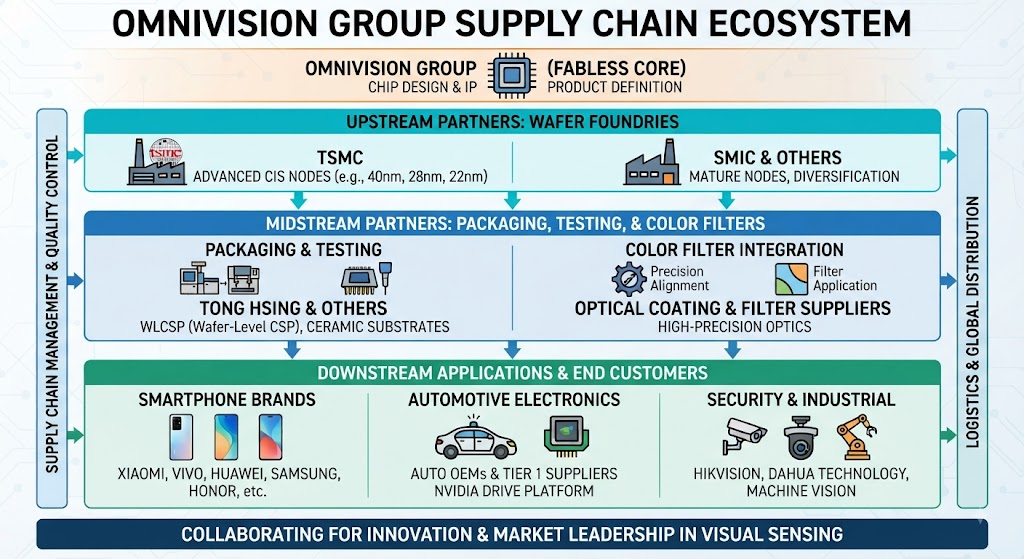
OmniVision Group (formerly Will Semiconductor) operates under a Fabless business model. Its supply chain framework encompasses upstream wafer foundries, midstream packaging and testing, and downstream brand manufacturers:
1. Upstream Wafer Foundries and Core Partners
- TSMC: The world’s largest wafer foundry, TSMC is OmniVision’s core manufacturing partner for advanced CMOS Image Sensor (CIS) processes, maintaining long-term collaboration in advanced nodes and specialty technologies.
- SMIC and Other Foundries: To mitigate supply chain risks and meet the demand for mature nodes and certain consumer electronics chips, the company also partners with SMIC and other major mainland and global semiconductor foundries.
2. Midstream Packaging, Testing, and Color Filter Supply Chain
- Tong Hsing and Other Packaging Partners: Renowned packaging and testing houses providing critical support in wafer-level packaging (WLCSP) and ceramic substrates for image sensors.
- Testing Facilities: Responsible for backend processes including high-precision chip testing and color filter integration.
3. Downstream Applications and Major End Customers
- Smartphone Brands: Products are widely integrated into the supply chains of major global smartphone manufacturers, including Xiaomi, vivo, Huawei, Samsung, and Honor.
- Automotive and Security Leaders: In automotive electronics, its sensor solutions are integrated into top international automotive OEMs and autonomous driving platforms (such as NVIDIA DRIVE); in security surveillance, customers include industry leaders such as Hikvision and Dahua Technology.
OmniVision Integrated Circuits Group (formerly Will Semiconductor) holds a leading global position in the CMOS Image Sensor (CIS) field. Below is a competitive analysis of the company within the 2026 market environment:
1. Market Positioning and Competitive Landscape
The global CIS market exhibits a trend of high concentration (oligopoly), in which OmniVision plays a key role:
- Industry Status: OmniVision consistently ranks among the top three global CIS suppliers, trailing only Sony Semiconductor Solutions and Samsung Semiconductor.
- The “Big Three” Competitors:
- Sony: Leveraging cutting-edge process technology, high-end stacked sensors, and advanced image processing algorithms, it maintains dominance in the high-end market (particularly flagship smartphones) with long-standing market share leadership.
- Samsung: Possesses vertical integration capabilities through its internal wafer foundries and vast resources in memory and logic chips, providing strong pressure in product specifications and cost competition.
- OmniVision: As a representative fabless company, OmniVision excels in flexible product definition, cost-effective solutions, and deep cultivation in sectors like automotive electronics and security surveillance, allowing it to differentiate itself from the top two.
2. Core Areas of Competition
OmniVision competes through the breadth and depth of its product portfolio:
- Consumer Electronics (Smartphones): This is the most fiercely contested market. Facing technological monopolies by Sony and low-cost competition from local Chinese manufacturers (such as SmartSens), OmniVision relies on its mid-to-high-end product mix and computational photography solutions to maintain market share.
- Automotive Electronics (ADAS/Autonomous Driving): This is one of OmniVision’s most competitive segments. Benefiting from global safety regulations for Advanced Driver Assistance Systems (ADAS), demand for automotive imaging is growing rapidly. Through deep partnerships with major automotive OEMs, OmniVision performs strongly in high-resolution, low-light, and wide dynamic range (WDR) sensors.
- Industrial and Security: Targeting machine vision, industrial automation, and surveillance, OmniVision continues to expand its share in industrial automation by utilizing its “Global Shutter” technology and high-performance image processing solutions.
3. SWOT Competitive Analysis
| Strengths | Weaknesses |
| Comprehensive Tech Portfolio: Platform capabilities encompassing CIS, TDDI, and analog chips. | Supply Chain Dependency: As a fabless company, there is a high reliance on foundry capacity (e.g., TSMC, SMIC). |
| First-Mover Advantage in Automotive: Deep customer relationships in autonomous driving sensor solutions. | High-End Technology Gap: Still faces pressure to catch up with Sony in extreme imaging process technology. |
| Industrial Investment Ecosystem: Established upstream/downstream investment network through “Weihao Venture.” | Price War Risks: Faces intense price competition from second-tier domestic Chinese firms in the low-end market. |
4. Strategic Challenges in 2026
- Geopolitics and Supply Chain Sovereignty: With the global emphasis on chip self-sufficiency, OmniVision, as a company with Chinese capital roots, must balance its international market footprint against the supply chain scrutiny brought about by geopolitical tensions.
- AI Infrastructure Transformation: With the surge in demand for AI and edge computing, the CIS industry is shifting from mere “image acquisition” to “visual processing” (incorporating neural network engines). OmniVision must accelerate the integration of AI compute units (NPU/ISP) into its sensors.
- Inventory Cycle Management: Following the recovery from the semiconductor inventory adjustment, the critical factor for maintaining gross margins in 2026 will be accurately forecasting market demand for consumer electronics and managing foundry capacity quotas.
In summary, OmniVision’s current strategy is to “stabilize mobile, deepen automotive, and capture industrial/AI vision,” while attempting to narrow the gap with Sony and Samsung in high-end technology through continuous technical M&A and ecosystem investment.
Source:
https://www.omnivision-group.com
Back to Will semiconductor