
The history of Will Semiconductor (now known as OmniVision Integrated Circuits Group) can be categorized into three key stages, evolving from initial product diversification through strategic acquisitions to becoming a global platform-based semiconductor leader.
Phase 1: Diversified Layout and Parallel Distribution (2007–2016)
In its early years, the company primarily focused on the design of discrete power devices and power management ICs. To rapidly expand its business, the company adopted a strategy combining organic growth with external acquisitions:
- Entry into Distribution and New Technologies: In 2013, the company entered the semiconductor distribution market through the acquisitions of Beijing Jinghongzhi and Hong Kong Huaqing.
- Expanding Technical Breadth: Over the following years, the company acquired Taihe Zhiheng (Satellite Live SoC) and Wuxi Zhongpu Micro (RF chips). It also established subsidiaries such as Shanghai Panju and Shanghai Xijiu to develop microphone and broadband carrier technologies, establishing a multi-product business architecture.
Phase 2: IPO and the Acquisition of OmniVision, Pivoting to CIS (2017–2020)
This period was critical to the company’s transformation into a global tech giant, with capital operations and M&A acting as the primary drivers:
- IPO and Resource Integration: The company listed on the Shanghai Stock Exchange in 2017, opening new financing channels.
- Strategic Acquisitions: After multiple efforts and regulatory reviews, the company officially completed the acquisition of Beijing OmniVision, SuperPix Micro, and Shixinyuan in 2019. This propelled the company to become one of the world’s top CMOS Image Sensor (CIS) suppliers.
- Enhancing Display Technology: In 2020, the company acquired Synaptics’ Asia-based TDDI (Touch and Display Driver Integration) business, further refining its product matrix for mobile and display applications.
Phase 3: Platform Development and Industrial Venture Capital (2021–Present)
The company entered a phase of technological deepening and ecosystem construction, utilizing industrial funds to invest in upstream and downstream supply chains:
- Industrial Incubation: In 2020, the company founded the “Weihao Venture” investment platform, focusing on automotive electronics, wearables, sensor chips, and core manufacturing equipment to incubate emerging categories.
- Strategic Rebranding: As the revenue contribution from CIS grew, the company officially announced its rebranding to “OmniVision Integrated Circuits Group” in 2026. This change aims to strengthen brand recognition and reflect its core strategic focus on image sensing and visual processing technologies.
- Navigating Market Cycles: Despite enduring the semiconductor industry’s inventory adjustment cycles, the company achieved a significant performance turnaround by 2024, driven by technological penetration in smartphones and autonomous driving, further cementing its global market position.
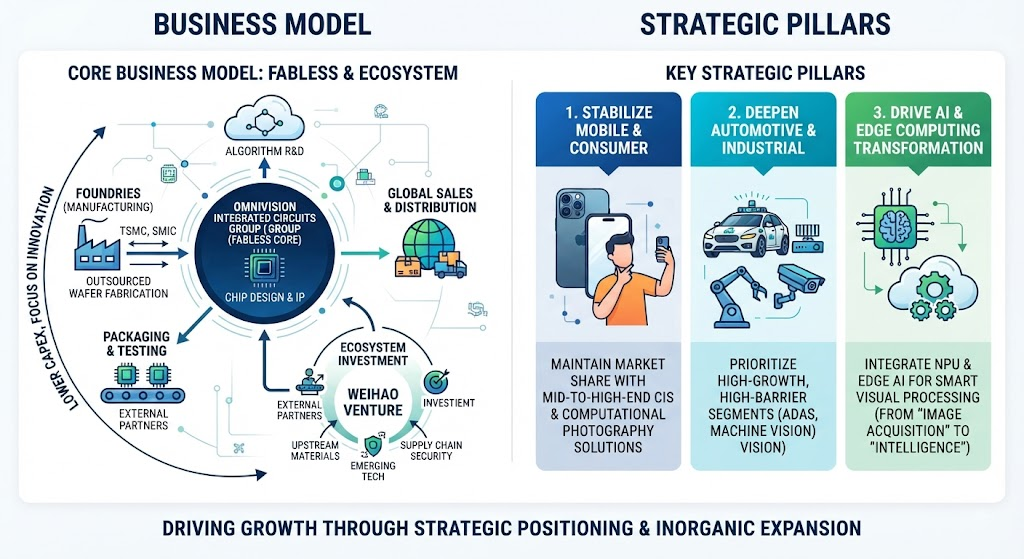
OmniVision Integrated Circuits Group (formerly Will Semiconductor) adopts a comprehensive business model combining a Fabless design approach, vertical application expansion, and an industrial venture capital ecosystem, driving growth through precise market positioning and M&A strategies.
1. Core Business Model
- Fabless Operating Model: The company focuses on core chip architecture design, algorithm R&D, product definition, and sales, while outsourcing manufacturing, wafer processing, and packaging testing to specialized foundries (such as TSMC and SMIC). This lowers capital expenditures on fixed assets and allows the company to concentrate on technological innovation and product iteration.
- High-Value Diverse Product Portfolio: Centered around CMOS Image Sensors (CIS), the company horizontally expands into Touch and Display Driver Integration (TDDI), power management ICs, and analog solutions, building a platform-based product matrix to meet diverse customer needs.
- Upstream and Downstream Ecosystem Investment: Through venture capital platforms (such as Weihao Venture), the company invests across the industrial chain to secure core upstream resources, cultivate emerging technologies, and strengthen supply chain security and market synergies.
2. Core Development Strategies
- Stabilize Consumer Electronics while Deepening Automotive and Industrial Segments: In the fiercely competitive smartphone market, the company maintains market share with mid-to-high-end products and computational photography solutions while shifting primary resources toward the fast-growing, high-barrier automotive electronics (such as ADAS and autonomous driving visual sensing) and industrial machine vision sectors to optimize gross margin structures.
- Inorganic M&A and Rapid Expansion: The company excels at leveraging capital markets and strategic mergers and acquisitions (such as the 2019 acquisition of Beijing OmniVision and the 2020 acquisition of Synaptics’ Asia TDDI business) to rapidly acquire key technologies and global customer resources for leapfrog growth.
- Adapting to AI and Edge Computing Transformation: To address surging market demand for intelligent visual processing, the company actively integrates Neural Processing Units (NPU) and edge computing capabilities into sensors, driving the product evolution from mere “image acquisition” to “intelligent visual processing.”
Source:
https://www.omnivision-group.com
Back to Will Semiconductor