Fosun Pharma holds a leading market position in the Chinese and global healthcare industries, with its industry rankings and market share characteristics reflected across several dimensions:
- Comprehensive Industry Ranking: Fosun Pharma has long been ranked among the top tier of China’s top 100 pharmaceutical industrial enterprises (such as ranking 5th among the top 100 pharmaceutical industrial enterprises in 2024 and 8th in comprehensive competitiveness for 2025).
- R&D Strength and Pipeline Scale: It performs prominently in global innovative drug R&D, having been selected for consecutive years among the Top 25 global pharmaceutical corporate R&D pipelines by the renowned consulting firm Citeline (ranking 17th globally), and ranks near the top (5th) in China’s top 100 comprehensive pharmaceutical R&D strength list.
- Niche Market and Market Share Advantages:
- Biopharmaceuticals and Frontier Therapies: Successfully launched China’s first approved biosimilar (Hanlikang), and its joint venture Fosun Kite launched the country’s first CAR-T cell therapy product (Yescarta), holding a pioneering and leading position in the domestic autologous cell immunotherapy market.
- International Generics and Supply Chain: Through its controlling stake in India’s Gland Pharma, it holds a significant share in the global injectable generic drugs and specialty active pharmaceutical ingredients markets, possessing mature export and supply capabilities for European, American, and emerging markets.
- Overseas Revenue Share: Its internationalization efforts have yielded notable results, with overseas operating revenue steadily accounting for nearly 30% (around 28%) of total revenue, demonstrating its expanding capability in the global pharmaceutical market.
Sources:
Fosun Pharma Official Website – Company Honors
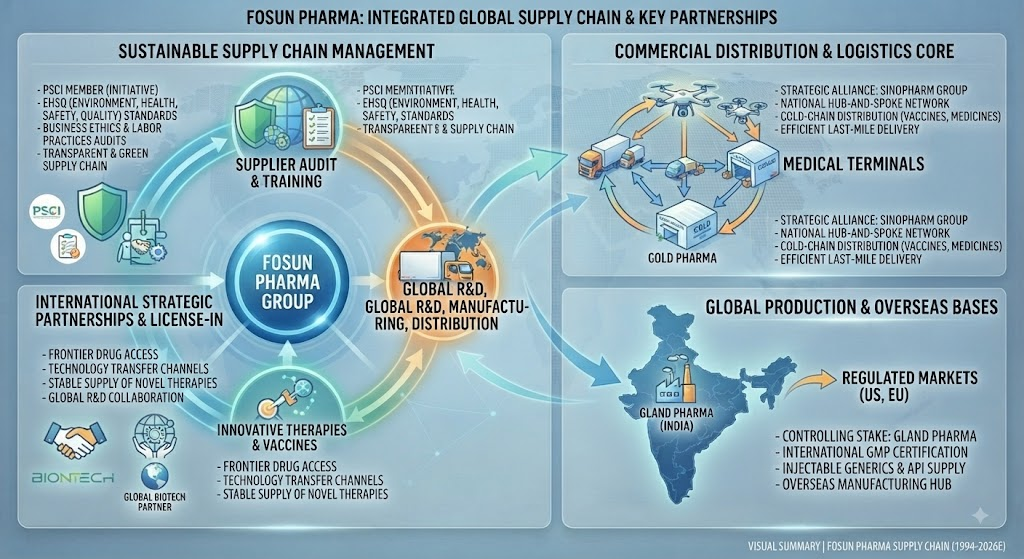
Fosun Pharma’s supply chain system and key partner layout revolve around the integration of “R&D, manufacturing, and distribution.” Its core supply chain characteristics and important cooperative networks include the following aspects:
- Commercial Distribution and Logistics Core: Through its equity participation and close alliance with Sinopharm Group, Fosun Pharma controls a massive and top-tier pharmaceutical distribution and logistics network in China, covering hub-level logistics centers and a nationwide cold-chain delivery system to ensure that products like medicines and vaccines are efficiently delivered to medical terminals at all levels.
- Global Production and Overseas Supply Bases: By holding a controlling stake in the Indian injectable drug manufacturer Gland Pharma, the company secures an important production and supply chain base for expanding into European, American, and global regulated markets, possessing international-standard GMP manufacturing and active pharmaceutical ingredient supply capabilities.
- International Strategic Partners and Licensed-In Technologies: Through cooperation with multinational biotech companies (such as Germany’s BioNTech), the company establishes global supply and technology transfer channels for cutting-edge drugs and vaccines, ensuring a stable supply of innovative therapies.
- Sustainable Supply Chain Management: The company comprehensively implements international procurement standards and supplier auditing mechanisms (joining the Pharmaceutical Supply Chain Initiative, or PSCI), conducting business ethics, quality, and EHSQ (environment, health, safety, and quality) audits and training for suppliers to build a transparent, robust, and socially responsible green supply chain.
Fosun Pharma is currently positioned as a “China-based Multinational Company” (CMNC) within the pharmaceutical industry. Its competitive analysis can be broken down by market positioning, product portfolio, and the competitive landscape:
I. Market Competitive Landscape
Fosun Pharma is actively transitioning from a traditional “Fast Follower” to an “Innovation-driven” global player. Its competitive core lies in:
- Avoiding Crowded Tracks: Given the intense competition in oncology, Fosun is actively shifting its R&D focus toward areas with significant market gaps and relatively lower competition, such as Central Nervous System (CNS) disorders (e.g., Alzheimer’s) and rare diseases, to seek differentiated competitive advantages.
- “License-out” Strategy: By licensing out internally developed drugs (such as the oral GLP-1 receptor agonist YP05002) to international giants like Pfizer, Fosun demonstrates its innovation capabilities. This allows the company to share the risks of international clinical development while securing cash flow and global market exposure.
- Full Industry Chain Integration: Fosun possesses not only innovation capabilities but also the integrated advantages of medical services, medical devices, and commercial logistics (via Sinopharm Group). This “R&D + Manufacturing + Logistics + Service” integrated ecosystem distinguishes it from pure-play biotech companies.
II. Major Competitors
Fosun Pharma’s competitors vary by business segment and primarily include:
- Chinese Innovative Biopharmaceutical Enterprises:
- Innovent Biologics: A major competitor in the Chinese market regarding biological drugs and immuno-oncology.
- Zai Lab: Uses a model similar to Fosun’s—combining “License-in” with internal R&D—leading to significant overlap in market positioning for innovative drugs.
- Akeso and Junshi Biosciences: Pose direct competition to Fosun’s subsidiary, Henlius, in the fields of antibodies and oncology drug R&D.
- International Competitors:
- Big Pharma: In the global market, as a late entrant, Fosun must compete with giants like Pfizer, AstraZeneca, and Roche, who possess superior global commercialization capabilities.
- Technology-focused Biotechs: In cutting-edge fields like CAR-T cell therapy, Fosun must compete with companies that hold technological leads, such as Legend Biotech.
III. Competitive Advantages and Risk Analysis
| Aspect | Key Strengths/Opportunities | Potential Risks |
| Innovation | Possesses multiple technology platforms (small molecules, antibodies, CAR-T) with high R&D intensity. | High R&D expenditures may pressure short-term net profit. |
| Global Footprint | Equipped with overseas manufacturing and registration experience (e.g., Gland Pharma) and actively expanding in the U.S. | High exposure to uncertainties regarding geopolitics and shifting international regulatory requirements. |
| Business Model | Generates strong cash flow through “License-out” deals to subsidize early-stage research. | Milestone payments are uncertain; over-reliance on big pharma partnerships may cap long-term upside. |
| Financial Health | Q1 2026 revenue exceeded 1 billion RMB, with healthy cash flow. | High share pledging ratios by major shareholders warrant monitoring of capital structure risks. |
IV. Conclusion
Fosun Pharma’s current strategy is to build a “moat” through “technology platformization.” The competitive analysis indicates that the company is attempting to shift from an “M&A and integration” model toward a global expansion supported by “original scientific research.” Whether Fosun can establish a successful blueprint in Alzheimer’s or other CNS fields will be the key indicator of its ability to truly stand out and enter the mainstream international pharmaceutical stage.
Back to Fosun pharma