
Anhui Conch Cement (0914.HK) holds a critical leading position in the cement and building materials industry both in China and globally:
I. Global and Domestic Market Position
- Industry Ranking: In terms of production capacity and scale, Conch Cement is the second-largest cement manufacturer in China and a leading global player (second only to China National Building Material). When considering profitability, cost control standards, and asset quality, Conch Cement is widely regarded as the most competitive benchmark enterprise in China’s cement industry.
- Group Backing: Its parent company, Conch Group, has consistently ranked among the Fortune Global 500 and China 500 lists for multiple years (ranking 181st on the China 500 list), possessing robust comprehensive strength.
II. Market Share
- Domestic Market Share: In the domestic Chinese market, Conch Cement’s production capacity and market share steadily hover around 11% to 12% (second only to China National Building Material Group’s approximately 14% to 15%). It maintains an extremely high regional market share and pricing influence in key economic belts such as East China, Central-South, and Southwest China.
- Industry Concentration: As China’s cement industry has advanced supply-side structural reform and phased out outdated capacity in recent years, the market share of the top ten enterprises (CR10) has risen above 65%. Leveraging its strong scale advantages and steady cash flow, Conch Cement has further expanded its dominance in key regional markets during this industry consolidation phase.
III. Market Competition Characteristics
- Cost Leader: Despite some competitors boasting massive production capacity, Conch Cement relies on its “T-shaped Strategy” and extreme cost management to remain one of the few leading enterprises capable of maintaining stable net profits and low debt ratios through successive industry downturns.
- Overseas Expansion: Beyond consolidating its domestic market share, the company has actively expanded into overseas markets such as Southeast Asia and the Middle East in recent years, gradually increasing its international market share and influence in the global cement supply chain.
Sources:
The supply chain management and key supplier structure of Anhui Conch Cement (0914.HK) are centered around its “T-shaped Strategy” and core cost-control principles:
I. Supply Chain System
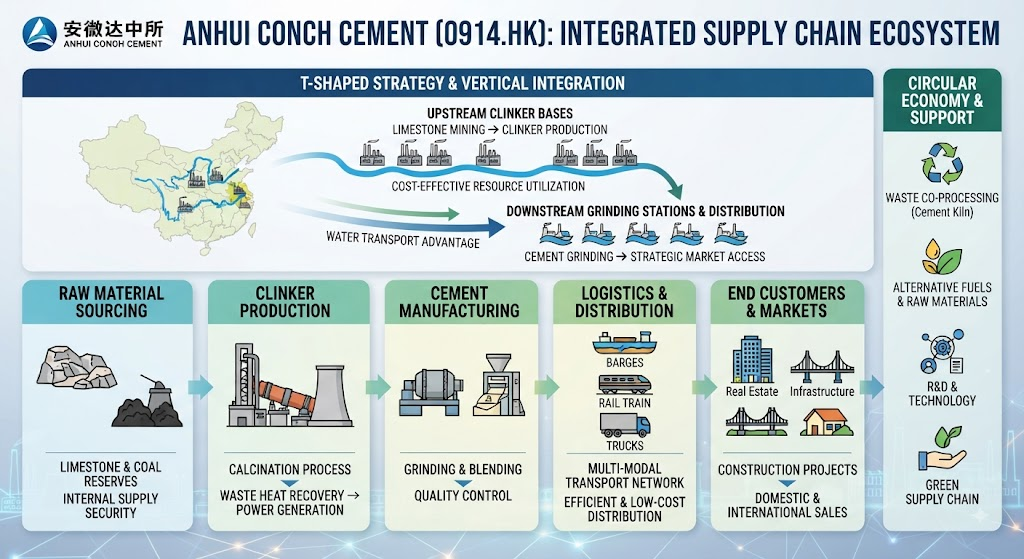
Conch Cement’s supply chain is characterized by its vertically integrated model, forming a linear industrial chain of “limestone mines — clinker bases — cement grinding stations.”
- Raw Material Supply: Limestone is the core resource for cement production. The company prioritizes locating mine bases in regions rich in limestone resources with competitive cost advantages to ensure long-term, stable, and low-cost supply.
- Logistics Supply Chain: Logistics is one of Conch’s core competitive advantages. Relying primarily on the low-cost water transportation of the Yangtze River, combined with rail and road transport, the company has built an efficient distribution system to transport clinker to grinding stations along the river and coast, effectively reducing long-distance transportation costs.
- Energy Supply: Coal and electricity are the main cost drivers for cement production. The company secures energy supply stability through long-term agreements or centralized procurement. Simultaneously, it widely employs Waste Heat Recovery (WHR) technology, converting waste heat from the cement production process into electricity, significantly reducing dependence on external power grids and lowering energy costs.
II. Key Suppliers and Partners
Conch Cement’s key suppliers and group-internal/external partners include the following specific entities:
- Internal Affiliates and Fine Chemical Suppliers:
- Anhui Conch Material Technology Co., Ltd. (Conch Material): Provides key cement additives, concrete additives, and related upstream raw materials (such as cement grinding aids, flue gas desulfurization agents, denitration agents, and coal-saving agents). The two parties enter into annual, normalized procurement contracts to ensure a stable supply of production additives.
- Energy and Bulk Raw Material Suppliers:
- The company engages with major domestic coal groups and power enterprises for the fuel and electricity needed for production, and conducts open joint bidding for auxiliary materials such as desulfurized gypsum.
- Logistics and Transportation Service Providers:
- This includes shipping companies operating in the Yangtze River basin, rail freight units, and port cargo handling service providers, which together support its low-cost intermodal water-and-land logistics network under the “T-shaped Strategy.”
- Equipment and Technical Service Providers:
- The company collaborates with major domestic and international heavy machinery manufacturers, cement kiln equipment makers, and environmental waste treatment facility providers to procure core production equipment and intelligent, low-carbon environmental technology systems.
III. Supply Chain Management Strategy
- Cost Transparency: Through large-scale group procurement and internal resource coordination, the company possesses immense bargaining power within its supply chain.
- Environmental Compliance: Environmental compliance is a critical factor in supplier selection. Especially in the waste co-processing (Waste Disposal) business, the company establishes long-term waste treatment supply relationships with industrial enterprises that generate industrial waste.
- Resilient Operations: Amid the current industry consolidation phase, Conch Cement prioritizes partnerships with large, market-competitive suppliers to maintain the resilience and operational efficiency of its production system during periods of sluggish real estate demand.
Sources:
In the current market environment (as of 2026), Anhui Conch Cement (0914.HK) faces the challenges of a deep correction in the real estate market and industrial overcapacity. The competitive landscape is characterized by a “zero-sum game” and industry consolidation. Below is a detailed competitive analysis:
I. Market Competitive Landscape
The global cement industry is highly concentrated, with Conch Cement maintaining a leading position globally and within China.
- Key Competitors: Includes China National Building Material (the world’s largest in terms of production capacity), Huaxin Cement, BBMG Corporation, Jidong Cement, and international leaders such as Holcim.
- Scale Advantage: Leveraging a robust production capacity (approximately 400 million tons in 2025), Conch Cement holds a stable domestic market share and significant pricing power. It is one of the few enterprises capable of maintaining stable cash flow and profitability during industry downturns, providing a significant advantage over many loss-making peers.
II. Core Competitiveness (Moat)
- Cost Control: Through its “T-shaped Strategy” and vertically integrated operational model, Conch Cement possesses superior logistics efficiency and a low-cost clinker supply system. This allows the company to maintain profit margins above the industry average, even during periods of coal price volatility or sluggish demand.
- Robust Financial Position: As of 2026, Conch Cement maintains a strong net cash position (exceeding 50 billion RMB). This capital strength enables the company to weather market fluctuations with ease and provides the financial capacity for further mergers and acquisitions.
- Technology and Green Transition: Leading waste heat recovery power generation technology, capabilities in co-processing waste in cement kilns, and investments in intelligent manufacturing give the company a distinct competitive edge under strict environmental policies and “carbon neutrality” mandates.
III. Current Market Challenges
- Weak Demand: With the real estate market undergoing low-level adjustments, infrastructure investment offers limited support. Demand in the domestic cement market is expected to continue a slight decline in 2026, forcing companies into intense zero-sum competition.
- Capacity Clearance Pressure: As ministries promote capacity replacement and strictly control new additions, the industry has entered a consolidation phase. Conch Cement must accelerate the elimination of inefficient capacity through internal optimization and M&A, which places high demands on management and capital allocation.
- Overseas Expansion: To hedge against declining domestic demand, Conch Cement is accelerating its footprint in overseas markets (such as Southeast Asia and the Middle East). While these operations offer higher profit margins, they are subject to geopolitical risks and international management complexities.
IV. Competitive Outlook
2026 marks the beginning of the “15th Five-Year Plan” in China, and the core of industry competition has shifted from “scale expansion” to “quality growth.” Conch Cement is expected to continue its focus on:
- Market Consolidation: Utilizing its scale advantage to increase pricing power in core regions and accelerate the integration of regional markets.
- Industrial Chain Extension: Transforming from a single cement supplier into an integrated provider of aggregates, ready-mixed concrete, and environmental energy services to enhance profitability per unit.
The outcome of this competition will depend on the company’s ability to further expand market share and reshape its value chain through technological upgrades and cost leadership in an environment of declining demand.
Back to Conch Cement