
Market Position
Maxscend’s current market position can be summarized as: A leading enterprise in China’s radio frequency (RF) front-end sector, currently in a critical transition phase from a “discrete component supplier” to an “integrated modular solution provider.”
Its market position is analyzed through three key dimensions:
1. Domestic Market: The Leader in Domestic Substitution
- Technological First-Mover Advantage: Maxscend was the earliest domestic company to achieve large-scale mass production in RF switches and low-noise amplifiers (LNAs), breaking the long-term monopoly held by European and American major manufacturers.
- Core Position in the Android Supply Chain: The company’s products have been widely integrated into the supply chains of mainstream Android smartphone brands (such as Xiaomi, OPPO, vivo, and Honor), securing an extremely high market share among domestic firms.
- Technological Leadership: In the niche markets of RF switches and LNAs, its product performance has approached the standards of international tier-one giants, making it a representative enterprise driving China’s semiconductor industry toward “independent control.”
2. Global Market: A Challenger in the High-End Segment
- Market Share Gap: Compared to international giants like Broadcom, Qorvo, Skyworks, and Qualcomm, Maxscend still has a significant gap in global market share (these giants collectively hold about 70% to 80% of the global market).
- Modular Competition: The global high-end market is currently dominated by highly integrated modules (such as PAMiD). Maxscend is actively closing this technological gap by building its own filter (SAW/IPD) production lines, with the goal of entering the top five global RF front-end suppliers.
- Patent and Regulatory Pressures: As a challenger, Maxscend faces patent legal dispute challenges from international giants (such as Murata Manufacturing) when expanding into overseas markets and high-end product lines, which remains a primary obstacle to further elevating its market position.
3. Strategic Transition Positioning: From Components to Modules
- Vertical Integration Strategy: By building its own filter wafer fabs, Maxscend is attempting to transition from a pure Fabless (fabulous design) model to an IDM (Integrated Device Manufacturer) model to secure stable production capacity and enhance profit margins.
- Diversified Positioning: Beyond the core smartphone RF sector, the company is extending its presence into automotive electronics, Internet of Things (IoT), and high-end Bluetooth microcontroller markets to reduce its reliance on the single smartphone market.
Data Sources:
- Maxscend Technologies – Wikipedia
- Maxscend Microelectronics Company Profile – Futubull
- 卓勝微電子股份有限公司官方網站
Supply Chain Architecture
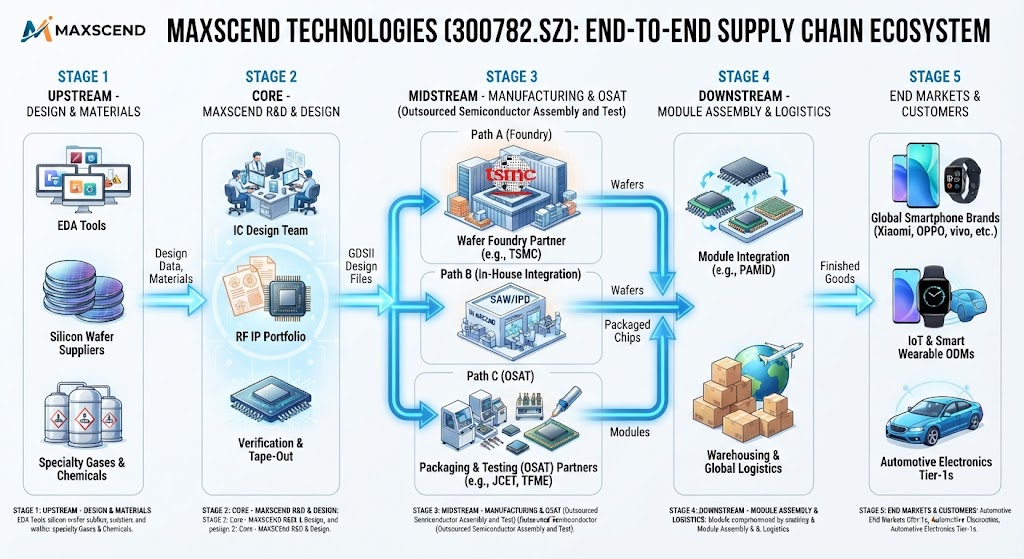
Maxscend adopts a typical fabless semiconductor business model, focusing on front-end chip design, R&D, and sales, while outsourcing manufacturing and packaging/testing to top-tier global specialized partners. Additionally, to break through technological bottlenecks in high-end modular products, the company has actively promoted partial vertical integration in recent years by building its own wafer fabs.
- Upstream (Raw Materials and Design Tools): Includes semiconductor silicon wafer material suppliers, specialty chemical suppliers, and EDA tool providers offering chip design software.
- Midstream (Wafer Manufacturing and OSAT):
- Wafer Foundry: Relies on top-tier wafer foundries such as TSMC, utilizing advanced processes like RF CMOS for chip manufacturing.
- Packaging and Testing (OSAT): Entrusts manufactured wafers to professional packaging and testing firms (such as JCET Group and TFME) for chip packaging and performance testing.
- In-House Production Lines (Vertical Integration): To strengthen its independent supply capability for filters (SAW/IPD), the company has established in-house production lines in locations such as Wuxi, reducing reliance on pure outsourcing.
- Downstream (Applications and End Customers): Delivers products through direct sales and distributor networks to global smartphone brands (such as Xiaomi, OPPO, vivo, and Honor), IoT device manufacturers, and networking equipment makers.
Key Suppliers and Partners
- TSMC: Maxscend’s core wafer foundry partner, providing critical advanced RF CMOS process technology to ensure high performance and stable production capacity for its chips.
- OSAT Partners: Packaging and testing enterprises such as JCET Group and TFME, responsible for wafer-level packaging (WLCSP) and modular packaging of the chips.
- EDA, Equipment, and Material Suppliers: Providers of Electronic Design Automation (EDA) software necessary for chip design, as well as essential raw materials like photomasks and specialty gases required for manufacturing.
The competitive landscape of Maxscend Technologies can be divided into two main camps: “International Giants” and “Domestic Peers.” In the global radio frequency (RF) front-end market, Maxscend acts as a challenger, striving to narrow the technological and patent gaps with global industry leaders.
1. International Competitors (Dominators of the Global High-End Market)
These companies possess deep technical expertise, maintain independent capabilities for full RF front-end modules (PAMiD/L-PAMiD), and collectively hold approximately 70% to 80% of the global market share.
- Broadcom: Holds an absolute monopoly in the FBAR/BAW filter sector, representing a formidable technological barrier.
- Qualcomm: Leverages its integrated “Modem-to-Antenna” solution, providing significant competitive advantages in the mid-to-high-end smartphone market; it is currently one of the market share leaders.
- Qorvo and Skyworks: Having operated for decades in Power Amplifiers (PA), high-end filters, and RF modules, these are the primary benchmarks for Maxscend in its high-end modular product lines.
- Murata: As the global leader in SAW filters, it competes directly with Maxscend in the filter product segment and has recently been involved in patent-related legal disputes with the company.
2. Domestic Competitors (Domestic Substitution and Mid-to-Low-End Market)
Domestic peers compete fiercely with Maxscend for market share among Android smartphone brands, IoT applications, and the automotive sector, driven by the national push for “domestic substitution.”
- Vanchip: Possesses strong capabilities in PA (Power Amplifiers) and was among the first to achieve mass production and shipment of high-end module products.
- Smarter Micro: Emphasizes “reconfigurable” RF technology and is actively pushing for automotive-grade product certifications.
- OnMicro: Competes closely with Maxscend in niche segments such as RF switches and Low-Noise Amplifiers (LNA).
3. Competitive Landscape Summary
- Technological Barriers: International giants use patent moats and the IDM (Integrated Device Manufacturer) model to monopolize the high-end market. Meanwhile, Maxscend is committed to transitioning from a discrete device manufacturer to a modular solution provider to increase product value.
- Key Trends: The market is accelerating toward 5G/6G high-frequency bands, modular integration, and applications in automotive and AI terminals. Maxscend is currently enhancing its vertical integration (e.g., building its own filter production lines) to reduce reliance on outsourced assembly and testing, thereby mitigating technological containment efforts by international firms.
- Current Challenges: Maxscend faces pressure from international patent disputes. Amidst cyclical fluctuations in the global semiconductor industry, the company is pivoting toward growth engines in high-margin markets such as automotive electronics and high-end filters.
Data Sources:
- Who are Maxscend’s competitors? – E-eway
- Qualcomm Has Established a Solid Lead in the RFFE – TechInsights
- RF Front End Module Market Size, Share Report – Grand View Research
- Maxscend Microelectronics Company (300782) Earnings Summary – Quartr
Back to Maxscend