Market position of SAIC motor
- Domestic Sales and Leadership: SAIC Motor maintains its leading position in the Chinese domestic automotive market, reclaiming the top spot for domestic auto sales with cumulative sales of 2.045 million units in the first half of 2026.
- Overall Market Share: Total vehicle sales reached 4.507 million units for the full year of 2025, capturing a 13.1% market share in the domestic Chinese market.
- Surge in Own-Brand Share: A structural shift has occurred within the group, with the sales proportion of self-owned brands surpassing the 70% milestone for the first time in the first half of 2026 (reaching 71.8%), serving as the core foundation supporting its market position.
- Globalization and Overseas Market Share: Overseas expansion remains robust, with international sales reaching 735,000 units in the first half of 2026 (a 48.7% year-over-year increase). Notably, its core MG brand has maintained its ranking as the top-selling Chinese automotive brand in Europe for consecutive years.
- Fortune Global 500 Ranking: Backed by its massive revenue scale, SAIC Motor ranked 125th in the Fortune Global 500 rankings.
SAIC Motor is currently in a critical transition phase, shifting from “joint-venture dependency” to “autonomous-driven growth.” Below is an analysis of its competitive advantages, challenges, and key rivals:
1. Competitive Advantages (Core Competencies)
- Diversified Brand Portfolio: SAIC has built a highly tiered product matrix to address varying market demands:
- IM Motors: Targets the high-end intelligent EV market with digital chassis and advanced driver-assistance systems.
- MG: Serves as the core brand for global expansion, maintaining significant influence in European and Australian markets.
- Wuling (SAIC-GM-Wuling): Secures the mass-market, affordable commuter vehicle segment with consistent volume and scale advantages.
- Roewe and MAXUS: Focus on specific household and commercial market segments.
- Global Supply Chain and Export Capacity: SAIC leads the Chinese automotive export industry. Leveraging its extensive global layout, it maintains a sales and service network covering over 170 countries and regions, providing a significant first-mover advantage in overseas markets.
- Vertical Integration in R&D: The group actively invests in batteries, electric drives, electronic controls, and AI applications (e.g., smart driving and intelligent cockpits). By collaborating with industry leaders like BYD on solid-state battery R&D, it aims to secure a lead in next-generation power technologies.
2. Challenges
- Pressure on Joint Venture Transformation: The joint ventures that historically served as core profit pillars (such as SAIC Volkswagen and SAIC-GM) are facing profit margin pressure as their electrification transition lags behind domestic rivals, specifically BYD and “new energy” startups.
- Hyper-Competitive Market: The domestic EV market is intensely “involutionary,” characterized by frequent price wars. While SAIC’s own-brand sales now exceed 70% of its total, it continues to battle rivals like BYD, Xiaomi, and Zeekr for market share in the mid-to-high-end segments.
- Geopolitical Risks: With increasing trade barriers and anti-subsidy investigations from regions like the EU, SAIC’s overseas expansion strategy—led by the MG brand—faces potential tariff challenges and demands for supply chain localization.
3. Key Competitor Analysis
| Competitor | Primary Domain | Analysis |
| BYD | Global EV/PHEV | The biggest direct competitor, possessing absolute cost advantages via vertical integration and strong market pricing power. |
| Geely | Globalization/Multi-brand | Highly experienced in brand management; utilizes Lynk & Co, Zeekr, and the acquisition of Volvo to perform strongly in premium and global markets. |
| EV Startups | Intelligence/UX | Companies like Xiaomi, Li Auto, and Xpeng; they use “software-defined vehicles” and innovative service models to accurately capture younger consumer segments. |
| Global Automakers | Brand Heritage/Tech | Brands like Tesla and VW (global headquarters) remain benchmarks for brand premium and specific technological paths. |
Conclusion
2026 marks a critical starting point for SAIC Motor as it advances its “15th Five-Year Plan.” Its core strategy hinges on using own-brands (specifically MG and IM) to offset the decline in joint-venture market share. Whether SAIC can maintain its leading scale while optimizing its profit structure by increasing the sales proportion of intelligent, high-value products will be the key indicator for investors and industry observers in assessing its competitiveness.
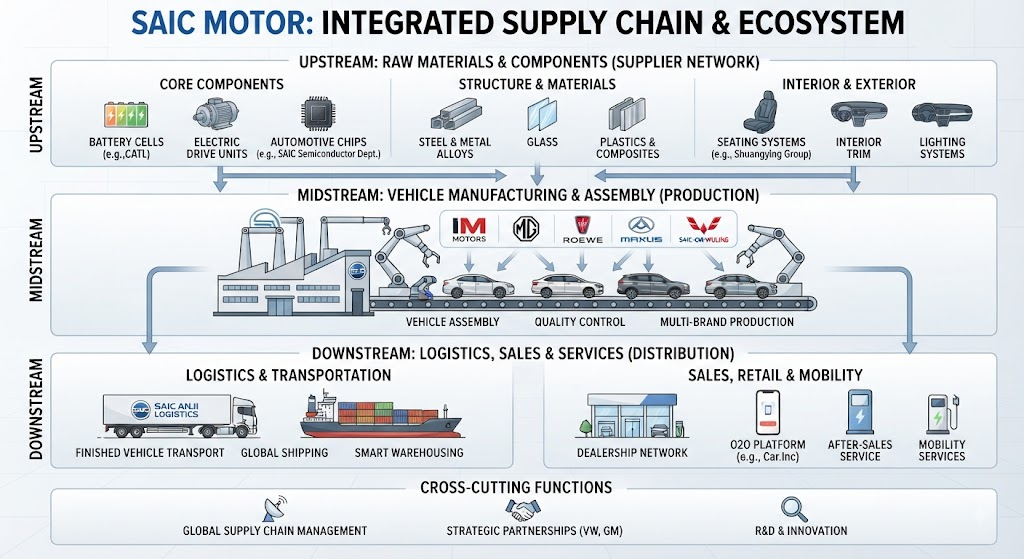
SAIC Motor’s automotive supply chain spans upstream raw materials and component supply, midstream vehicle manufacturing and joint ventures, and downstream logistics, sales services, and smart mobility. Below is the breakdown of its supply chain architecture and corresponding representative suppliers:
- Upstream: Core Components and Semiconductor Supply Chain
- Semiconductor and Chip Security: Integrates automotive chips through its dedicated procurement platform (SAIC Supply Chain / Semiconductor Division), connecting with major semiconductor manufacturers and distributors to secure supplies for original equipment manufacturers and Tier-1 suppliers.
- Interior and Structural Components Suppliers: Companies such as Shuangying Group provide vehicle interiors and seating solutions for the group’s brands.
- Smart EV Core Technologies: Actively allies with industry partners in batteries, electric drives, electronic controls, and autonomous driving hardware/software, while engaging in deep cooperation with tech enterprises like Huawei Terminal in product definition and supply chain management.
- Midstream: Vehicle Manufacturing and Joint Venture System
- Own-Brand Manufacturing: Covers in-house brands including Roewe, MG, MAXUS, IM Motors, and SAIC-GM-Wuling, responsible for vehicle assembly and mass production.
- Joint Venture System: Shares mature international supply chain networks and manufacturing standards through long-standing, heavyweight joint ventures such as SAIC Volkswagen and SAIC-GM.
- Downstream: Logistics, Transportation, and Sales Service Supply Chain
- Logistics and Supply Chain Services: Its subsidiary, SAIC Anji Logistics, is China’s largest and internationally leading third-party automotive logistics provider, offering domestic and international smart logistics and supply chain solutions for both finished vehicles and components.
- Automotive Sales and Retail Channels: Delivers multi-brand vehicle sales, maintenance, and aftermarket services via the Shanghai Automotive Industry Sales Company and the full-lifecycle O2O platform Car, Inc. (Chexiang).
Source:
- https://www.saicmotor.com/
- https://www.saicmotor.com/english/our_business/index.shtml
- https://www.fortune.com/ranking/global500/2025/
- https://www.saicmotor.com/english/investor_relations/index.shtml
Back to SAIC Motor