
The development history of CICC can be divided into the following four key stages:
Founding and Foundation Period (1995–2000)
Established in 1995 as a joint venture between China Construction Bank and Morgan Stanley, CICC became China’s first joint-venture investment bank. During this stage, the firm focused on exploring ways to align China’s financial industry with international standards and assisted large state-owned enterprises in restructuring their shareholding systems, setting the institutional foundation for the subsequent overseas listings of Chinese state-owned enterprises.
Rapid Expansion and Market Transformation (2001–2010)
Following China’s accession to the WTO and the opening of its capital markets, CICC entered a period of rapid growth. The firm established a dual-track strategy focused on both domestic and international markets. It played a core intermediary role in the Hong Kong capital market, securing numerous IPO projects for major telecommunications, energy, and financial giants, which solidified its market-leading position in large-scale investment banking.
Diversification and Full-Service Chain Development (2011–2017)
CICC accelerated its efforts toward business diversification and full-service chain development, actively expanding into asset management, wealth management, and private equity. In 2015, CICC was listed on the Main Board of the Hong Kong Stock Exchange (Stock Code: 03908), marking a new phase of capital market operation and significantly enhancing the firm’s risk management capabilities and operational scale.
Integrated Operations and Technology-Driven Growth (2018–Present)
Through the acquisition and integration of CICC Wealth Management (formerly China Investment Securities), CICC further strengthened its moat in wealth management and retail businesses. In 2020, the firm was listed on the Main Board of the Shanghai Stock Exchange (Stock Code: 601995), becoming an “A+H” listed brokerage firm. In the current phase, CICC is committed to digital transformation, deeply integrating financial technology into its operations to continuously enhance its international competitiveness in serving national strategies and the real economy.
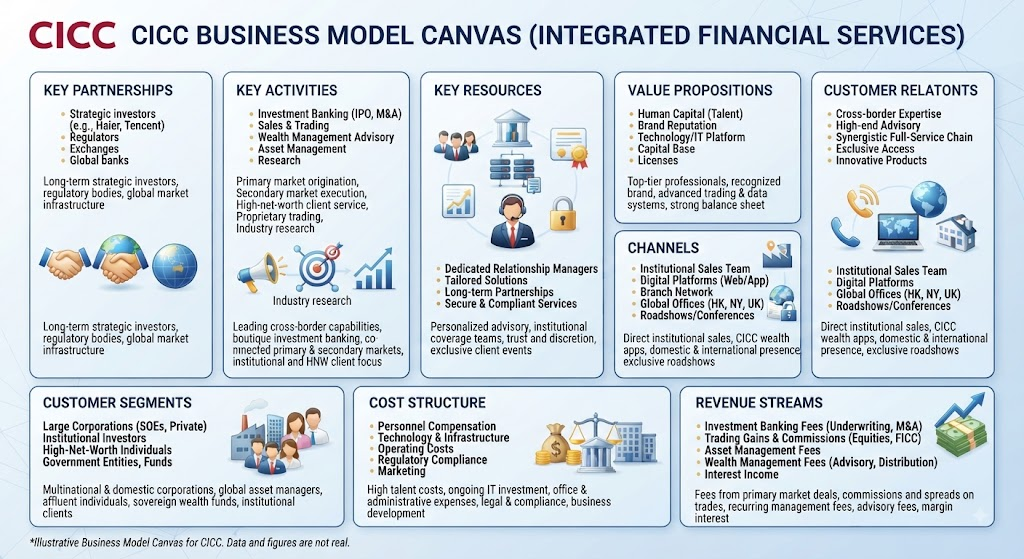
The business model of CICC (China International Capital Corporation) is built upon a comprehensive financial service framework anchored by top-tier investment banking and synergistic development across its full service chain, encompassing the following five core business segments:
- Investment Banking: Provides domestic and overseas equity issuance (IPOs and refinancings), bond underwriting, offshore debt issuance, and M&A financial advisory services to corporate clients. This is CICC’s most competitive and iconic business, generating revenue primarily through underwriting fees and advisory commissions.
- Equities: Includes institutional brokerage, prime brokerage, equity derivatives (such as Total Return Swaps/TRS), and quantitative trading services. This segment primarily serves institutional investors, generating fee income, interest income, and trading gains by providing liquidity, margin financing, and complex trading structures.
- Fixed Income, Currencies, and Commodities (FICC): Covers trading and market-making in bonds and interest rate products, foreign exchange services, structured products, and commodity businesses, providing clients with risk management and asset allocation solutions.
- Wealth Management: Combines the extensive branch network of CICC Wealth Management (formerly China Investment Securities) with the firm’s own high-net-worth client resources to provide securities brokerage, financial product sales, investment consulting, and asset allocation services to retail, high-net-worth, and institutional clients, earning brokerage commissions and management fees.
- Asset Management: Provides professional investment management services for mutual funds, collective asset management schemes, and individual asset management schemes, generating profits through management fees and performance-based incentives.
Unlike traditional brokerages that rely primarily on retail brokerage transaction fees, CICC’s profit model is heavily dependent on institutionalized, high-end, and cross-border capital intermediaries and advisory services. By leveraging deep corporate client relationships to seamlessly connect the primary market (investment banking) with the secondary market (equities, FICC, and wealth management), CICC forms a powerful business synergy.
Source:
Back to CICC