
SDIC Power Market Position
SDIC Power holds a significant and leading position within China’s power and energy market. Its core market position can be analyzed through the following dimensions:
1. Listed Flagship of a National Energy Group
As the listed power business flagship of the State Development & Investment Corp (SDIC) in China (Shanghai Stock Exchange: 600886, London Stock Exchange: SDIC), SDIC Power integrates the group’s most core and high-quality power assets. Within China’s state-owned enterprise-dominated energy system, the company benefits from high-level policy support and robust financing capabilities.
2. Leading Position in Hydropower and River Basin Advantages
Within China’s hydropower sector, SDIC Power (particularly through its controlling stake in Yalong River Hydropower Development Company) occupies a pivotal leading role. By executing large-scale, cascading, and comprehensive basin-wide development of major rivers, the company controls scarce, high-quality hydropower resources with powerful regulatory capacity, placing its generation scale and cost-control capabilities among the top tier of China’s hydropower peers.
3. Pioneer of Green Transformation with High Clean Energy Share
Compared to traditional power enterprises heavily reliant on coal, SDIC Power leads the industry in power structure transformation. With clean energy (hydropower, wind, solar) accounting for over 70% of its installed capacity, the company holds a benchmark position as a green energy supplier amid China’s pursuit of its “Dual Carbon” goals (carbon peak and carbon neutrality).
4. International Visibility in Capital Markets
SDIC Power not only maintains a stable performance in the A-share market but has also successfully issued Global Depositary Receipts (GDRs) listed on the London Stock Exchange. It is among the few major Chinese comprehensive energy enterprises to successfully bridge both domestic and international capital markets, commanding high transparency and visibility in global financial markets.
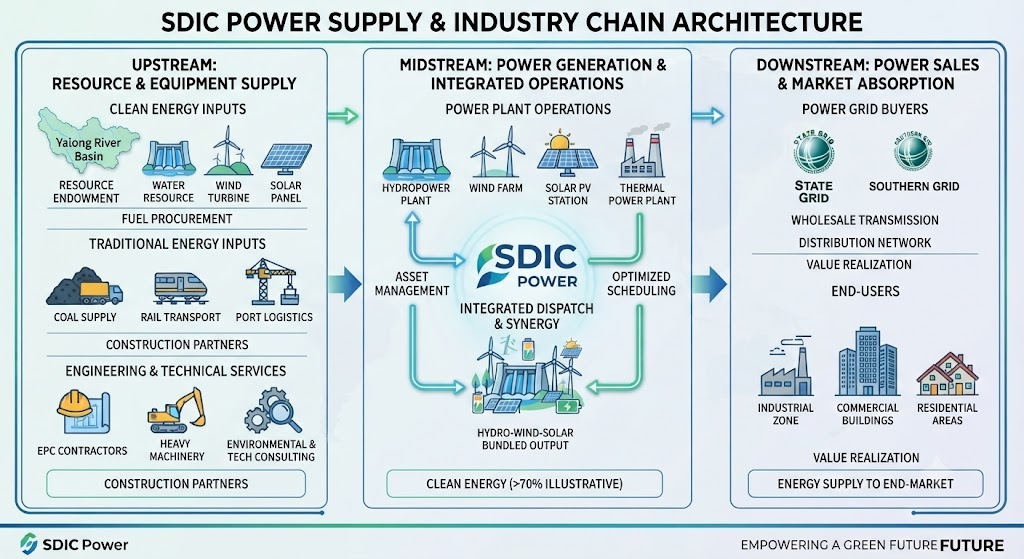
SDIC Power Supply Chain and Industry Chain Architecture
SDIC Power operates in the midstream segment of the energy industry chain, connecting upstream equipment and resource suppliers while delivering electricity to downstream power grids and end-users. Its overall supply chain system can be divided into three main links:
1. Upstream: Resource Acquisition and Equipment Supply
- Power Generation Inputs:
- Clean Energy: Hydropower relies heavily on water resources in the Yalong River basin; wind and solar photovoltaic power require the procurement of wind turbines, solar panels, inverters, and other equipment.
- Traditional Thermal Power: For the remaining high-efficiency thermal power plants, the upstream segment relies heavily on coal suppliers, railway transportation groups, and port logistics, utilizing long-term supply agreements (long-term contract coal) to lock in fuel costs and supply stability.
- Engineering Construction and Technical Services: Includes engineering contractors, heavy machinery equipment suppliers, and environmental impact assessment or technical consulting service providers required for the construction of large-scale hydropower stations and wind-solar power bases.
2. Midstream: Power Generation and Integrated Operations
- Core Asset Operations: SDIC Power acts as a midstream operator, converting upstream resources and equipment into electricity by constructing and managing hydro, wind, solar, and thermal power plants.
- Base-Level Coordination: Through the “Hydro-Wind-Solar Integrated” model, internal supply chain scheduling leverages the regulatory capacity of hydropower to balance the intermittency of renewable generation, thereby optimizing overall power generation efficiency.
3. Downstream: Power Sales and Market Absorption
- Primary Customers: The generated electricity is predominantly transmitted and sold directly to state-level transmission and distribution entities such as the State Grid and China Southern Power Grid.
- End-Market: Through the transmission and distribution networks of grid companies, electricity is ultimately supplied to industrial, commercial, and residential end-users, completing the value realization of the electricity commodity.
The competitive landscape analysis of SDIC Power focuses on its unique position in the Chinese energy industry and the challenges it faces.
Overview of the Competitive Landscape
As a major participant in the Chinese power market, SDIC Power operates in a capital-intensive and policy-driven industry. Its primary competitors are the “Big Five” power generation groups in China (China Huaneng Group, China Datang Corporation, China Huadian Corporation, State Power Investment Corporation, and China Energy Investment Corporation).
Core Competitiveness and Positioning
- Strategic Asset Layout: SDIC Power adopts a differentiated strategy of “hydropower as the core, with clean energy as the growth engine.” Its highly concentrated hydropower assets in the Yalong River basin provide a stable cash flow and a solid technological moat.
- Flexible Transformation Path: Compared to traditional central state-owned enterprises (SOEs) that rely heavily on coal, SDIC Power shifted its power structure toward clean energy (hydropower, wind, and solar) earlier, with clean energy now accounting for over 70% of its installed capacity.
- Capital Market Capability: As a listed flagship, the company maintains higher transparency and better financing channels in capital markets (including A-shares and London GDRs) compared to some non-listed SOE platforms, enabling more effective attraction of strategic investors.
Competitor Analysis
| Competitor | Core Characteristics and Market Position | Competitive Advantages |
| SPIC | A leader in the energy sector with a strong foothold in nuclear and clean energy. | Stronger background in nuclear assets and technological transformation capabilities. |
| Huaneng Group | Largest market share with a massive traditional thermal power scale. | Extremely strong economies of scale and significant influence in national power dispatch. |
| China Energy | Integrated coal and power operations. | Internal hedging advantage regarding fuel costs, providing high resilience against risks. |
| China Yangtze Power | The dominant leader in the hydropower sector. | Focuses on super-large river basin development with unparalleled scale and cost efficiency in hydropower generation. |
Key Industry Challenges (Porter’s Five Forces Perspective)
- High Buyer Power: The Chinese power market is highly monopolized by the State Grid Corporation of China (SGCC) and China Southern Power Grid (CSG). Power enterprises rely on these grid companies for procurement and dispatch, leaving limited room for negotiation on power pricing and market access.
- Supplier Concentration: Wind and solar equipment are dominated by a few leading manufacturers (e.g., Goldwind, LONGi Green Energy). SDIC Power has a degree of dependence on these upstream suppliers for equipment procurement and technological upgrades.
- Threat of Substitutes: The rapid iteration of distributed energy, energy storage technologies, and the advancement of end-user energy efficiency technologies are diverting demand away from traditional centralized power grids.
- Policy and Macro Pressures: Energy policies (such as “Dual Carbon” goals and power pricing reforms) and fuel price volatility caused by geopolitical factors (impacting thermal power costs) are critical external factors affecting profit margins.
Strategic Analysis
The core of SDIC Power’s current strategy is building “Hydro-Wind-Solar Integrated” demonstration bases. By integrating existing hydropower assets along the Yalong River with newly developed wind and solar projects, the company utilizes the regulatory capacity of hydropower to overcome the intermittency of renewable energy, thereby enhancing the stability and market competitiveness of its total energy output. This “base-oriented and integrated” development model is its core strategy for dealing with peer competition and market uncertainty.
Sources:
Fitch Ratings – SPIC Rating Update (2026)
SDIC Power – Q1 2026 Operating Results
Matrix BCG – SDIC Power Porter’s Five Forces Analysis
Tracxn – SDIC Power Competitor Landscape
Back to SDIC power